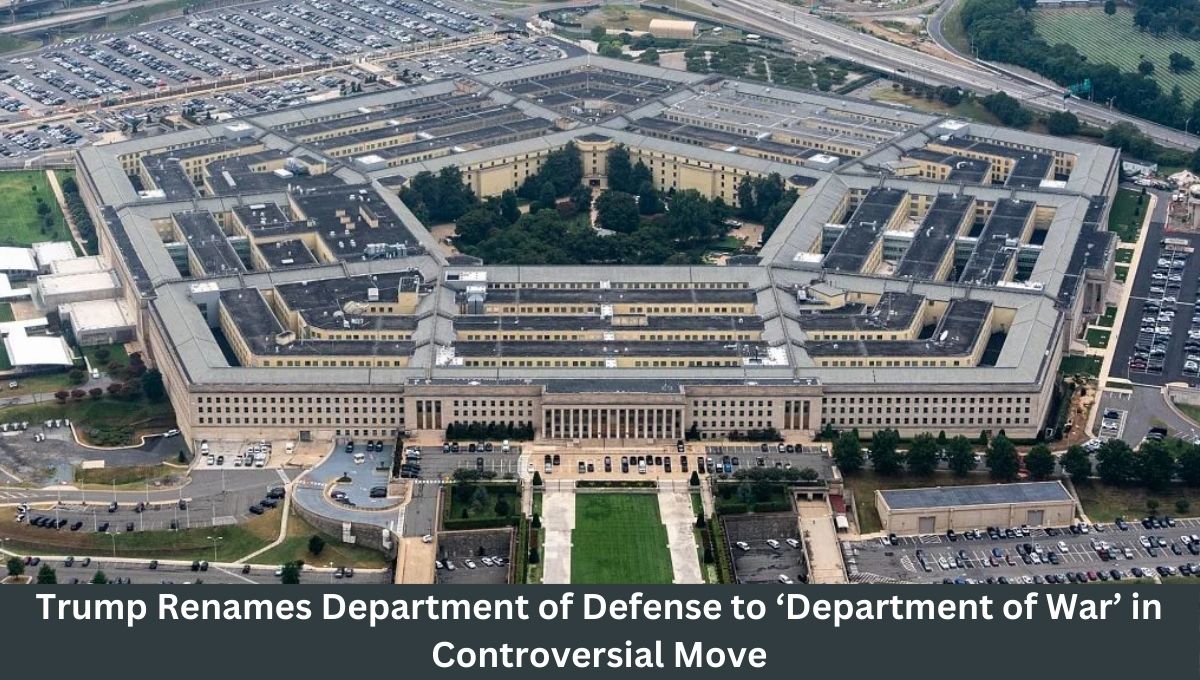
Reviving a title last used before World War II, Trump Renames Department of Defense to ‘Department of War’ in Controversial Move. In one of the most controversial moves of his presidency, United States President Donald Trump on Friday signed an executive order renaming the Department of Defense to its original title, the Department of War.
The decision revives a name not used since 1947, when President Harry Truman reorganized America’s military structure after World War II. At the time, lawmakers wanted to emphasize defense and deterrence in the nuclear age rather than offensive operations.
For Trump, however, the change is about projecting toughness. “It’s a much more appropriate name, especially in light of where the world is right now,” Trump said at the signing ceremony. “The Department of Defense was too defensive. We want to be defensive, but we want to be offensive too if we have to be. The name Department of War just sounds better.”
Trump Renames Department of Defense to ‘Department of War’ in Controversial Move
From Defense to War: A Historic Throwback
The Department of War was originally created in 1789, overseeing the Army and playing a central role in America’s early military campaigns.
After the Second World War, Congress merged the Department of War with the Navy and the newly formed Air Force, creating the Department of Defense under the National Security Act of 1947.
That reform was designed to adapt the United States to an era of nuclear deterrence, with the word “defense” chosen to signal a shift away from aggressive terminology.
By reviving the old name, Trump argues he is restoring military heritage:
“We won World War I. We won World War II. We won everything before that, and it was all under the Department of War. Then we went woke, changed it to Department of Defense, and since then we haven’t won a major war,” Trump told reporters.
Pete Hegseth: “It’s About Warrior Ethos”
Defense Secretary Pete Hegseth, who has been one of the strongest advocates for the change, joined Trump in announcing the new order.
“This is not just about words it’s about warrior ethos,” Hegseth said. “We’re going to go on offense, not just defense. Maximum lethality, not tepid legality. Violent effect, not politically correct. We’re going to raise up warriors, not just defenders. So this War Department, Mr. President, just like America, is back.”
Hegseth also hinted at the move earlier this week when he addressed troops at Fort Benning, Georgia, saying he might have “a slightly different title tomorrow.”
What the Executive Order Does
According to the White House fact sheet, the executive order:
- Designates “Department of War” as a secondary official title for the Pentagon.
- Authorizes Secretary Pete Hegseth and other officials to use secondary titles such as Secretary of War and Deputy Secretary of War in correspondence and public communications.
- Directs Hegseth to recommend legislative and executive actions to make the change permanent.
- Begins immediate rebranding, including redirecting the Pentagon’s website from defense.gov to war.gov.
Because formal renaming of federal agencies requires an act of Congress, Trump’s move sidesteps the legal process by allowing “secondary titles” for official use.
Congressional Reaction: Mixed Support
Reaction in Congress has been divided along party lines.
Republican allies of Trump, such as Rep. Greg Steube (R-Fla.), an Army veteran, praised the decision:
“From 1789 until the end of World War II, the United States military fought under the banner of the Department of War. It is only fitting that we pay tribute to their eternal example and renowned commitment to lethality by restoring the name,” Steube said.
Senators Rick Scott (R-Fla.) and Mike Lee (R-Utah) are introducing companion legislation in the Senate to codify the change into law. However, Democrats sharply criticized the move as unnecessary and politically motivated.
Senator Tammy Duckworth (D-Ill.), a veteran and member of the Armed Services Committee, said:
“Why not put this money toward supporting military families or employing diplomats who prevent conflicts from starting in the first place? Trump would rather use our military to score political points than strengthen national security.”
Critics Warn of High Costs
Changing the Pentagon’s name on a global scale is not just symbolic it’s also costly.
Signs, letterheads, uniforms, websites, and legal documents across thousands of military installations worldwide will require updates. Past renaming efforts offer a sense of the price tag.
When the Biden administration pushed to rename nine bases that honored Confederate leaders, the Army estimated costs at $39 million. That initiative was reversed earlier this year by Hegseth.
Critics argue that renaming the entire Department of Defense could cost far more.
“This is a distraction at a time when the Pentagon needs to focus on modernization and readiness,” one defense analyst told Reuters.
Trump’s Pattern of Renaming
The renaming of the Department of Defense is not an isolated case. Since returning to office, Trump has made it a point to change names of federal institutions and landmarks:
- He proposed renaming the Gulf of Mexico earlier this year.
- He pushed to restore original names of military bases changed after racial justice protests.
- During his first term, aides like Kash Patel at the Pentagon even signed emails using “War Department” informally.
Trump frames the changes as part of restoring “tradition” and rejecting what he calls “woke” ideology.
Also Read: Why Was Department Of War Renamed After World War II And Why Donald Trump Wants It Restored
A Political Move or Strategic Rebrand?
Supporters see the move as symbolic strength. Opponents call it political theater.
For Trump’s base, the renaming plays into themes of heritage, toughness, and rejecting political correctness. For critics, it’s a costly distraction that risks confusing allies and undermining America’s diplomatic posture.
The timing is also notable. The order comes days after a controversial U.S. Navy airstrike off Venezuela, which killed 11 people on a vessel Washington linked to drug traffickers. The incident reignited debate over whether Trump is the “anti-war president” he claims to be.
Pentagon Reactions: Uneasy Acceptance
Inside the Pentagon, reactions have been mixed. Some senior officers expressed concern privately that the change could complicate relations with allies, who may interpret “Department of War” as signaling a more aggressive U.S. stance.
Others, however, welcomed the symbolism as a morale boost.
“Words matter. War is what we do. It’s not just defense,” one unnamed Army officer told U.S. media.
Historical Echoes: Why the War Department Ended
Historians note that the original change from “War” to “Defense” in 1947 was not just about image but also about policy direction in the nuclear age.
By emphasizing “defense,” the Truman administration hoped to underscore America’s role in preventing wars rather than waging them.
Trump’s reversal, therefore, signals not just a linguistic shift but a symbolic departure from postwar U.S. military philosophy.
International Reactions
Though official responses have been muted, international analysts quickly weighed in.
- European officials privately told media outlets they fear the renaming could reinforce perceptions of a more aggressive U.S. posture.
- China’s state media mocked the move as proof that Washington is “obsessed with war.”
- Russian commentators suggested the change validates their claim that NATO expansion is driven by offensive U.S. ambitions.
India and other U.S. partners in Asia have not issued formal responses, but observers believe allies will carefully parse the implications.
Trump’s Justification: “It Sounds Better”
For Trump himself, the reasoning remains straightforward and blunt.
“Everybody likes that we had an unbelievable history of victory when it was Department of War,” he said. “Then we changed it to Department of Defense. Defense is too defensive. We want to be offensive too, if we have to be.”
He also dismissed legal questions about whether Congress must approve the change:
“We’re just going to do it. I’m sure Congress will go along, if we need that.”
Conclusion: Symbolism, Strategy, or Showmanship?
Trump’s decision to rebrand the Department of Defense as the Department of War is one of the boldest symbolic gestures of his presidency. Supporters hail it as a restoration of military tradition and warrior ethos. Critics condemn it as wasteful, unnecessary, and politically motivated.
What is clear is that the renaming will have ripple effects financial, diplomatic, and symbolic both at home and abroad.
Whether it marks the start of a lasting shift in U.S. military philosophy or simply another Trump-era controversy remains to be seen.
Also Read: Putin Tests ‘Burevestnik’ Nuclear Missile as Trump Calls for Renewed U.S.–Russia Arms Talks