
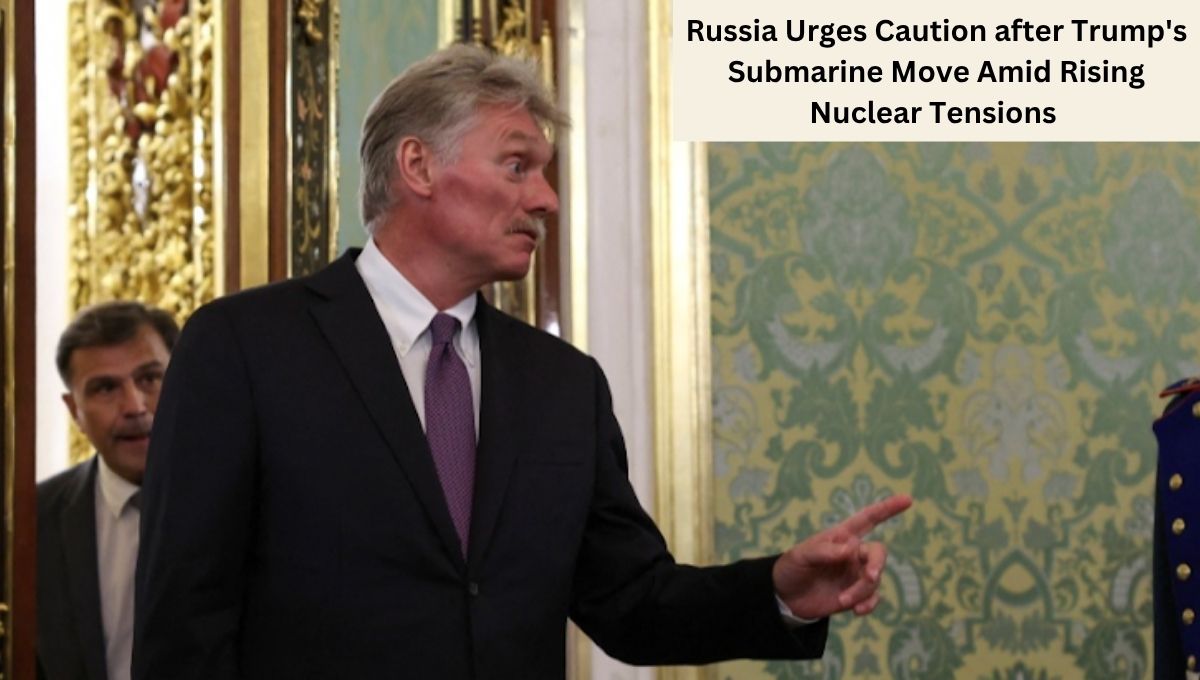
As the ceasefire deadline looms, Russia urges caution after Trump’s submarine move amid rising nuclear tensions. In a carefully worded statement on Monday, Russia’s Kremlin cautioned against the use of nuclear rhetoric, just days after US President Donald Trump publicly announced he had ordered two nuclear submarines to reposition to “appropriate regions.” The Kremlin’s message was clear: tread carefully when discussing nuclear capabilities especially in such a fraught geopolitical climate.
Kremlin spokesman Dmitry Peskov responded to the submarine news by saying that Russia did not interpret Trump’s statement as an escalation, and that such deployments were part of standard US military operations. “Of course, we believe that everyone should be very, very careful with nuclear rhetoric,” Peskov told reporters in Moscow.
Russia Urges Caution after Trump’s Submarine Move Amid Rising Nuclear Tensions
Trump Reacts to Medvedev with Nuclear Show of Strength
Trump’s remarks last Friday were prompted by provocative online statements from former Russian President Dmitry Medvedev, who warned of an increased risk of nuclear conflict if the US continued “playing the ultimatum game” with Moscow over Ukraine.
In response, Trump declared that he had ordered the repositioning of two US nuclear submarines, without clarifying whether they were nuclear-armed or nuclear-powered.
Trump’s statement came just days after issuing a new ceasefire ultimatum to Russian President Vladimir Putin, warning that unless a peace deal is signed by August 8, Moscow would face severe sanctions and secondary tariffs on oil and exports.
Russia: ‘No Escalation’ but ‘Sensitive Issues’ Being Discussed
In its first official reaction to the submarine announcement, the Kremlin played down any suggestion of heightened nuclear tension.
“We do not believe that we are talking about any escalation now,” said Peskov. “It is clear that very complex, very sensitive issues are being discussed, which are perceived very emotionally by many people.”
Peskov stressed that American submarines are already on combat duty around the world and that moving them does not necessarily signify a shift in strategic intent.
Still, the message from Moscow was cautious: don’t inflame nuclear tensions unnecessarily, especially over political or rhetorical disputes.
Trump vs. Medvedev: A Volatile Exchange
The current online spat between Trump and Medvedev has taken on serious geopolitical weight.
Medvedev, once seen as a moderate, has in recent years adopted a more aggressive, hawkish tone, particularly on social media.
After Trump issued his new Ukraine deadline, Medvedev accused him of resorting to ultimatums against a nuclear power, escalating tensions needlessly.
Trump responded by announcing the submarine repositioning, triggering Russia’s diplomatic reply.
Notably, Medvedev has not commented further and has not posted on social media since the exchange.
Who Controls Russian Foreign Policy? Putin Alone, Kremlin Says
When asked if the Kremlin had tried to rein in Medvedev’s rhetoric, Peskov refused to answer directly, instead stating that within any country, political figures have divergent viewpoints.
“There are people who are very, very tough-minded in the United States and in European countries. This is always the case,” Peskov noted. “But the main thing, of course, is the position of President Putin.”
He reiterated that in Russia, all foreign policy decisions are made by President Vladimir Putin, not Medvedev or other senior officials.
Steve Witkoff to Visit Moscow Amid High Stakes
While tensions remain high, diplomacy continues. Trump has announced that his envoy, Steve Witkoff, will travel to Moscow this week.
The visit is scheduled just days before the August 8 ceasefire deadline.
“We are always happy to see Mr. Witkoff in Moscow,” said Peskov, describing the talks as “important, meaningful and very useful.”
Witkoff, a Trump confidant with a history of dialogue with the Kremlin, has met with Putin before, though previous efforts to secure a ceasefire in Ukraine have failed.
The Ceasefire Clock Is Ticking
Trump’s August 8 deadline for a peace deal in Ukraine is fast approaching. If unmet, the US plans to enact new sanctions and secondary tariffs against Russia, and potentially against nations that continue to purchase its oil, such as India and China.
“Russia has gotten pretty good at avoiding sanctions,” Trump admitted on his Truth Social platform, even as he ramped up the pressure.
He also took aim at India, accusing the country of ignoring the humanitarian toll of Russia’s invasion in Ukraine by continuing to import Russian oil.
The Human Cost of Escalation
As the diplomatic chess match plays out, the war in Ukraine continues unabated. Over the weekend, Russian missile strikes killed four people in Zaporizhzhia and another in Kherson.
The previous week, a deadly air raid on Kyiv left at least 31 civilians dead and 159 injured.
In retaliation, Ukrainian drone strikes targeted a Russian airbase in Crimea, reportedly destroying a fighter jet and damaging others.
Both sides remain locked in a deadly war of attrition, with peace talks stuck and little sign of compromise.
Trump’s Hawkish Turn: A Shift in Tone?
Though Trump has previously spoken admiringly of Putin, recent weeks have shown a tougher stance from the US president.
His public frustration with Putin’s refusal to yield and the increasing frequency of Russian airstrikes has led to stronger rhetoric and policy threats.
“This is about stopping the Russian War Machine,” Trump wrote on Truth Social, as he laid out his plan for expanded tariffs and sanctions.
He has promised to “end the war in 24 hours” if Russia complies, but few in the international community believe a quick resolution is possible given the scale of Moscow’s demands.
Russia’s Peace Terms Remain a Non-Starter
Putin continues to insist that peace is only possible if Ukraine becomes a neutral state, abandons NATO aspirations, and dramatically reduces its military.
These maximalist preconditions remain completely unacceptable to Kyiv and its Western allies.
Although Putin acknowledged some “progress” in diplomacy, he also asserted that Russia had the momentum, suggesting little appetite for meaningful compromise before August 8.
Global Reactions to Trump’s Submarine Order
The Trump submarine order has sparked debate among defense analysts in both the West and Russia.
Some accuse the US president of playing with fire, escalating a Twitter feud into a potential military provocation.
Others argue that the move was largely symbolic, serving as a signal of strength in the face of Russian posturing rather than a real escalation of force.
Kremlin’s Final Word: Avoid Escalation
Despite its concern, the Kremlin has taken pains to avoid fanning the flames. Peskov reiterated that Russia does not seek confrontation and that diplomatic channels remain open.
“We do not believe that we are talking about any escalation now,” he concluded.
As the world watches nervously, both sides appear locked in a high-stakes standoff one where a poorly chosen word, or a symbolic military move, could potentially push an already dangerous situation closer to the brink.
Conclusion: Words, War, and the Weight of Nuclear Power
The Trump submarine order has underscored the volatile mix of rhetoric and military power that defines the current US-Russia relationship. While both sides publicly deny escalation, their actions and words suggest a deepening mistrust and strategic signaling ahead of the August 8 deadline.
As diplomats prepare for what could be a pivotal round of talks in Moscow, the world is left hoping that reason, not rhetoric, will prevail and that the shadow of nuclear warfare remains just that: a shadow.
Also Read: Trump vs. Medvedev: Nuclear Brinkmanship Returns in a Dangerous Digital Age
Also Read: Kremlin plays down Trump’s nuclear rhetoric as US envoy set to visit Moscow
Related Posts:
- Trump Ends 33-Year Pause: U.S. to Resume Nuclear…

- Trump vs. Medvedev: Nuclear Brinkmanship Returns in…
- What’s Next for Donald Trump After Court Rules His…
- “Don’t Want Them To Buy Russian Oil”: Trump Urges…
- Trump’s 2025 Gaza Peace Plan Signing and Historic…

- 5 Explosive Global Implications of Trump’s Nuclear…
