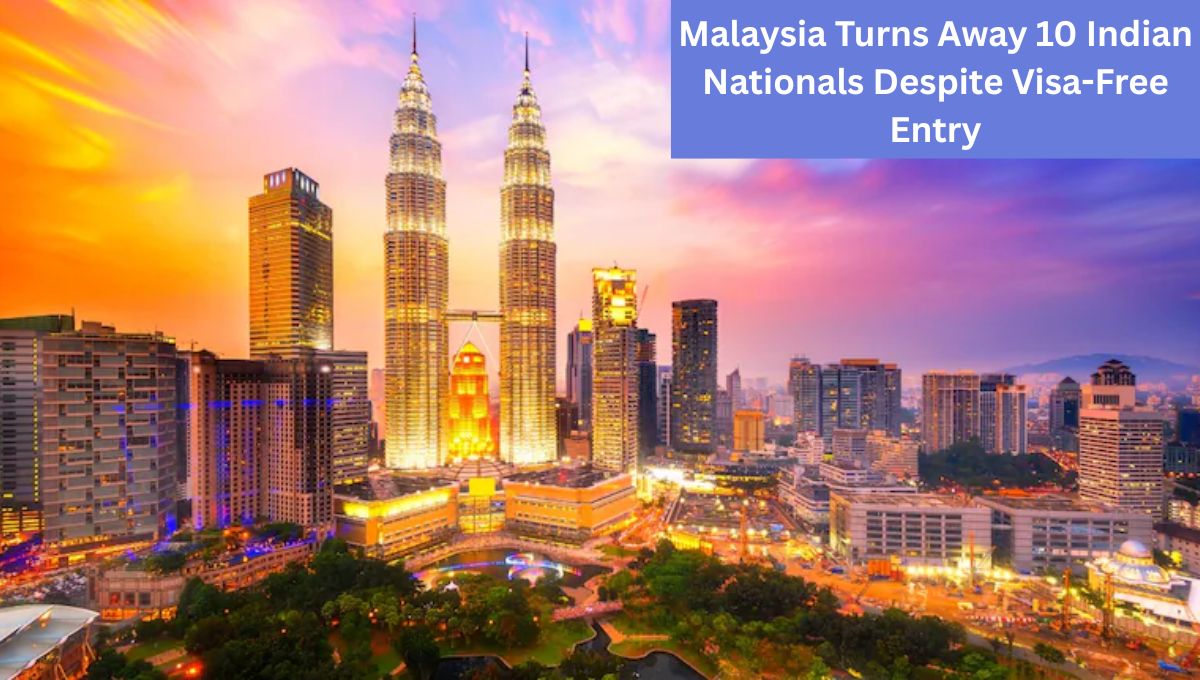
In a move that has raised eyebrows across the region, Malaysia Turns Away 10 Indian Nationals Despite Visa-Free Entry. Malaysia denied entry to ten Indian nationals this week at Kuala Lumpur International Airport (KLIA), despite an ongoing visa-free entry facility for Indian passport holders. The incident has stirred concern among travelers and policymakers alike, as it highlights Malaysia’s renewed efforts to tighten immigration enforcement.
Malaysia Turns Away 10 Indian Nationals Despite Visa-Free Entry
Immigration Sweep at KLIA Targets ‘High-Risk Flights’
According to the Malaysian Border Control and Protection Agency (AKPS), the refusal came during a special seven-hour immigration operation conducted at KLIA Terminal 1.
The initiative was part of a broader crackdown on what authorities describe as “high-risk flights.”
During the operation, more than 400 passengers were screened, leading to the denial of entry for 99 individuals from various countries.
Among the rejected were 80 Bangladeshi nationals, 10 Indian nationals, and nine Pakistani men.
Authorities cited “suspicious travel history” and vague or unconvincing reasons for visiting Malaysia as key reasons for the refusal.
All 99 travelers underwent rigorous background checks, documentation scrutiny, and personal interviews before being classified as Not-To-Land (NTL) cases.
Malaysia’s Push to Prevent Visa Abuse and Human Trafficking
The AKPS emphasized that such immigration operations will be conducted more frequently in an effort to curb the abuse of social visit passes and crack down on human trafficking.
While Malaysia remains committed to welcoming tourists and business travelers, the country is also determined to prevent its borders from being exploited by illegal syndicates.
“These operations demonstrate our commitment to blocking unlawful entry at the earliest point of contact,” said AKPS Director-General Datuk Seri Mohd Shuhaily Mohd Zain.
Larger Crackdown: 198 Foreign Nationals Denied Entry in One Day
The 10 Indians were part of a larger group of 198 foreign nationals who were refused entry into Malaysia on July 24, during a massive enforcement sweep at both KLIA Terminal 1 and Terminal 2.
The operation, supported by behavioral profiling teams and stealth surveillance officers, aimed to detect individuals showing signs of irregular travel behavior.
In total, 128 people were stopped at Terminal 1, while 70 were intercepted at Terminal 2.
The bulk of the detainees were from Bangladesh (123), followed by 51 Indonesians, 13 Indians, four Pakistanis, two Vietnamese nationals, and a Syrian citizen.
Red Flags: No Funds, No Accommodation, No Clear Itinerary
During inspection, many of the travelers could not provide clear answers about their purpose in Malaysia, had insufficient financial documentation, or lacked proof of accommodation.
Officials said these were red flags commonly associated with non-genuine travelers or those potentially involved in syndicate-led operations.
“Many had no accommodation plans and could not explain their presence here, which strongly aligns with what we’ve observed in smuggling attempts,” Shuhaily said.
The Not-To-Land Procedure and Airline Responsibilities
All the denied individuals were processed under Malaysia’s Not-To-Land (NTL) procedure, which allows immigration authorities to deport individuals at the point of entry if they fail to meet standard requirements.
Under international aviation law and Malaysian immigration regulations, the airlines that brought them into the country are responsible for returning them to their place of origin.
Syndicates Under Scrutiny: Photos of Officers Found on Phones
In a chilling discovery, immigration officers reportedly found images of AKPS personnel on the mobile phones of several detainees.
Authorities believe these images were distributed by previously deported individuals, as part of a coordinated effort by illegal immigration syndicates to help future travelers bypass security screening.
“It’s a sign that syndicates are adapting to enforcement actions,” Shuhaily noted. “We are now facing an evolving threat, and we intend to address it decisively.”
India-Malaysia Visa-Free Policy: Still in Place
Interestingly, this incident unfolds against the backdrop of Malaysia extending its visa-free entry facility for Indian passport holders until December 31, 2026.
Under the policy, Indian citizens are permitted to stay in Malaysia for up to 30 days without a visa.
The move was part of Malaysia’s strategic push to attract more tourists and boost the local economy in the lead-up to its chairmanship of ASEAN in 2025 and “Visit Malaysia Year” in 2026.
Tourism vs. Security: A Delicate Balancing Act
While Malaysia’s tourism sector continues to promote the country as a top destination for Indian travelers, incidents like this highlight the delicate balance between encouraging tourism and safeguarding national security.
Shuhaily emphasized that Malaysia remains open to genuine visitors, but insisted that border integrity will not be compromised.
“Our priority is national security, and we will not allow syndicates to abuse our hospitality or exploit vulnerable individuals for unlawful purposes,” he said.
Implications for Indian Travelers
Although the visa-free provision remains intact, Indian travelers planning to visit Malaysia are now advised to ensure that all documentation is in order.
This includes clear travel plans, proof of accommodation, return tickets, and adequate financial means to support their stay.
The incident serves as a reminder that visa-free entry does not guarantee automatic access to a foreign country.
Entry is still subject to immigration approval based on risk assessment and individual scrutiny.
Conclusion: What This Means for Regional Immigration Trends
Malaysia’s latest immigration crackdown reflects a broader regional trend of tightening border controls amid increasing concerns over undocumented migration, human trafficking, and organized syndicates.
While the country has opened its doors wider to encourage tourism and economic recovery post-pandemic, it is also drawing firm lines to maintain law and order.
For Indian travelers and others taking advantage of visa-free entry, the message is clear: come prepared, travel transparently, and expect thorough checks especially on high-risk routes.
If you’re planning a trip to Malaysia:
- Carry confirmed hotel bookings
- Show proof of sufficient funds (bank statements or cash)
- Be ready to explain your purpose of visit clearly
- Carry return flight tickets
- Avoid dubious travel agents or syndicates offering “easy entry”
Stay informed, and travel smart.
Also Read: Travelling to Malaysia? Here’s What Indian Nationals Must Know Before Flying
Also Read: Rejected for UAE Golden Visa? These 5 Gulf Alternatives Welcome You with Open Arms
Related Posts:
- 7 Powerful Takeaways from Trump’s Thai-Cambodia Peace Deal
- 5 Key Signals from PM Modi’s Virtual ASEAN Summit Appearance

- Drone Sightings Shut Copenhagen and Oslo Airports,…

- 55 Powerful Visa-Free Countries Indians Can Visit in 2026

- 5 Major Takeaways from the US Supreme Court's…

- 10 Million March: ‘No Kings’ Protests Sweep Across U.S.