President Emmanuel Macron of France to Recognize Palestine at UN: A Diplomatic Earthquake Ahead of September Summit. In a move described as “historic,” French President Emmanuel Macron announced that France will officially recognize the State of Palestine during the September 2025 United Nations General Assembly. This bold declaration makes France the first G7 nation and permanent UN Security Council member to take such a decisive step toward Palestinian statehood.
The statement, posted on X (formerly Twitter), sent shockwaves through international diplomacy, dramatically reshaping the conversation around the Israeli-Palestinian conflict. “Peace is possible. We need an immediate ceasefire, the release of all hostages, and massive humanitarian aid to the people of Gaza,” Macron declared. “France will recognize Palestine as a sovereign state. It is time the world matches words with action.”
This landmark announcement comes amid growing pressure over the worsening humanitarian crisis in Gaza, and a stalled peace process following the deadly October 2023 Hamas attacks on Israel.
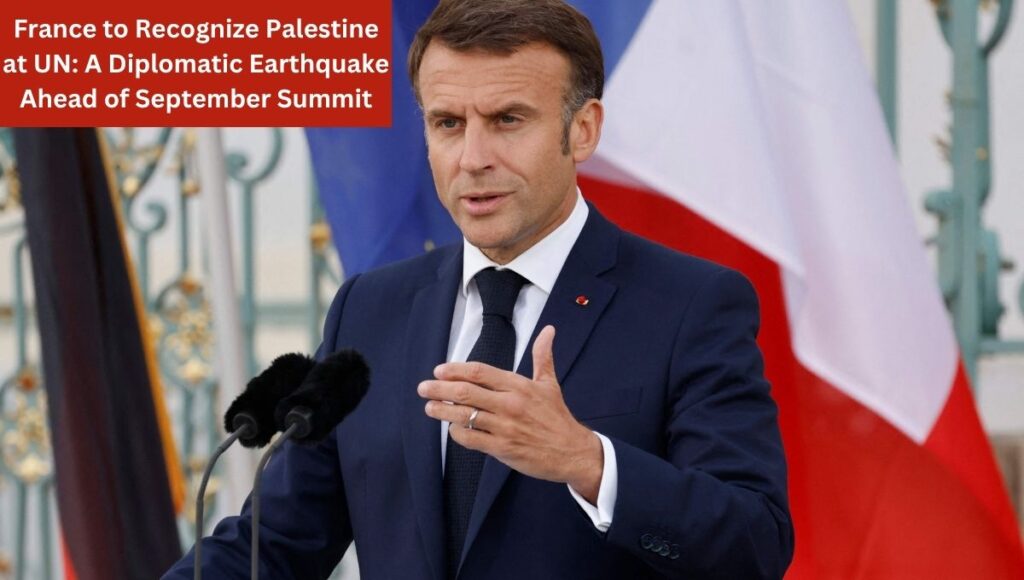
France to Recognize Palestine at UN: A Diplomatic Earthquake Ahead of September Summit
A Strategic Shift in European Diplomacy
While Spain, Norway, Ireland, and Slovenia recently recognized Palestine, France’s move carries far greater geopolitical weight.
As a nuclear power and a founding member of the European Union, France’s recognition of Palestine signals a seismic shift in Western diplomacy.
Behind closed doors, French officials admit the move had been months in the making. A planned France-Saudi Arabia summit in June 2025, intended to launch coordinated recognition efforts, was canceled due to the outbreak of war between Israel and Iran. Macron opted to go it alone.
A senior Élysée Palace adviser explained:
“The aim is to lead by example. If France moves first, others will follow.”
Humanitarian Crisis in Gaza Forces the Issue
The escalating humanitarian catastrophe in Gaza is central to Macron’s decision. Since the Israeli military campaign began in response to Hamas’s 2023 attack, nearly 60,000 Palestinians have been killed, according to Gaza’s health ministry.
Most of the victims are believed to be civilians. The World Health Organization has called the Gaza situation “man-made”, with famine and disease spreading rapidly.
UNRWA recently reported that 1 in 5 children in Gaza City is now malnourished, and more than 900,000 children face daily hunger.
“These people are walking corpses,” said Philippe Lazzarini, head of UNRWA.
Public outrage in France and across Europe has reached boiling point, placing mounting pressure on Macron to act.
The French President has repeatedly called for unhindered humanitarian aid, a ceasefire, and now, formal Palestinian statehood.
International Support for France’s Decision
Palestinian Authority: “A Bold and Just Move”
Palestinian leaders were quick to express gratitude. Hussein al-Sheikh, a senior official with the Palestinian Authority, said the announcement reflects France’s commitment to international law and the right of the Palestinian people to self-determination.
Even Hamas, despite being a controversial party in the West, called the move “a positive step in the right direction”, urging other European powers to follow suit.
Global South and European Allies Cheer Macron On
France now joins 147 UN member states in recognizing the State of Palestine, including India, Russia, Brazil, Mexico, and much of Africa, Latin America, and Asia.
Notably, leaders like Spanish Prime Minister Pedro Sanchez applauded Macron’s stand:
“Together, we must protect what Netanyahu is trying to destroy. The two-state solution is the only solution.”
Other European nations including Belgium, Malta, and even the UK are reportedly reconsidering their stance ahead of the September UN summit.
US and Israeli Backlash: “A Reward for Terrorism”
Washington Condemns Macron’s Move
The United States government was quick to condemn the move. Secretary of State Marco Rubio, a staunch Israel supporter, called it:
“Reckless. Shameful. A slap in the face to the victims of October 7th.”
The U.S. administration has repeatedly opposed any unilateral recognition of Palestine outside a broader peace agreement. Rubio insisted that the move only emboldens Hamas and damages peace prospects.
The U.S. has withdrawn from the UN conference co-chaired by France and Saudi Arabia, stating they have “nothing further to add.”
Israel’s Outrage: Netanyahu Warns of Fallout
Israel’s government responded with fury. Prime Minister Benjamin Netanyahu declared that Palestinian statehood recognition is:
“A reward for terrorism… a launch pad to annihilate Israel.”
He accused the Palestinians of seeking a state instead of Israel, not alongside it.
Defense Minister Israel Katz described France’s move as a “surrender to terrorism”, while Deputy PM Yariv Levin suggested Israel should annex the West Bank in retaliation.
Israeli officials also threatened to cut intelligence ties with France and block its diplomatic initiatives in the region.
Domestic Politics: Macron Walks a Tightrope at Home
France’s recognition of Palestine comes amid deep domestic sensitivities. With Europe’s largest Jewish and Muslim populations, Macron has consistently warned against “importing the conflict into France.”
He has condemned both antisemitism and Islamophobia, trying to maintain national unity in a highly polarized environment.
By choosing to move now, Macron is also attempting to reshape public opinion and redirect the narrative toward peace-building rather than escalating division.
What This Means for the Two-State Solution
Macron has positioned this move as a revival of the two-state solution, long considered the only viable path to ending the Israeli-Palestinian conflict.
However, trust between both sides is at its lowest point in decades. Macron’s vision includes:
- A demilitarized Palestinian state
- Based on 1967 borders
- Full recognition of Israel
- An end to Hamas control in Gaza
Critics argue this is unrealistic without serious security guarantees and international oversight.
Meanwhile, Donald Trump, who returned to the White House in 2025, has shown open hostility to the two-state concept.
His administration previously floated the idea of turning Gaza into a resort city, widely condemned as ethnic cleansing.
The September UN Assembly: A Defining Moment
The UN General Assembly in September 2025 is now shaping up to be a defining moment in Middle East diplomacy.
Macron is expected to deliver the official recognition speech, with a coalition of supportive nations standing alongside him. France will also host high-level summits in July and September to rally additional support.
“This is not just symbolic,” one French diplomat said.
“This is a new framework for peace.”
What Happens Next?
France’s recognition of Palestine raises key questions:
- Will other G7 nations like Germany, Canada, or the UK follow suit?
- Could this embolden the Palestinian Authority and sideline Hamas?
- Will Israel respond with more aggressive policies in the West Bank?
- Can the UN push forward a realistic peace plan?
These developments could reshape the geopolitical map, not just in the Middle East, but globally.
Conclusion: A High-Stakes Gamble for Peace
President Macron’s announcement that France will recognize the State of Palestine may prove to be a watershed moment. It is a daring diplomatic gamble, breaking from decades of cautious Western policy. For many Palestinians, it is the first glimmer of hope after a year marked by devastation, starvation, and displacement.
But the path forward is fraught with risk. Macron must now navigate global backlash, rally hesitant allies, and convince skeptics that this bold move is not just symbolic but a genuine step toward lasting peace.
Also Read: Indonesia Offers Diplomatic Recognition of Israel If Palestine Gains Statehood
Also Read: How significant is UK’s move to recognise Palestinian state, and why now?