In the much-anticipated Peace talks Zelenskyy, Putin, and Trump Absent as Confusion Clouds Ukraine-Russia Peace Talks in Istanbul. The Istanbul peace talks between Ukraine and Russia began Thursday under a cloud of confusion and diplomatic frustration, as neither Ukrainian President Volodymyr Zelenskyy, Russian President Vladimir Putin, nor U.S. President Donald Trump attended.
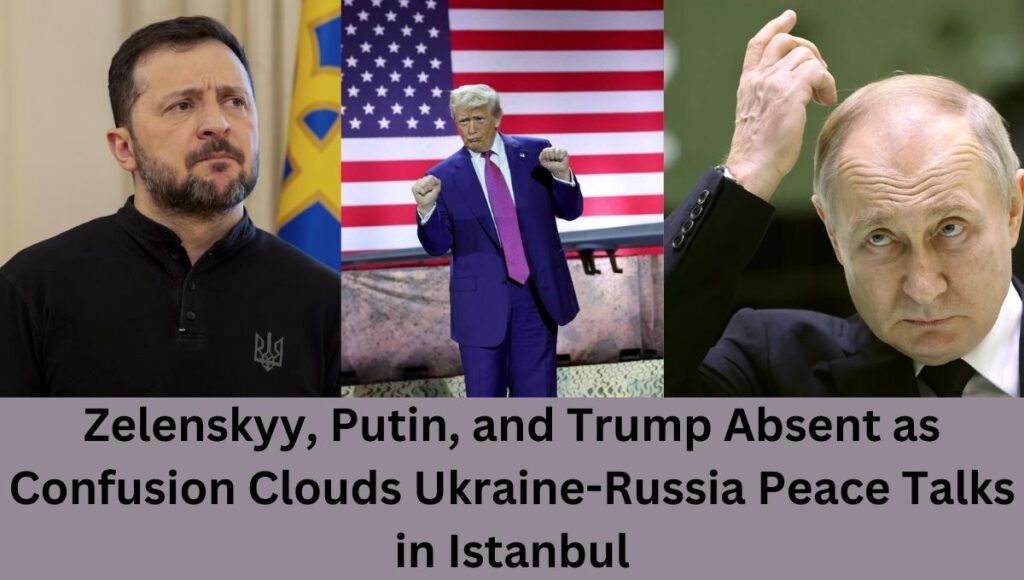
Zelenskyy, Putin, and Trump Absent as Confusion Clouds Ukraine-Russia Peace Talks in Istanbul
Peace Talks in Istanbul Begin Amid Absence of Key Leaders
Both Kyiv and Moscow dispatched high-level delegations to Turkey, attempting to navigate one of the most critical moments in the Russia-Ukraine conflict since the war began in 2022. Despite high hopes, the absence of these key leader’s casts doubts on the potential for a breakthrough.
Talks opened with significant delays as the Ukrainian and Russian delegations arrived in different Turkish cities and spent most of the day unsure if any direct meeting would take place.
Zelenskyy Criticizes Russian Delegation and Calls for Real Dialogue
Speaking from Ankara following a meeting with Turkish President Recep Tayyip Erdoğan, Zelenskyy expressed discontent over what he termed Russia’s unserious approach to the negotiations.
He slammed Moscow for sending a “midlevel delegation” and criticized the lack of a formal agenda or high-level Russian participation.
“There is not enough pressure—political, economic, or otherwise—on the Russian Federation,” Zelenskyy said. “You want to meet? Let’s meet,” he added, throwing the gauntlet to Putin while reaffirming Ukraine’s commitment to achieving peace on its terms.
Still, Ukraine opted to send a scaled-back delegation to Istanbul, led by Defense Minister Rustem Umerov, alongside senior military and intelligence officials.
According to Kyiv, Umerov’s selection is both strategic and symbolic, reflecting the seriousness of Ukraine’s approach and “out of respect for President Trump,” in the words of Zelenskyy.
Putin Sends Familiar Faces with Familiar Demands
Russia’s delegation, led by longtime Kremlin aide and former culture minister Vladimir Medinsky, mirrors the team sent to the failed 2022 peace negotiations.
Joining him are Deputy Foreign Minister Mikhail Galuzin, Deputy Defense Minister Alexander Fomin, and GRU intelligence chief Igor Kostyukov.
Moscow has made clear its core demands remain unchanged: recognition of its control over Donetsk, Lugansk, Zaporizhzhia, Kherson, and Crimea, as well as guarantees that Ukraine will never join NATO.
Medinsky described the Istanbul peace talks as a “continuation” of earlier efforts and emphasized the need to address the “root causes” of the war — a reference to Ukraine’s Western alignment.
Trump Claims Only He Can Seal the Deal
From Abu Dhabi, Donald Trump confirmed he would not attend the peace summit despite earlier speculation. “Nothing’s gonna happen until Putin and I get together,” he declared, suggesting that the only viable path to ending the war involves direct talks between himself and the Russian president.
The Trump administration has sent envoys to Istanbul, including retired General Keith Kellogg, with Steve Witkoff expected to join soon.
Trump’s earlier decision to temporarily halt U.S. military aid to Ukraine, citing Kyiv’s “lack of compromise,” raised eyebrows among European allies and added complexity to the Ukraine-Russia negotiations.
Ceasefire Proposal Remains the Core Issue
At the heart of the negotiations is a proposed 30-day Ukraine ceasefire, initially backed by the U.S. and supported by Zelenskyy.
However, Putin has rejected this comprehensive plan, offering instead two short-term truces around Easter and Victory Day.
Kyiv accused Moscow of violating both. Zelenskyy has reiterated his demand for an “unconditional ceasefire” covering land, air, and sea, while Russian officials express concern that Ukraine would use the lull to rearm and regroup. This mutual distrust continues to hamper any serious progress.
NATO Membership and Territorial Integrity: Deep Divides Remain
Few issues are as divisive as the question of territorial integrity and NATO membership. While Russia insists that Ukraine formally abandon aspirations to join the Western alliance and recognize its annexation of key regions, Ukraine refuses to cede any land.
Zelenskyy has hinted at the possibility of resolving some territorial issues through diplomacy rather than war, a subtle shift that has sparked debate within Ukraine.
Nevertheless, he remains firm that Crimea and the Donbas must be returned.
UK’s Keir Starmer Demands Accountability
British Prime Minister Keir Starmer entered the conversation forcefully, condemning Putin for “delaying peace while continuing bloodshed.”
Speaking from the European Political Community summit in Albania, Starmer warned that unless a ceasefire is agreed upon, Russian energy exports would face increased EU and UK sanctions.
The UK and EU imposed new sanctions this week targeting Russia’s shadow oil fleet, an attempt to cut off funds that help sustain Moscow’s war machine.
Security Guarantees: A Sticking Point with Global Implications
Ukraine’s call for security guarantees remains another major obstacle. While NATO membership is Kyiv’s preferred outcome, both Trump and Russia have opposed this route.
Alternative ideas involve European troop deployments under French or British leadership, but these have been firmly rejected by Moscow as a “red line.”
For now, the West is seeking ways to offer Ukraine protection that avoids triggering a direct confrontation with Russia — a diplomatic tightrope that is proving hard to walk.
Talks Symbolic but Fragile as Global Stakes Rise
Though expectations for a breakthrough remain low, the Istanbul peace talks represent the first direct negotiations between Ukraine and Russia in over three years.
Their rocky start highlights just how far apart the two sides remain, both in tone and substance.
The presence of high-ranking officials, coupled with Trump’s shadow influence, hints at potential shifts to come. Yet, time is running out. With the Russia-Ukraine war grinding into its third year, the human toll, geopolitical strain, and global energy instability continue to grow.
Conclusion: A Test of Patience and Pressure
The next 24 to 48 hours in Istanbul may prove critical in determining whether these negotiations offer a path toward de-escalation — or merely another round of diplomatic theater. For now, peace remains elusive, and the world waits.
Also Read: Zelenskyy Pushes for Direct Peace Talks with Putin in Turkey as Trump Mulls Attendance
Also Read: Uncertainty clouds Ukraine peace talks in Istanbul: What we know so far
Related Posts:
- 5 Powerful Highlights as Trump Lands Second Nobel…

- Dramatic Moments Behind Trump’s Gaza Peace Push and…

- Trump’s 2025 Gaza Peace Plan Signing and Historic…

- Trump’s 20-Point Gaza Peace Plan Gains Urgent Global…

- 7 Shocking Reasons FIFA’s Peace Prize for Trump…

- Rubio’s Urgent Note to Trump Before Gaza Peace Deal…