
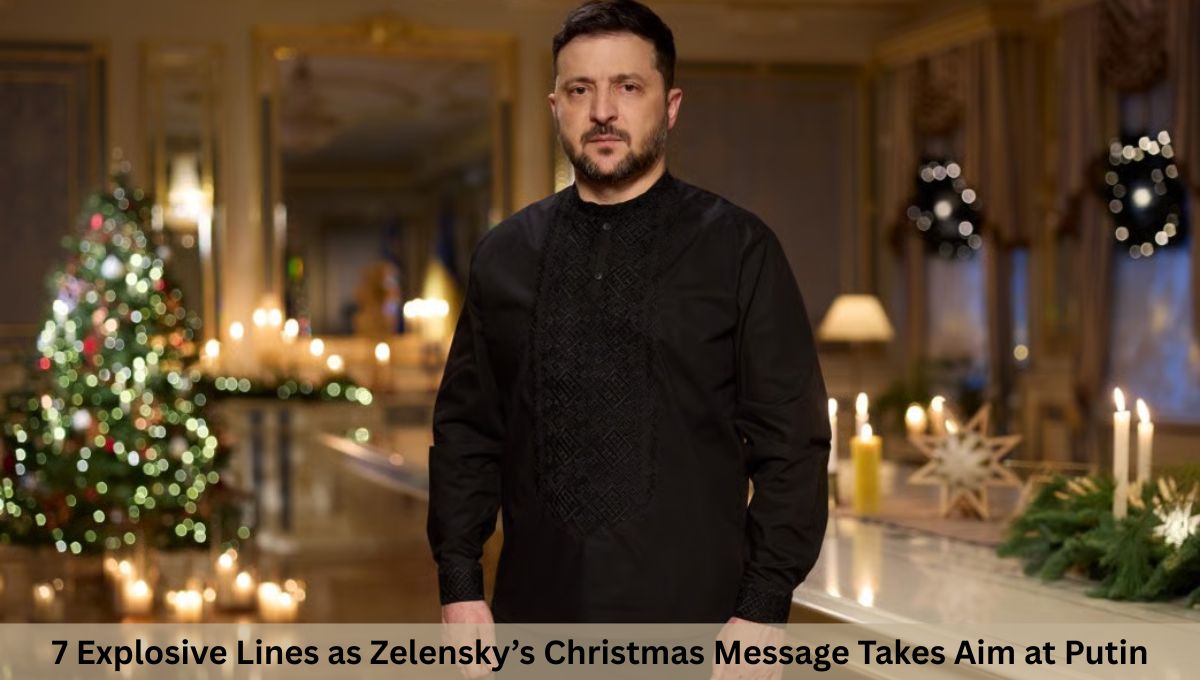
7 Explosive Lines as Zelensky’s Christmas Message Takes Aim at Putin while calling for peace in Ukraine. Ukrainian President Volodymyr Zelensky’s Christmas Eve address has ignited intense international debate after he appeared to voice a death wish for Russian President Vladimir Putin, even as he framed his remarks around peace, faith, and national resilience.
Delivered amid ongoing Russian missile and drone strikes across Ukraine, the speech captured both the emotional toll of nearly four years of war and Kyiv’s determination to continue fighting for sovereignty.
In a three-minute video posted on X on Christmas Eve, Zelensky invoked a traditional Ukrainian belief that “the heavens open” on Christmas night, allowing wishes to come true.
It was within this context that he delivered his most striking line:
“Today, we all share one dream. And we make one wish – for all of us. ‘May he perish,’ each of us may think to ourselves.”
Though Zelensky did not name Putin directly, the reference was unmistakable. Yet the Ukrainian president immediately softened the statement, adding that when Ukrainians turn to God, they ask for “something greater” — peace for Ukraine.

7 Explosive Lines as Zelensky’s Christmas Message Takes Aim at Putin
A Wartime Christmas Address Unlike Any Other
This year’s Christmas message was Zelensky’s fourth since Russia launched its full-scale invasion of Ukraine in February 2022.
Unlike traditional holiday addresses centered on celebration and unity, Zelensky’s speech reflected a nation exhausted by war but unwilling to surrender its core values.
“Despite all the suffering that Russia has brought, it is not capable of occupying or bombing what matters most,” Zelensky said. “That is our Ukrainian heart, our faith in one another, and our unity.”
The address was widely shared across social media and quickly picked up by international media outlets, many focusing on the controversial “may he perish” line.
Supporters saw it as an emotional expression of a nation under relentless attack, while critics argued it crossed a rhetorical line.
Russian Strikes Overshadow the Festive Season
Zelensky’s remarks came as Russia intensified its military campaign during the Christmas period. According to Ukrainian authorities, Russian forces launched missiles and waves of drones across multiple regions in the days leading up to Christmas.
At least three people were killed, including a four-year-old child, and dozens were injured. Energy infrastructure was again targeted, triggering power outages in several cities at a time when families were attempting to gather for the holiday.
“On the eve of Christmas, the Russians once again showed who they truly are,” Zelensky said. “Massive shelling, hundreds of ‘Shaheds,’ ballistic missiles, Kinzhal strikes — everything was used. This is how the godless strike.”
Ukraine’s air force reported that Russia launched more than 130 drones overnight into Christmas, with most intercepted but at least 22 striking targets across 15 regions.
‘May He Perish’: Symbolism and Interpretation
The phrase “may he perish” has deep symbolic resonance in Ukrainian folklore and religious tradition, often used as a private thought rather than a public call.
Zelensky framed it as an internal wish many Ukrainians might harbor after enduring years of bombardment, occupation, and loss.
Analysts note that Zelensky deliberately balanced the remark with a broader appeal to peace, emphasizing prayer, faith, and the future of Ukrainian children.
“But when we turn to God, of course, we ask for something greater,” he said. “We ask for peace for Ukraine. We fight for it. And we pray for it. And we deserve it.”
The Ukrainian president also stressed his hope that every family could live in harmony and that children could preserve “that so very important childlike faith in goodness and miracles.”
Kremlin Reaction: Anger and Condemnation
The Kremlin reacted swiftly and angrily to Zelensky’s remarks. Russian presidential spokesman Dmitry Peskov dismissed the speech as “uncultured” and “embittered,” questioning whether Zelensky was capable of rational decision-making.
Russian state media amplified the criticism, portraying the Ukrainian leader’s comments as evidence that Kyiv was not serious about peace negotiations. Moscow has consistently accused Zelensky of using inflammatory rhetoric to rally Western support.
Despite the backlash, Ukrainian officials defended the speech as a reflection of public sentiment during an unprecedented national crisis.
Ukrainians React: Grief, Anger, and Resolve
Inside Ukraine, reactions to Zelensky’s Christmas message were largely supportive. Many Ukrainians saw the speech as a raw and honest expression of collective grief and anger after years of war.
Social media platforms were flooded with messages praising Zelensky for “saying what many feel,” while others highlighted the president’s emphasis on unity and resilience rather than vengeance.
“For all our fallen heroes who defended Ukraine at the cost of their lives,” Zelensky said. “For everyone whom Russia has driven into occupation and forced to flee. Today we stand shoulder to shoulder. We will not lose our way in the darkness.”
The Human Cost of a Fourth Wartime Christmas
Zelensky repeatedly returned to the human cost of the conflict, particularly its impact on families and children. Millions of Ukrainians remain displaced, both internally and abroad, while countless others live under the constant threat of air raids.
“This is already the fourth wartime Christmas for the Ukrainian people,” Zelensky noted in a separate statement. “The largest war in Europe since World War II.”
The destruction of homes, schools, and energy infrastructure has transformed what should be a season of warmth into one marked by loss and uncertainty.
Russia Rejects Christmas Ceasefire
Zelensky also condemned Russia for rejecting Ukraine’s proposal for a temporary Christmas ceasefire. Writing on X, he expressed disappointment that Moscow refused to halt fighting even for a religious holiday.
“Moscow has not only rejected the request to end the killing at least for this Holy Day,” he wrote, “instead, Russia launched a massive missile and drone strike against Ukraine’s energy grid.”
The Ukrainian leader thanked global figures, including Pope Francis, for supporting diplomatic efforts to end the war, while urging world leaders to continue pressuring Russia.
The US-Led 20-Point Peace Plan
Amid the Christmas turmoil, Zelensky also revealed new details of a US-led 20-point peace plan aimed at ending the war. The proposal, developed by negotiators from Kyiv and Washington, was presented to Russia for feedback.
Zelensky said the plan focuses on Ukraine’s sovereignty, long-term security guarantees, and post-war reconstruction.
Separate bilateral agreements would address security arrangements and rebuilding efforts. However, he acknowledged that the most contentious issue — territory — remains unresolved.
Territorial Disputes Remain the Core Obstacle
Russia continues to demand that Ukraine concede the Donbas region, a condition Kyiv has firmly rejected. Zelensky reiterated that peace cannot come at the cost of Ukraine’s territorial integrity.
In one briefing, Zelensky suggested Ukraine could consider withdrawing troops from parts of the eastern industrial heartland, but only if Russia did the same and the area became a demilitarised zone under international monitoring.
Moscow has so far dismissed such proposals, maintaining its maximalist demands.
Drone Warfare Escalates on Both Sides
The Christmas period also saw a record exchange of drone strikes between Russia and Ukraine. Ukrainian officials said Russia launched more than 130 drones overnight, while Moscow claimed it shot down hundreds of Ukrainian drones, including near Moscow.
The escalating drone warfare underscores how technology has transformed the conflict, making even holidays vulnerable to attack.
Faith, Identity, and National Survival
Zelensky’s Christmas address blended religious symbolism with national identity, portraying Ukraine’s struggle as not just territorial but moral.
“Christmas reflects everything that defines us,” he said. “Our love for family, for our homeland, for our traditions, and for our shared roots.”
By invoking faith, Zelensky sought to strengthen morale at a moment when exhaustion and despair threaten to take hold.
International Response and Diplomatic Stakes
Western governments largely avoided direct comment on Zelensky’s controversial phrasing, instead reiterating support for Ukraine’s right to self-defence.
Diplomats privately acknowledged the speech’s emotional tone, noting that prolonged war inevitably shapes rhetoric. At the same time, they stressed the importance of keeping diplomatic channels open.
The Christmas address highlighted the delicate balance Zelensky must maintain: rallying domestic support while sustaining international backing.
A Message to the World
Beyond its immediate controversy, Zelensky’s speech was ultimately a message to the global community — that Ukraine remains committed to peace, but not surrender.
“It is critical that everyone around the world speak out against this war,” Zelensky urged, “and prevent Russia from normalizing its brutality, terror, and aggression.”
As Ukraine enters another year of war, the president’s words underscored both the depth of suffering and the endurance of hope.
Conclusion: Between Anger and Hope
Zelensky’s Christmas Eve address captured the contradiction at the heart of Ukraine’s wartime reality: profound anger at an aggressor, and an unyielding desire for peace.
The phrase “may he perish” may dominate headlines, but the broader message was one of survival, unity, and faith in a future beyond war.
As missiles and drones continue to fall, Ukraine’s Christmas wish remains unchanged — not vengeance, but a just peace that allows families to gather without fear and children to grow up believing in miracles once again.
Also Read: 20-Point Breakthrough: Trump-Led Peace Plan That Could End the Russia-Ukraine War
Also Read: Kremlin Slams Zelensky’s ‘Uncouth’ Christmas Address
Related Posts:
- 8 Shocking Facts Behind JD Vance’s Call for his…

- Trump Honors Late Activist Charlie Kirk With…

- 7 Key Developments in JD Vance’s Wife Conversion Remark

- Afghanistan–Pakistan War 2025: Inside the 48-Hour Ceasefire

- 11 Explosive Revelations From Ted Cruz’s Leaked…

- 7 Powerful Measures: Trump Sanctions Russian Oil…
