
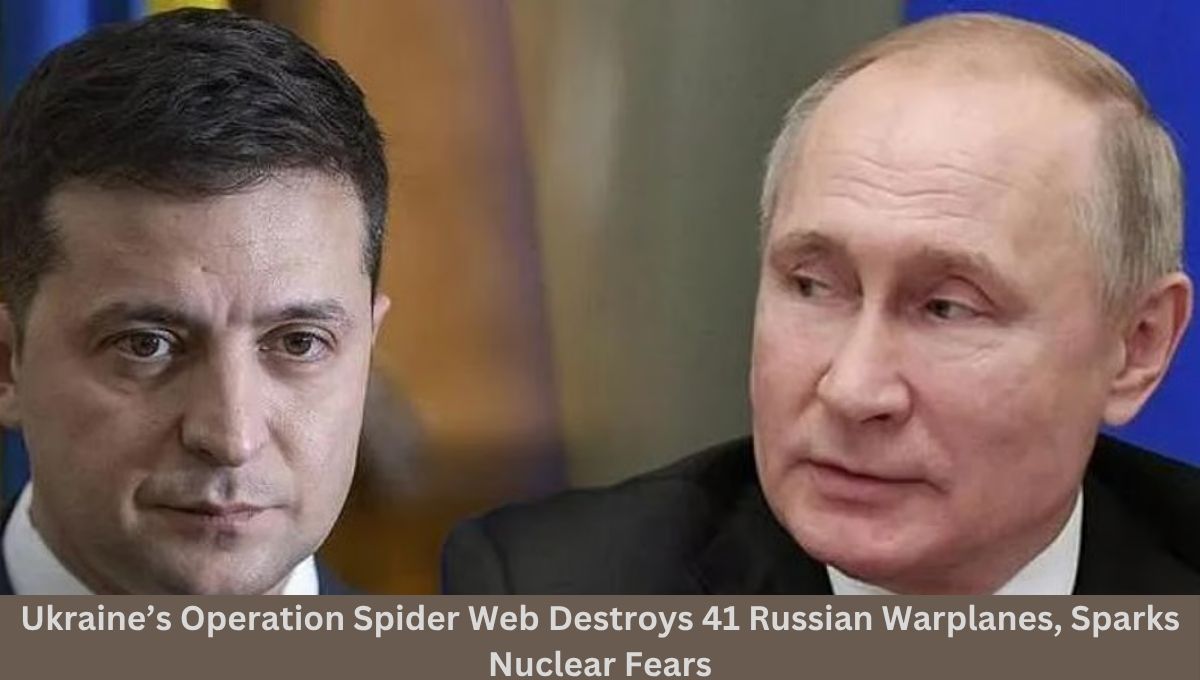
In a jaw-dropping display of modern covert warfare, Ukraine’s Operation Spider Web Destroys 41 Russian Warplanes, Sparks Nuclear Fears. Ukraine has executed one of the boldest long-range drone attacks of the 21st century. Dubbed Operation Spider Web, this secretive and high-impact mission destroyed or damaged 41 Russian warplanes at five different military airbases deep inside Russian territory.
Ukrainian authorities confirmed the attack was spearheaded by the Security Service of Ukraine (SBU), using 117 FPV drones remotely launched from within Russia. This move marks a significant escalation in the Ukraine-Russia War of 2025 and has left Moscow scrambling. Military analysts are calling the operation a game-changer not just for the war, but for global defense strategy.
Ukraine’s Operation Spider Web Destroys 41 Russian Warplanes, Sparks Nuclear Fears
Five Russian Airbases Targeted Across Thousands of Kilometers
The scope of Operation Spider Web was massive. Ukrainian drones targeted Russian military bases across three time zones, some as far as 8,000 km from Ukraine:
- Belaya Air Base (Irkutsk, Siberia) – over 4,500 km from Ukraine
- Olenya Air Base (Murmansk) – 2,000+ km away
- Ivanovo Severny Air Base – 800+ km
- Dyagilevo Air Base (Ryazan) – 520+ km
- Ukrainka Air Base (Russian Far East) – a staggering 8,000+ km
Despite visible attempts by Russia to defend these bases with tires, decoy paintings, and camouflage, the low-cost Ukrainian drones bypassed these defenses with surgical precision.
Artem Tymofieiev: The Phantom Behind the Operation
Central to the success of Operation Spider Web is Artem Tymofieiev, a 37-year-old Ukrainian spy operating undercover in Chelyabinsk, Russia. Disguised as a logistics entrepreneur, Tymofieiev allegedly used his company to smuggle drones disguised as prefab houses across Russia.
From there, the drones were remotely activated to launch the unprecedented strikes. His wife, Ekaterina Timofeeva, is also suspected of aiding the operation. Russia has launched a full-scale manhunt for Tymofieiev, publicly sharing his image and name.
Strategic Bombers in Flames: Satellite Images Confirm Damage
Satellite imagery and synthetic aperture radar (SAR) data have confirmed the destruction. According to reports:
- Belaya Air Base: Tu-95 and Tu-22M bombers destroyed
- Olenya Air Base: Three Tu-95s seen ablaze
- Ivanovo: Ukraine claims to have damaged rare A-50 AWACS aircraft
- Dyagilevo: Ilyushin IL-78 tankers targeted despite decoy efforts
- Ukrainka: Additional Tu-95 bombers reportedly hit
The SBU estimates total economic damage at $7 billion, wiping out 34% of Russia’s strategic cruise missile fleet.
Moscow’s Complacency Shattered
Russia’s assumption that its airbases were safe due to geographic distance has proven disastrously wrong. Typically, Ukraine relies on NATO-supplied missiles like ATACMS and Storm Shadow none of which can reach such remote targets.
Instead, Trojan-horse tactics were used to hide drones in Russian logistics networks, revealing a glaring weakness in domestic security. The success of the mission is forcing Russia to rethink its air defense strategy, with experts predicting a possible reallocation of mobile air defense systems across its vast territory.
Nuclear Nerves: Could Putin Retaliate with Tactical Weapons?
The attack did more than just destroy hardware it struck at the heart of Russia’s nuclear deterrence doctrine. Among the bombers hit were Tu-95s and Tu-22M3s, both capable of delivering nuclear payloads.
This raises a chilling question: Could Putin respond with nuclear force? Russia’s updated nuclear doctrine now allows for the use of nuclear weapons in response to conventional attacks backed by nuclear powers like Ukraine’s Western-supported strikes.
With 1,718 nuclear warheads ready for launch, according to the Federation of American Scientists, and with delivery systems like the RS-28 Sarmat, Iskander-M, Oreshnik, and Kh-22/Kh-32, the threat is real.
Russia’s Missile Arsenal: A Growing Concern
Here are the key nuclear-capable weapons in Putin’s arsenal:
- RS-28 Sarmat (Satan-2): Can carry 15 warheads, travels 18,000 km at Mach 20
- Oreshnik Missile: Hypersonic, 5,000 km range, six warheads with submunitions
- Iskander-M: 500 km range, Mach 7, highly maneuverable
- Kh-22/Kh-32: Air-launched cruise missiles with a 1,000 km range
Each of these has been used or showcased recently, underlining the escalation potential in the current climate.
Crimean Bridge Sabotaged Again
Just two days after Spider Web, the SBU confirmed a third successful attack on the Crimean Bridge on June 3, 2025, damaging its underwater supports using 1,100 kg of TNT equivalent explosives. The operation was months in the making and executed without civilian casualties.
SBU Chief Vasyl Maliuk claimed credit: “God loves the Trinity, and the SBU always brings what is conceived to the end and never repeats itself.” This third strike underscores Ukraine’s commitment to undermining key Russian logistics and symbolic targets.
Global Stakes: India and the World Urged to Act
India and other nations are watching anxiously. A nuclear escalation would destabilize global markets, disrupt energy supply chains, and threaten food security, especially in the Global South. With its neutral stance, India is uniquely positioned to push for de-escalation using diplomatic channels like the UN and G20.
Conclusion: A Historic Moment, A Dangerous Crossroad
Operation Spider Web isn’t just a tactical win for Ukraine it’s a strategic signal to the world. Low-cost drones have just neutralized a significant portion of a superpower’s air force, proving that ingenuity can outmatch brute strength.
But the world now stands on the edge. Will this daring operation become a turning point for peace or a spark for nuclear catastrophe?
Only time and diplomacy will tell.
Also Read: Russia Pounds Kharkiv in Retaliation: Massive Drone and Missile Barrage Kills 3, Injures Dozens
Related Posts:
- Ukraine Eliminates Russian FSB Agents After SBU…

- Zelensky Hails 'Brilliant' Drone Strike as Ukraine…

- 5 Explosive Firsts: Ukraine’s Underwater Drones Hit…

- 3 Explosive Conditions Iran Sets to End War with US…

- In 8 Moves, EU Targets China-Linked Refineries and…

- 7 Critical Reasons the Donbas Is the Most Explosive…

Comments are closed.