In a major turning point Trump Meets Syria’s New Leader Ahmad al-Sharaa, Signals Historic Shift in U.S. Foreign Policy. Former U.S. President Donald Trump’s Middle East visit has sparked international headlines following a surprise meeting with Ahmad al-Sharaa, the interim president of Syria. The meeting, brokered in Riyadh by Saudi Crown Prince Mohammed bin Salman (MBS), marks an unprecedented pivot in U.S.-Syria relations and could signal a broader shift in Middle East geopolitics.
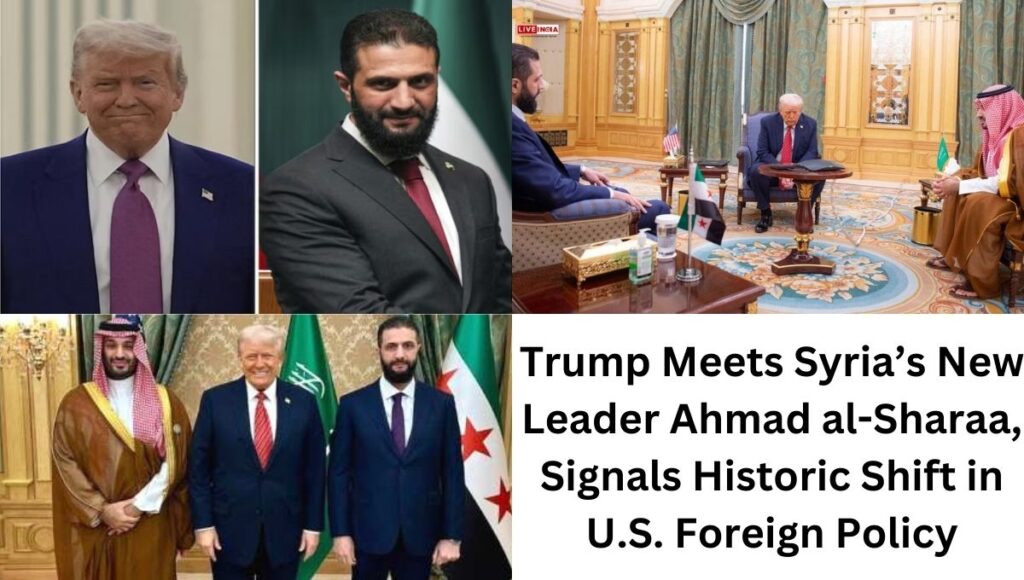
Trump Meets Syria’s New Leader Ahmad al-Sharaa, Signals Historic Shift in U.S. Foreign Policy
Trump’s Meeting with Syria’s Ahmad al-Sharaa Marks Major Turning Point in Middle East Geopolitics
This historic encounter, held inside a Saudi royal palace, was the first formal engagement between a U.S. president and a Syrian leader in over two decades. Trump’s move to lift U.S. sanctions on Syria during the meeting sent shockwaves across diplomatic circles, as many viewed it as a dramatic reversal of longstanding U.S. policy.
From Militant Commander to President: The Rise of Ahmad al-Sharaa
Ahmad al-Sharaa, formerly known as Abu Mohammad al-Jawlani, was once one of the most wanted men in the world. As the former leader of Hay’at Tahrir al-Sham (HTS), a group with roots in al-Qaeda, his transformation into Syria’s interim head of state is both controversial and significant.
Al-Sharaa took power in January 2025 after the sudden collapse of the Assad regime, which ended with Bashar al-Assad fleeing to Russia in late 2024. Since then, Sharaa has attempted to distance himself from his militant past, rebranding as a reformer and wearing Western business suits instead of fatigues.
Trump acknowledged this transformation, calling Sharaa “a tough guy with a strong past,” and argued that Syria now has “a chance at greatness.”
Trump Lifts Syria Sanctions: A Game-Changer
Perhaps the most consequential outcome of the Trump meets Ahmad al-Sharaa meeting was the lifting of U.S. sanctions on Syria—some in place since 1979.
The sanctions, initially imposed due to Syria’s support for terrorism and its ties with Iran-backed groups, had effectively crippled the nation’s economy.
“This is about giving Syrians hope and opportunity,” Trump said during a joint press conference with MBS. The announcement drew applause at the U.S.-Saudi investment forum being held concurrently in Riyadh, signaling strong regional support.
According to U.S. officials, certain sanctions will be lifted immediately via presidential waivers, while others will be dismantled gradually.
Saudi and Turkish Mediation: MBS and Erdogan Play Key Roles
Saudi Crown Prince MBS played a crucial role in orchestrating the meeting, serving as a mediator between the U.S. and the newly established Syrian leadership. Turkish President Recep Tayyip Erdogan also joined the talks via a secure video call, signaling Ankara’s support for the transition.
Analysts suggest that the move aligns with Saudi and Turkish interests in countering Iranian influence in Syria. Backing a Sunni-led Syrian government under al-Sharaa could be a regional strategy to stabilize Syria while minimizing Tehran’s footprint.
Economic Relief and Reconstruction on the Horizon
With Syria sanctions lifted, the war-torn country could soon see major investments flowing in. Over 90% of Syrians live in poverty, and years of civil war have devastated the economy and infrastructure.
Syrian interim Minister of Social Affairs Hind Kabawat described the lifting of sanctions as “a new light at the end of the tunnel.”
Aid groups, international banks, and private investors are expected to engage quickly, with infrastructure, energy, and education listed as immediate priorities. Trump also hinted at U.S.-backed reconstruction programs, potentially funded through Gulf partnerships.
Joining the Abraham Accords: A Bold New Direction
In a further sign of normalization, Trump urged al-Sharaa to consider joining the Abraham Accords the U.S.-brokered agreements that have normalized ties between Israel and several Arab states.
Sharaa reportedly expressed cautious openness, stating Syria could engage diplomatically “under the right conditions.”
This development is startling, considering Syria’s historical stance on Israel. However, analysts believe normalization with Israel could be a precondition for deeper U.S.-Syria relations and broader regional integration.
Israel Reacts with Alarm
Despite the diplomatic excitement, Israel expressed deep concern over the legitimacy being extended to a former jihadist leader. Prime Minister Benjamin Netanyahu reportedly warned Trump against trusting Sharaa, citing HTS Syria ties and the ongoing presence of foreign fighters.
U.S. officials responded by assuring Israel that future cooperation with Syria would depend on verifiable steps, including removing extremist elements and working toward long-term stability.
Business, AI, and the Trump Doctrine
The Riyadh visit wasn’t just about politics. Trump announced a $142 billion arms deal with Saudi Arabia and brought a high-profile delegation including Elon Musk, OpenAI CEO Sam Altman, and Nvidia CEO Jensen Huang.
Nvidia confirmed a major tech deal involving the sale of 18,000 AI chips to Saudi Arabia, underscoring the economic tone of Trump’s second-term diplomacy.
Trump framed his approach as “peace through prosperity,” emphasizing that economic opportunity, not endless war, is the key to transforming the Middle East.
Conclusion: A Defining Moment for Syria and the Region
The Donald Trump Middle East visit and his meeting with Ahmad al-Sharaa may mark a historic turning point. For Syrians, the end of economic isolation offers a real chance at rebuilding. For the region, it could signify a rebalancing of power, with new alliances emerging.
While critics argue Trump is normalizing a dangerous precedent, others see a calculated bet on pragmatism over purity. Either way, this bold step has opened a new chapter in the Syria civil war’s long and painful story one that could reshape the geopolitical landscape of the Middle East for years to come.
Also Read: Trump meets Syria’s al-Sharaa, eyes normalisation of ties with Damascus
Related Posts:
- 7 Shocking Revelations from Trump’s Defense of MBS…

- 7 Stunning Signs Trump and Musk Are Repairing Their…

- 7 Powerful Ways the US–Saudi $1 Trillion Partnership…
- Saudi Arabia Rolls Out the Purple Carpet as Trump…
- Trump’s 2025 Gaza Peace Plan Signing and Historic…

- 7 Powerful Reasons Trump’s F-35 Deal with Saudi…