InIsrael Syria conflict, Israel Launches Strikes in Syria to Protect Druze Amid Sweida Crisis: Geopolitical Shield or Sectarian Chaos? In a dramatic escalation of the Israel Syria conflict, Israel launched powerful airstrikes on Syrian government targets, citing the urgent need to defend the embattled Druze minority in southern Syria’s Sweida province.
The Israeli military hit strategic points near Damascus, including the defense ministry’s entrance and areas adjacent to the presidential palace. According to Israeli leaders, this is more than just a military operation it’s a moral obligation. But critics suggest deeper strategic motives may be at play.
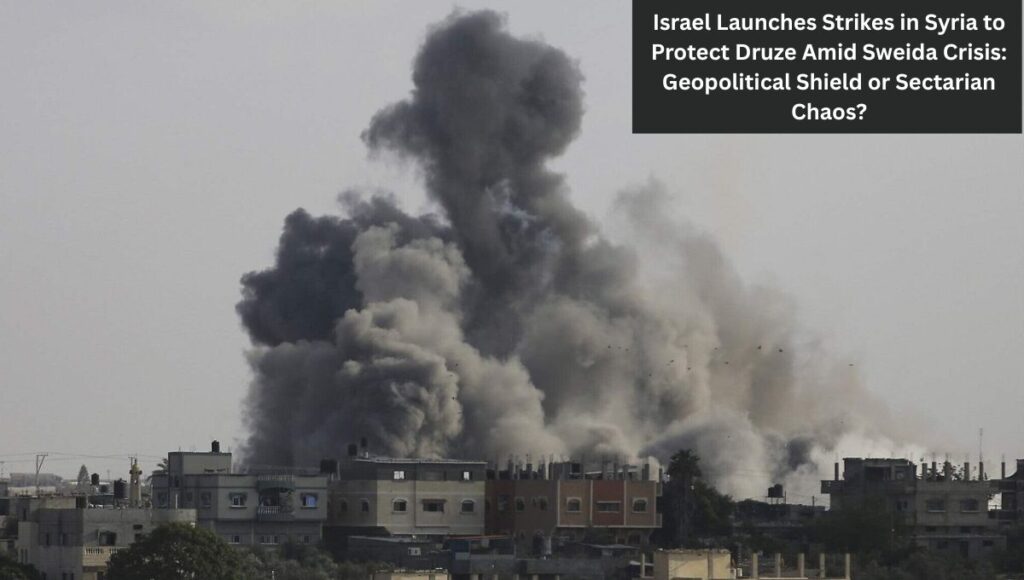
Israel Launches Strikes in Syria to Protect Druze Amid Sweida Crisis: Geopolitical Shield or Sectarian Chaos?
Why Did Israel Attack Syria?
The immediate spark for the Israeli airstrikes was the rising Sweida violence. The Druze-majority city in southern Syria erupted in deadly clashes between local Druze militias and armed Bedouin groups.
Syrian forces intervened but soon engaged in combat with Druze factions, fueling further instability.
Israeli Defense Minister Israel Katz stated bluntly, “The Israeli military will continue to operate vigorously in Sweida to destroy the forces that attacked the Druze until they withdraw completely.”
Prime Minister Benjamin Netanyahu reinforced this, calling the Druze “brothers” and linking their protection to Israel’s deep-rooted historical and familial ties with the Druze in Israel.
Who Are the Druze Minority?
The Druze are a small, religious minority that emerged in the 10th–11th century as an offshoot of Ismaili Shiite Islam.
Their theology blends Islamic doctrine with Greek philosophy, reincarnation, Gnosticism, and Hindu influences. The Druze faith emphasizes loyalty, community, and secrecy regarding religious texts and rituals.
Globally, there are about 1 million Druze, primarily concentrated in Syria, Lebanon, and Israel. In Syria, most live in Sweida, the Jaramana suburb of Damascus, and near the Israeli-occupied Golan Heights.
The Druze have historically maintained autonomy and often found themselves in uneasy alliances or at odds with ruling powers from French colonists to the Assad regime, and now, the new government under Ahmed al-Sharaa.
The Sweida Flashpoint: Sectarian and Strategic
The recent Sweida violence saw over 590 deaths, including combatants and civilians. Syrian troops, dispatched to pacify the unrest, clashed directly with Druze forces instead.
A ceasefire was brokered Tuesday but collapsed within hours, prompting Israel to act militarily. Reports indicate widespread destruction, executions, and burned neighborhoods.
As Netanyahu put it, “We will not allow Syrian army forces to enter the region south of Damascus and will not allow any harm to the Druze.”
Syria’s New Leadership: A Troubled Transition
The Syrian political landscape shifted dramatically following the ousting of Bashar al-Assad in December 2024.
Interim President Ahmed al-Sharaa now leads a mostly Sunni-dominated government viewed by many including Israel as aligned with jihadist factions like Hayat Tahrir al-Sham (HTS).
This administration faces increasing distrust from ethnic and religious minorities, especially after March’s sectarian revenge killings, where hundreds of Alawite civilians were murdered.
Israel’s intelligence labels the new regime as “barely disguised jihadists,” citing the breakdown of minority protections as justification for intervention.
Druze in Israel: A Complicated Bond
The Druze in Israel number around 150,000 and are deeply integrated into Israeli society, with many serving in the military and government. This creates a unique bridge between the two countries.
Israel’s government has emphasized its responsibility to protect the Druze in Syria, citing these close ties.
Netanyahu urged Israeli Druze not to cross into Syria, even as reports emerged that some had already attempted to aid their relatives.
U.S. and Global Reaction: Calls for Calm, Not Combat
The U.S. State Department voiced opposition to Israel’s airstrikes, urging immediate de-escalation. Spokesperson Tammy Bruce said, “We are asking the Syrian government to withdraw their military to allow all sides to de-escalate and find a path forward.”
Secretary of State Marco Rubio, alongside President Donald Trump, confirmed ongoing efforts to broker peace: “Historic rivalries led to this misunderstanding. We’re working morning and night to de-escalate.”
Meanwhile, UN Secretary-General António Guterres called the Israeli strikes “escalatory,” emphasizing respect for Syria’s sovereignty.
A joint statement from 11 Arab League nations condemned all foreign military activity in Syria, stressing the importance of preserving national unity.
Ceasefire Attempt in Sweida: A Fragile Peace
A new ceasefire announced on Wednesday includes:
- Withdrawal of Syrian troops
- Local Druze-led security patrols
- End to Israeli airstrikes
- A neutral monitoring committee
However, not all Druze leaders are on board. Influential religious leader Sheikh Hikmat al-Hijri rejected the deal, calling for international protection for the Druze and encouraging continued resistance.
Strategic Geography: Why Sweida Matters
Sweida’s location is pivotal bordering Jordan, near the Golan Heights, and acting as a corridor for Iranian and militant movements.
Controlling this region means controlling access to northern Israel, Damascus, and southern Syria.
For Israel, securing this buffer zone ensures its national security against both Iranian-backed militias and jihadist factions.
A History of Israeli Airstrikes in Syria
This isn’t Israel’s first strike inside Syria. Since the outbreak of the Syrian civil war, Israel has carried out hundreds of air raids, primarily targeting:
- Iranian-backed militias
- Hezbollah arms convoys
- Syrian military sites
But this latest campaign marks a shift targeting Damascus and intervening in intra-Syrian sectarian conflicts is unprecedented and potentially escalatory.
Humanitarian Toll: Lives Lost, Homes Destroyed
The conflict’s impact has been devastating:
- 300 Druze fighters and 257 Syrian soldiers killed
- 83 civilians reportedly executed
- 146 civilians caught in crossfire
- 34 injured in Israeli strikes
Local journalist Ryan Marouf described the horror in Sweida: “Bodies lay unburied in the streets. Homes were torched. Families wiped out.”
The Syrian Network for Human Rights (SNHR) confirmed at least 254 civilian deaths, including women, children, and medical personnel.
Syria’s Response: Sharaa Accuses Israel of Sabotage
In a fiery speech, Ahmed al-Sharaa accused Israel of trying to “fracture Syria along sectarian lines.” He praised mediation efforts by Turkey, the U.S., and Arab states, while promising to protect all Syrian citizens, including the Druze.
“The Israeli entity has consistently tried to destabilize us,” Sharaa declared. “But Syria will not be divided by force or manipulation.”
The Bigger Picture: Israel’s Strategic Intent
Many analysts view Israel’s actions as more than a humanitarian mission. Former Israeli diplomat Alon Pinkas noted: “This is less about saving the Druze and more about shaping a fractured Syria that can’t threaten Israel.”
Israel benefits from a divided Syria a mosaic of warring factions, unable to coalesce into a stable, potentially hostile regime.
Domestic Politics in Israel: War Fatigue and Political Strategy
Inside Israel, reactions to the Syria strikes are muted. Analysts point to public war fatigue after operations in Gaza, Lebanon, and now Syria.
Political analyst Ori Goldberg said, “It’s not apathy. It’s a numbness. Conflict has become normalized.”
Netanyahu, currently under corruption trial, faces domestic pressure and may be leveraging military action to reassert leadership and delay legal consequences.
What Lies Ahead?
The Israel Syria conflict is entering a dangerous new phase. The Druze, once a quiet minority, are now central to a growing geopolitical battle.
Key takeaways:
- Israel is unlikely to back down without full Syrian withdrawal from Sweida.
- The Syrian government faces a credibility crisis with minorities.
- The Druze are split between diplomacy and defiance.
- Global powers are watching, but acting cautiously.
The path forward is uncertain. For the Druze minority, the stakes are existential. For Israel and Syria, the battle is about more than land it’s about identity, influence, and long-term regional control.
Conclusion: Humanitarian Protection or Political Maneuvering?
Israel’s intervention in Syria, wrapped in the language of protecting the Druze minority, reflects deeper currents in Middle East geopolitics. As violence simmers and ceasefires remain tenuous, Sweida stands at the intersection of humanitarian need and strategic ambition.
Whether this ends in peace or prolonged warfare may depend less on battlefield victories and more on diplomatic resolve and regional will.
Also Read: Israel-Syria Ceasefire Begins as Druze-Bedouin Clashes Ignite Crisis in Sweida
Also Read: World Insights: Syria’s future hangs in balance amid Sweida violence, Israeli strikes
Related Posts:
- Israel-Syria Ceasefire Begins as Druze-Bedouin…

- Ceasefire in Suwayda Wobbles as Israeli Strikes Hit Syria
- Israel Launches Strikes on Syria After Rocket Fire:…

- 10 Explosive Strikes: Israel Bombs Tehran Oil Depots…

- Trump Meets Syria’s New Leader Ahmad al-Sharaa,…

- 9 Explosive Signals as Netanyahu Says Israel Is…