7 Powerful Takeaways from Trump’s Congo–Rwanda Peace and Minerals Deal, which he hailed as a “Great Day for the World.” US President Donald Trump on Thursday declared a “great day for Africa” as he hosted the leaders of the Democratic Republic of the Congo (DRC) and Rwanda for the signing of a U.S.-brokered peace and minerals deal.
The agreement, finalised in Washington after months of mediation, aims to halt the escalating conflict in eastern Congo while opening access to some of the world’s most coveted rare earth mineral reserves for American companies.
Trump framed the event as a diplomatic triumph—one he believes few world leaders could have secured. Yet on the ground in eastern Congo, violence continues, and questions remain about whether the pact can truly reshape one of Africa’s most entrenched conflicts.
This in-depth report examines the key elements of the deal, the regional dynamics behind the conflict, and the high-stakes implications for the United States, Congo, Rwanda, and the broader global minerals market.
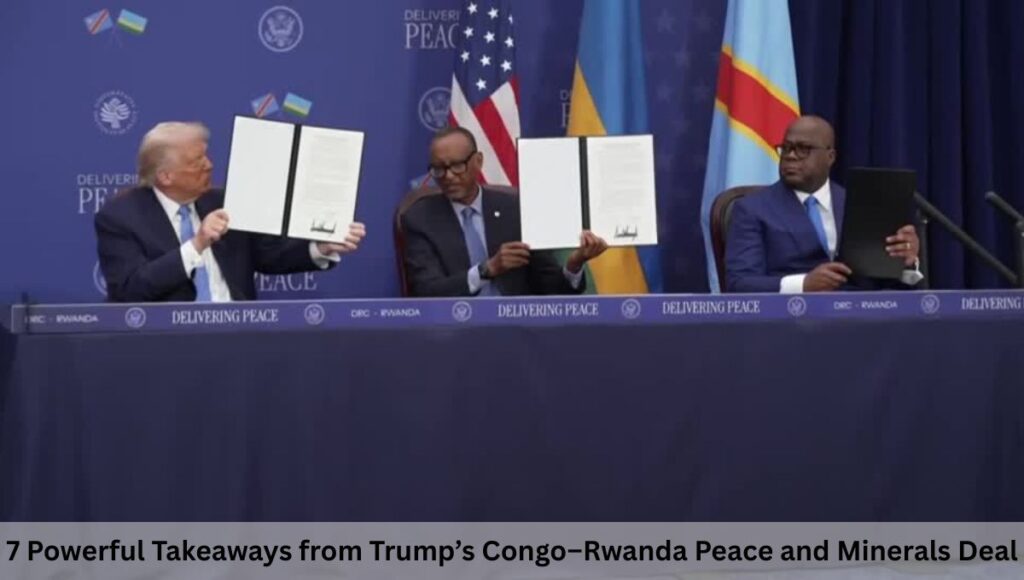
7 Powerful Takeaways from Trump’s Congo–Rwanda Peace and Minerals Deal
A “Great Day for the World”: Trump Seizes the Diplomatic Stage
Calling the signing ceremony “a great day for Africa, a great day for the world,” Trump celebrated his success in bringing Congolese President Félix Tshisekedi and Rwandan President Paul Kagame to the table. The peace agreement builds on a preliminary framework reached in June, with mediation support from the United States, Qatar, and the African Union.
“Today, we’re succeeding where so many others have failed,” Trump said, positioning himself as the world’s leading dealmaker. The event took place just days after he sparked backlash for disparaging remarks about Somalia, underscoring the contradictions in Trump’s dealings with African nations.
The White House described the deal as “historic,” crediting persistent U.S. engagement in pushing both Congo and Rwanda toward a diplomatic breakthrough.
The Core of the Pact: Stopping the M23 Conflict in Eastern Congo
The most urgent objective of the U.S.-brokered agreement is to ease the violence that has engulfed eastern Congo, particularly around the cities of Goma and Bukavu. The region has long been plagued by more than 100 armed groups, including the M23 rebels, who are widely believed to receive backing from Rwanda—an accusation Kigali denies.
The deal’s central provisions include:
- Rwanda agrees to end any support for the M23 rebels.
- Congo commits to “neutralising” the Hutu militias, particularly the Democratic Forces for the Liberation of Rwanda (FDLR), which Kigali sees as a cross-border threat.
- Both countries pledge to respect territorial integrity and prevent military incursions.
Although these commitments echo earlier regional agreements, this time they carry the weight of direct U.S. involvement and economic incentives.
Why the Conflict Runs So Deep: The Legacy of the 1994 Genocide
Understanding the significance of the deal requires revisiting the conflict’s roots in the 1994 Rwandan genocide, which killed up to one million people—mostly Tutsis.
- Nearly two million Hutus fled into eastern Congo, including armed groups linked to the genocide.
- Rwanda argues that remnants of these militias still operate in Congo and pose an existential threat to Tutsi communities.
- Congo counter-accuses Rwanda of using this justification to destabilise its territory and exploit minerals through the M23 rebels.
This cycle of accusation and retaliation has fuelled decades of mistrust, making Thursday’s peace agreement symbolically significant—even if not yet transformative on the ground.
Violence Persists Despite the Peace Deal
Although the signing ceremony reflected optimism in Washington, the situation in eastern Congo remains extremely volatile. Armored vehicles, artillery fire, and displaced families continue to define life in the region.
A resident of Goma, Amani Chibalonza Edith, offered a stark reminder of the reality:
“We are still at war. There can be no peace as long as the front lines remain active.”
The M23 rebels still hold key territory, Goma’s airport remains closed, and shortages of essential goods are worsening. Analysts warn that while the peace deal is promising, it is unlikely on its own to reverse decades of conflict, militia activity, and humanitarian catastrophe in the DRC.
Kagame and Tshisekedi Strike a Cautious Tone
Both leaders welcomed the agreement but struck notably cautious notes during the signing ceremony.
Kagame: “There will be ups and downs”
Rwandan President Paul Kagame acknowledged the difficulty ahead:
“There will be ups and downs on the road ahead. Rwanda will not be found wanting, I can assure you of that.”
Kagame also praised Trump’s decision to intervene:
“No one was asking President Trump to take up this task, but when he saw the opportunity to contribute to peace, he immediately took it.”
Tshisekedi: A “turning point” but not an endpoint
Congo’s President Tshisekedi emphasised that the agreement offers hope but not guarantees:
“This day is the beginning of a new path… a turning point.”
He highlighted that the accord integrates peace and economic development, providing a potential foundation for “friendship, cooperation and prosperity.” Yet both leaders avoided direct eye contact and exchanged minimal interaction during the 50-minute ceremony, underscoring underlying tensions.
A Deal Driven by Critical Minerals — and U.S. Interests
One of the most consequential components of the agreement is the U.S. plan to expand access to rare earth minerals in Congo and Rwanda.
These minerals are essential for modern technologies, including:
- fighter jets
- electric vehicle batteries
- smartphones
- renewable energy systems
- medical devices
Trump announced bilateral agreements with both countries to facilitate American extraction and investment.
Trump: “Everybody is going to make a lot of money”
In characteristically blunt terms, Trump framed the economic side of the deal as a win for all parties:
“We’ll be involved with sending some of our biggest and greatest companies over to the two countries… Everybody is going to make a lot of money.”
Washington has been urgently seeking alternatives to China, which currently dominates global rare earth mining and processing. Congo, home to some of the world’s richest mineral deposits, is a strategic priority. For both Rwanda and the DRC, economic cooperation with U.S. corporations could yield significant revenue, infrastructure development, and political leverage.
Critics Warn of Risks: Is Minerals Access Overshadowing Peace?
Some analysts have warned that while the peace deal is commendable, the simultaneous rollout of minerals agreements raises concerns about:
- whether peace is tied too closely to U.S. economic interests
- whether local communities will actually benefit from minerals extraction
- whether security conditions are sufficient for safe mining operations
- whether the deal might empower elites or foreign companies more than civilians
Human rights organisations argue that past mineral-driven interventions in Congo have exacerbated conflict rather than resolved it. Without stability, transparency, and oversight, mineral agreements risk becoming a “resource curse” rather than a catalyst for peace.
Trump’s Nobel Peace Prize Ambitions Resurface
The signing ceremony also revived Trump’s repeated claim that he deserves the Nobel Peace Prize for “resolving eight world conflicts,” a statement many experts dispute.
At the event, Trump emphasised:
“It’s an amazing day… And they have so much to be proud of.”
He positioned the Congo–Rwanda peace deal as a signature foreign policy achievement, adding to his list of claimed diplomatic successes. However, critics point to ongoing violence in eastern Congo and the fragility of previous regional agreements as reasons to temper expectations.
A Region Scarred by War Looks for a New Chapter
Despite the symbolism of the Washington ceremony, the eastern Congo conflict remains one of the world’s largest humanitarian crises:
- Millions displaced
- Widespread sexual violence
- Deadly clashes between armed groups
- Collapsed transport routes and closed banks
- International aid reductions
For ordinary Congolese like Edith in Goma, peace remains a distant hope rather than an imminent reality. Still, many African leaders and international observers cautiously welcomed the U.S. initiative. If implemented effectively, the agreement could create the groundwork for long-term stability and economic revival.
The Road Ahead: Fragile Optimism and High Stakes
The Congo–Rwanda peace and minerals deal represents a rare moment of diplomatic unity between two historic rivals—with the United States playing a decisive role.
But the key questions remain:
- Will Rwanda genuinely withdraw support for M23?
- Can Congo neutralise the Hutu militias embedded in its territory?
- Will minerals cooperation lead to development—or deepen grievances?
- Can the agreement withstand political changes, military pressure, and regional rivalries?
The coming months will determine whether this moment was a symbolic ceremony or the beginning of a transformative peace process. For now, the world watches with cautious optimism—and the people of eastern Congo wait for real change on the ground.
Also Read: 7 Shocking Moments: Congo Minister’s Plane Bursts into Flames After Runway Skid
Also Read: Trump claims breakthrough as Congo and Rwanda sign peace and minerals deal
Related Posts:
- 5 Powerful Highlights as Trump Lands Second Nobel…

- Trump’s 2025 Gaza Peace Plan Signing and Historic…

- Dramatic Moments Behind Trump’s Gaza Peace Push and…

- 7 Shocking Reasons FIFA’s Peace Prize for Trump…

- 7 Powerful Takeaways from Trump’s Thai-Cambodia Peace Deal
- 11 Explosive Revelations From Ted Cruz’s Leaked…