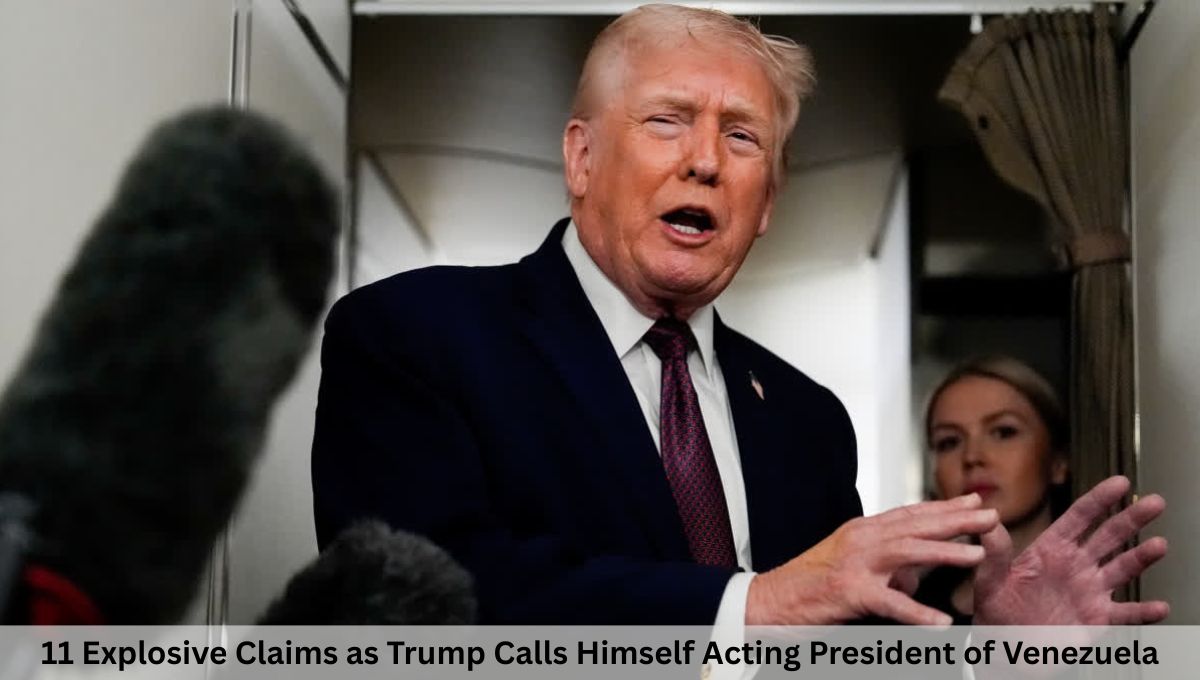
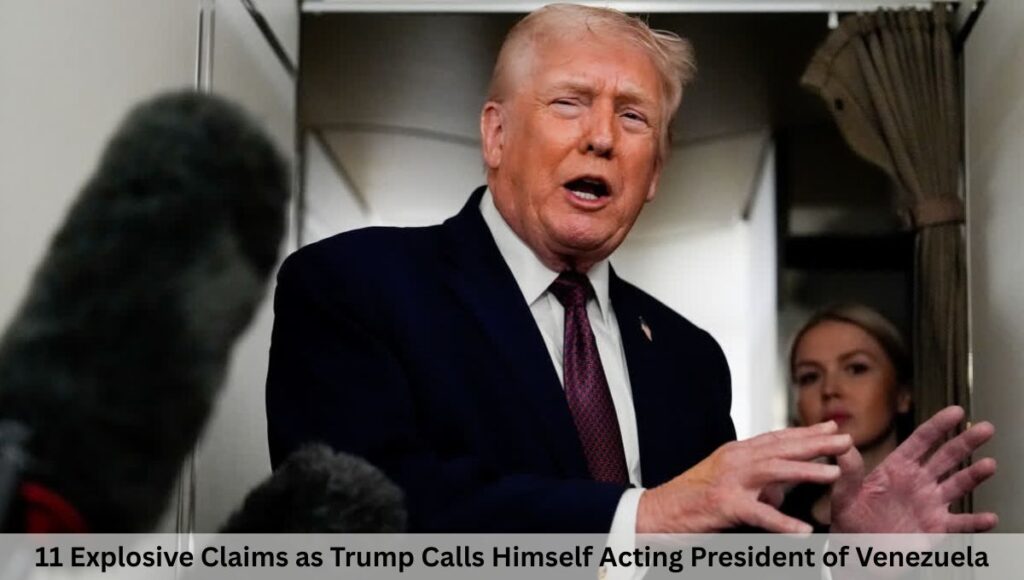
11 Explosive Claims as Trump Calls Himself Acting President of Venezuela, igniting global controversy. United States President Donald Trump has ignited a fresh international controversy after declaring himself the “Acting President of Venezuela” in a viral post on his social media platform, Truth Social.
The declaration came days after the U.S. military captured Venezuelan President Nicolás Maduro and his wife, Cilia Flores, transporting them to New York to face federal charges related to narcoterrorism and drug trafficking conspiracies.
Styled as a digitally altered Wikipedia page, the image showed Trump’s official presidential portrait with the designation:
“Acting President of Venezuela – Incumbent January 2026” The post immediately set off global alarm, diplomatic backlash, and widespread online ridicule, with critics accusing Trump of spreading disinformation and escalating an already volatile geopolitical crisis.
11 Explosive Claims as Trump Calls Himself Acting President of Venezuela
What Trump Actually Posted on Truth Social
The image Trump shared appeared to mimic an official Wikipedia entry:
- Trump’s official White House portrait was displayed
- The page listed him as 45th and 47th President of the United States
- Beneath his portrait, the title “Acting President of Venezuela” was prominently shown
- The date “Incumbent January 2026” was added
Importantly, the real Wikipedia page does not list Trump as Venezuela’s acting president, nor has any international body recognised such a role.
The post garnered over 18,000 reactions within hours, pushing Trump’s name to the top of Google Trends on January 12, alongside the phrase “Acting President of Venezuela.”
Trump’s Pattern of Provocation Continues
This is not the first time Trump has used social media theatrics to make geopolitical statements.
In the same time frame:
- Trump jokingly endorsed the idea of Marco Rubio becoming President of Cuba, reposting a claim with the caption, “Sounds good to me.”
- He publicly warned Venezuela’s interim leadership of severe consequences if they resisted US authority.
- He claimed personal credit for political prisoner releases inside Venezuela.
Critics argue the posts blur the line between policy signaling, provocation, and performance politics.
What Really Happened After Maduro’s Capture
The US Operation
Earlier this month, the United States conducted what it described as a “large-scale” military operation inside Venezuela.
During the operation:
- Nicolás Maduro and Cilia Flores were captured
- Both were flown to New York
- US prosecutors unsealed indictments accusing Maduro of narco-terrorism conspiracy
Maduro has denied all charges, describing his detention as a kidnapping and a violation of international law and sovereign immunity.
Who Is Actually Governing Venezuela Right Now?
Delcy Rodríguez Sworn In as Interim President
Contrary to Trump’s claim, Venezuela’s Supreme Tribunal of Justice initiated a domestic constitutional succession process.
As a result:
- Vice President and Oil Minister Delcy Rodríguez was sworn in as Interim President
- The move was framed as necessary to ensure administrative continuity
- Rodríguez rejected US claims of authority over Venezuela’s governance
“Maduro remains the legitimate president,” Rodríguez declared, while demanding his immediate release.
US Signals: Influence, Not Formal Control
Despite Trump’s rhetoric, US officials have sent mixed signals:
- Trump said the US would “run Venezuela” temporarily
- He declared the United States was “in charge” following Maduro’s removal
- Secretary of State Marco Rubio later clarified the US does not intend to directly administer Venezuela
The administration has instead emphasized:
- An “oil quarantine”
- Strategic leverage through sanctions
- Control over energy flows rather than governance
Trump’s Oil Strategy: Control Without Annexation
“Get the Oil Flowing”
Trump has repeatedly framed Venezuela through the lens of energy security.
Key claims made by Trump include:
- Venezuela agreed to supply 30–50 million barrels of crude oil to the US
- Oil deliveries could continue indefinitely
- Proceeds would be controlled by the US administration
- American oil companies would invest up to $100 billion to rebuild Venezuela’s energy sector
Trump also signed an executive order protecting Venezuelan oil revenues held in US banks.
“We will decide who operates in Venezuela,” Trump told oil executives at the White House.
Threats to Venezuela’s Interim Leadership
Trump issued direct warnings to Delcy Rodríguez, suggesting she could face consequences worse than Maduro’s if she refused US cooperation.
“She could pay a very big price,” Trump said publicly.
Despite the threats, Rodríguez has:
- Demanded Maduro’s release
- Rejected US claims of sovereignty
- Begun limited diplomatic engagement with Washington
International Backlash and Legal Alarm
Global Condemnation
Several countries have condemned the US action:
- China
- Russia
- Colombia
- Spain
All described the operation as a blatant violation of international law.
Legal experts warn that:
- Capturing a sitting head of state without international mandate sets a dangerous precedent
- Trump’s online claim risks normalising unlawful assertions of executive power
Why Trump Is Trending on Google Today
Trump’s virality on January 12 stems from:
- The Truth Social post
- The bizarre claim of being Venezuela’s acting president
- Widespread meme culture reaction
Social media users mocked the declaration:
“Tomorrow he’ll announce he’s Head Boy of Slytherin and Queen of Narnia,” one user wrote.
Others accused Trump of deliberately stoking confusion for political leverage.
Disinformation Concerns and Wikipedia Manipulation
The post also reignited concerns about:
- Edited screenshots
- Misuse of Wikipedia-style layouts
- The ease with which false authority can be implied online
Wikipedia confirmed no such designation exists on its platform.
Trump Cancels Further Military Action — For Now
As cooperation with Rodríguez increased, Trump claimed credit for stabilisation:
- He announced the cancellation of a “second wave of attacks”
- Said Venezuela and the US were “working well together”
- Highlighted progress on rebuilding oil infrastructure
However, he also cautioned:
“Only time will tell when we stop direct oversight.”
A Dangerous Precedent for Global Order
Trump’s declaration, whether sarcastic or strategic, raises profound questions:
- Can a US president publicly claim executive authority over another nation?
- Does such rhetoric undermine international law?
- What happens when social media becomes a tool of geopolitical signaling?
Even US allies have privately expressed concern that the episode erodes norms of sovereignty and diplomatic restraint.
Conclusion: Performance Politics Meets Global Crisis
Donald Trump’s claim to be the “Acting President of Venezuela” may not be legally recognised, but its impact is undeniable.
It has:
- Fueled diplomatic tensions
- Confused public understanding
- Highlighted the fragility of international norms
- Reinforced Trump’s governing style — confrontational, theatrical, and disruptive
As Venezuela navigates a fraught transition under Delcy Rodríguez, and Maduro fights his detention in US courts, one reality is clear:
No matter how viral the post, Trump is not Venezuela’s acting president — but his words are shaping the crisis in real time.
Also Read: 7 Explosive Moves: Trump Unveils His High-Stakes Venezuela Plan
Also Read: Trump’s mental health questioned after posting meme he’s now ‘acting Venezuelan president’