Despite a recent legal setback in the U.S. Court of International Trade, Tariff Storm Looms as Trump’s 90-Day Pause Nears Expiration. As the 90-day suspension on Trump’s aggressive global tariffs inches toward its early July expiration, global markets and U.S. trading partners are bracing for impact.
Despite a legal setback in the U.S. Court, the White House has signaled no intention of backing down, instead doubling down on its commitment to reshape the global trade landscape through tariffs.
Commerce Secretary Howard Lutnick made the administration’s position crystal clear during a Fox News interview: “Tariffs are not going away.” His words underscore the administration’s firm stance even in the face of mounting legal challenges, shaky negotiations, and widespread uncertainty among American businesses and international allies.
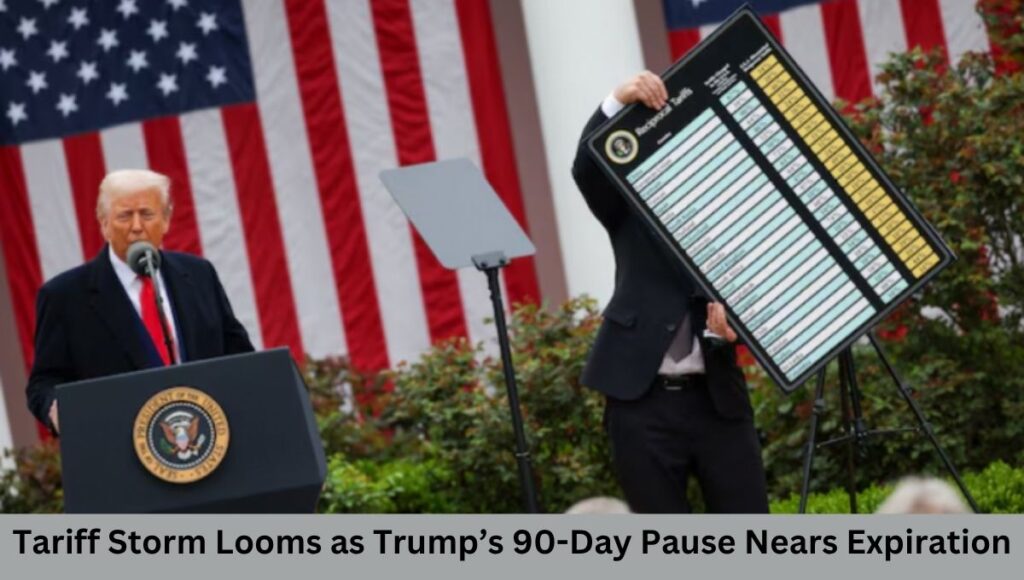
Tariff Storm Looms as Trump’s 90-Day Pause Nears Expiration
Trump Tariffs Recap: An Economic Offensive Resurfaces
Trump’s sweeping tariff initiative, announced in April, introduced import duties ranging from 11% to over 100%. While initially paused to ease stock market volatility, these tariffs are now poised for reinstatement unless rapid progress is made in trade talks.
The so-called “worst offenders,” according to the Trump administration, include China, the European Union, Vietnam, and South Africa. In a notable escalation, Trump recently doubled tariffs on steel and aluminum from 25% to 50% citing national security and the need to restore domestic manufacturing strength.
Legal Pushback: Court Blocks Emergency Tariffs For Now
A recent ruling by the U.S. Court of International Trade dealt a major blow to Trump’s tariff strategy. The court found that the president had overreached by using the 1977 International Emergency Economic Powers Act (IEEPA) to unilaterally impose tariffs without congressional approval.
However, the legal tide quickly shifted when a federal appeals court paused that decision, allowing tariffs to remain in place while litigation continues. Despite this uncertainty, the administration remains confident. “You can’t listen to silly people making silly comments,” Lutnick quipped, dismissing legal and international concerns alike.
Trump’s Trade Playbook: Section 232, 301, and More
Even if the courts eventually strike down the IEEPA-based tariffs, the Trump administration has no shortage of alternatives to keep tariffs alive. Officials are eyeing several legal pathways, each offering different levels of authority and duration.
- Section 122 of the Trade Act of 1974 allows short-term tariffs (up to 15% for 150 days) to address significant trade deficits. While previously dismissed due to time limits, it’s back on the table if courts strike down IEEPA tariffs.
- Section 232 of the Trade Expansion Act of 1962 enables tariffs on national security grounds. This was the legal foundation for Trump’s steel, aluminum, and auto tariffs and remains unaffected by the current legal battles.
- Section 301 of the Trade Act of 1974 allows action against nations engaging in unfair trade practices. Trump used this to hit Chinese and EU imports during his first term. Though slower to implement, it allows unlimited duration and tariff levels.
- Section 338 of the Tariff Act of 1930, though never used before, allows tariffs up to 50% on countries discriminating against the U.S. Use of this statute could trigger global backlash and WTO challenges.
With these tools in hand, officials believe they can sustain or even expand tariffs regardless of court decisions.
U.S.-China Trade Talks: Still on Ice
Despite a temporary truce in May that saw both the U.S. and China reduce reciprocal tariffs, a comprehensive trade deal remains elusive. U.S. Treasury Secretary Scott Bessent recently accused Beijing of withholding critical industrial goods, possibly as a pressure tactic.
No date has been set for a new conversation between President Trump and Chinese President Xi Jinping, adding to uncertainty. Without a breakthrough, more tariffs could be announced by mid-July.
Business Uncertainty and Economic Fallout
Trump’s tariff policy has triggered anxiety in the markets. While the recent court ruling offered a brief reprieve, the looming expiration of the tariff pause has once again rattled businesses and investors. Companies are rushing to import goods ahead of possible tariff hikes, while others are revisiting global supply chains to minimize exposure.
Economists at Capital Economics predict that repealing the IEEPA tariffs could boost U.S. growth to 2% in the second half of 2025, compared to the current 1.5% forecast. On the flip side, failure to resolve trade disputes could hinder recovery and worsen inflation for imported goods.
Refunds for paid IEEPA tariffs may be on the table if courts ultimately rule against the administration. However, the government is expected to delay any payouts until the Supreme Court delivers a final verdict.
Global Response and Diplomatic Fallout
America’s allies are watching closely. European leaders, in particular, are concerned about the July 9 deadline for the 50% tariff on EU goods. The EU has so far refused to make major concessions, but U.S. officials insist they are negotiating from a position of strength.
Lutnick, for his part, dismissed concerns over legal uncertainty impacting the talks. “The President’s just going to determine what rates people have if they can’t get a deal done,” he warned, framing Trump’s trade agenda as a hardball strategy that forces action from reluctant partners.
Supreme Court Showdown Awaits
Legal experts believe the final word on Trump tariffs may come from the U.S. Supreme Court. Multiple lawsuits including those from small businesses and state coalitions challenge the president’s use of emergency powers to levy trade taxes. The central argument: trade deficits and economic concerns do not constitute a “national emergency” under IEEPA.
Should the Supreme Court rule against Trump, the administration may pivot entirely to Section 232 and Section 301 tariffs both of which remain on solid legal footing.
Conclusion: A Trade Crossroads with Global Implications
As the 90-day tariff pause nears its expiration, Trump’s trade policy stands at a legal and diplomatic crossroads. Whether these tariffs persist or collapse under judicial scrutiny will shape not only America’s economic trajectory but also the stability of global trade.
For now, Trump’s message is clear: he’s not bluffing. Tariffs Section 232, Section 301, Section 122, and even Section 338 to make them stick. The next few weeks will be pivotal. With court rulings pending, trade negotiations underway, and the global economy holding its breath, the world is watching to see if the tariff storm becomes a full-blown hurricane.
Also Read: Trump’s 90-Day Tariff Pause Sparks Global Market Rebound,but China Hit with 125% Tariff
Also Read: Bessent floats extending tariff pause for countries in ‘good faith’ trade talks
Related Posts:
- What’s Next for Donald Trump After Court Rules His…
- Trump’s 2025 Gaza Peace Plan Signing and Historic…

- Trump to Host 2026 G20 Summit at His Florida Golf…
- Trump Targets Sri Lanka, BRICS with Sweeping Tariffs
- 7 Shocking Reasons FIFA’s Peace Prize for Trump…

- 9 Explosive Revelations as Trump Declares His Health…