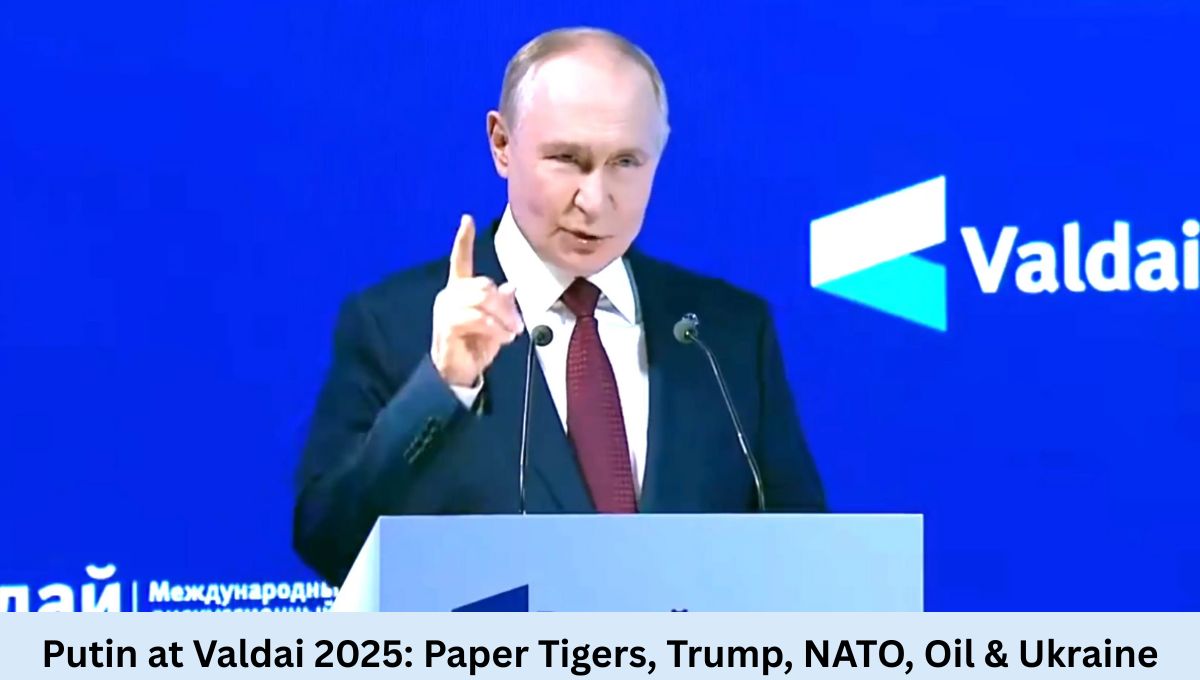
Putin at Valdai 2025: Paper Tigers, Trump, NATO, Oil & Ukraine, warns Europe against ‘War Hysteria’ and militarization. Russian President Vladimir Putin delivered a fiery speech on October 2, 2025, at the Valdai Discussion Club in the Black Sea resort city of Sochi, touching on a wide range of global issues — from NATO and the Ukraine war to Donald Trump, energy ties with India, and the West’s alleged “war hysteria.”
Speaking before Russian and international analysts, Putin blended defiance, mockery, and sharp warnings, insisting Russia was “confident” on the battlefield while accusing European leaders of manufacturing fear to justify militarisation. He also praised U.S. President Donald Trump’s willingness to “listen” and reiterated Moscow’s calls for a two-state solution in the Middle East. Below is a comprehensive account of Putin’s most striking remarks and their implications.

Putin at Valdai 2025: Paper Tigers, Trump, NATO, Oil & Ukraine
Putin on NATO and the “Paper Tiger”
One of Putin’s most talked-about lines was a direct response to Donald Trump’s description of Russia as a “paper tiger.”
“A paper tiger. What follows then? Go and deal with this paper tiger,” Putin said.
“Well, if we are fighting with the entire NATO bloc, we are moving, advancing, and we feel confident, and we are a ‘paper tiger,’ then what is NATO itself?”
The statement came after Trump, following his meeting with Ukrainian President Volodymyr Zelenskyy at the UN General Assembly, argued that Russia’s prolonged war in Ukraine made it appear weak. Trump claimed a “real military power” could have won the war in a week.
Putin, however, turned the remark on its head — suggesting that if Russia, allegedly isolated and outnumbered, is still advancing, then NATO’s strength must also be questionable.
Europe’s “War Hysteria” and Militarisation
Putin reserved some of his harshest words for European leaders, whom he accused of fueling “hysteria” about a Russian invasion of NATO.
“The ruling elites of united Europe continue to whip up hysteria. They repeat this nonsense, this mantra, over and over again … They can’t believe what they’re saying, that Russia is going to attack NATO? They’re either incredibly incompetent … or they’re simply dishonest.”
He mocked Western claims of an imminent Russian attack, saying they were “plucked out of thin air,” and accused Europe of using the Russia threat to justify military build-ups.
On Germany’s pledge to strengthen its armed forces, Putin warned:
“Germany, for example, says that the German army should be the most powerful in Europe. Good. We listen carefully, understanding what is meant. Russia’s countermeasures will not be long in coming. The response will be, to put it mildly, very convincing.”
This was a thinly veiled warning that Moscow would escalate its military posture in response to Europe’s rearmament.
Also Read: EU Unveils 19th Sanctions Package on Russia: LNG Ban, Banking Crackdown, and Trump Pressure
Russia’s Progress in Ukraine
Putin painted a picture of steady Russian advances on the battlefield, despite international reports of a stalemate.
“Our troops are confidently advancing along practically the entire line of contact,” he claimed.
“We control almost 100% of the Luhansk region. The enemy controls a little over 19% in the Donetsk region, and 24-25% in the Zaporizhzhia and Kherson regions, respectively. And everywhere, Russian troops confidently maintain the strategic initiative.”
He insisted NATO countries were directly fighting Russia, providing weapons, training, intelligence, and operational support to Kyiv.
“All NATO countries are fighting us, and they’re no longer hiding it. A centre was created in Europe that supports everything the Ukrainian armed forces do.”
The remarks underline Moscow’s narrative that the war is not just with Ukraine, but with the West as a whole.
On Trump, the U.S., and Restoring Relations
Despite Trump’s “paper tiger” remark, Putin spoke warmly of the U.S. president, contrasting him with European leaders.
“Trump is a person who can listen,” Putin said, recalling their August 2025 Alaska summit.
“We discussed practically nothing there, not even the bilateral agenda. We only discussed the possibilities and ways to resolve the Ukrainian crisis … albeit superficially.”
Putin praised Trump’s blunt style of diplomacy:
“The current White House administration states its interests and desires directly … and bluntly, but without any unnecessary hypocrisy. We see that the current U.S. administration is guided primarily by its own interests. I believe this is a rational approach. Russia also reserves the right to be guided by its national interests.”
He reiterated Russia’s desire to restore full-fledged relations with Washington, even as ties remain at their “lowest point in memory.”
Putin on Trump’s Gaza Plan
Putin also addressed Trump’s latest push for Middle East peace.
“In general, Russia is prepared to support it. Provided, of course, it leads to the ultimate goal we have always discussed. Russia has always advocated the creation of two states – both Israel and a Palestinian state. And this, in my view, is the key to a final solution to the Palestinian-Israeli conflict.”
Moscow has long positioned itself as a supporter of Palestinian statehood, even as it maintains ties with Israel. Putin’s comments signal cautious endorsement of Trump’s plan — so long as it aligns with Russia’s two-state principle.
Also Read: Gaza peace plan: Arab, Muslim leaders pushing Hamas to accept Trump’s deal as deadline looms
India, Oil, and Energy Security
Energy trade featured prominently in Putin’s remarks, particularly India’s role as a major buyer of Russian oil.
“If India refuses our energy supplies, it will suffer a certain loss … of course, the people of a country like India will never allow humiliation. And I know Prime Minister Modi; he would never take such steps.”
Putin estimated potential Indian losses at $9–10 billion if New Delhi halted purchases under Western pressure. He suggested that Washington’s calls for India to renounce Russian energy would not succeed.
He also touched on uranium exports to the United States, noting:
“The United States is one of the largest, if not the largest, state using nuclear power plants. Russia is the second-largest supplier of uranium to the American market.”
This underscores the paradox of U.S.-Russia relations: while clashing over Ukraine, they remain intertwined in critical energy trade.
Nuclear Warnings and the Zaporizhzhia Plant
On Ukraine’s alleged strikes near the Zaporizhzhia nuclear power plant, Putin issued a chilling warning.
“This is a dangerous game. They still have functional nuclear power plants on their side. What prevents us from responding in kind? Let them think about this.”
He dismissed accusations that Russia was shelling a plant it already controlled, calling the claims “idiotic.” While saying the situation was “under control,” Putin warned Ukraine and its allies not to underestimate Moscow’s capacity to retaliate.
On French Seizure of Russian Oil Tanker
Putin condemned France’s seizure of a Russian tanker in international waters, calling it “piracy.”
“A tanker was seized without any justification. They were apparently looking for some kind of cargo, maybe drones, or military equipment. None of that was there, nor could it be.”
The remark reflects Moscow’s growing frustration with Western maritime enforcement of sanctions.
Gratitude to BRICS and Non-Western Allies
Despite his combative rhetoric, Putin expressed appreciation for countries backing Russia diplomatically.
“We are grateful to all the countries that have made sincere efforts to find a way out of this situation in recent years. These include BRICS members, Belarus, North Korea, the UAE, and many others.”
He insisted the West could not dictate global affairs:
“There is no and will be no power in the world that will dictate to everyone what to do. Every power has its limit.”
This aligns with Moscow’s strategy of deepening ties with BRICS and Global South nations to counter Western isolation.
Putin’s Broader Message
Throughout the Valdai speech, several themes emerged:
- Defiance toward NATO and Europe – Putin rejected the idea of Russia being weak, ridiculed NATO fears, and warned of “convincing” countermeasures.
- Confidence in Ukraine war – He portrayed Russia as advancing on multiple fronts while accusing NATO of being fully engaged in combat against Moscow.
- Openness to Trump – Despite insults, Putin views Trump as pragmatic and potentially a partner in resolving conflicts.
- Energy leverage – From India’s oil purchases to uranium exports to the U.S., energy remains a key Russian bargaining chip.
- Nuclear brinkmanship – By raising the specter of retaliating against Ukrainian nuclear plants, Putin reminded the world of Russia’s escalation options.
- Alternative alliances – Gratitude to BRICS nations and criticism of Western “hysteria” reinforce Russia’s pivot away from the West.
What’s Next? Putin’s India Visit
The Kremlin confirmed that Putin will travel to India in December 2025 for the annual summit with Prime Minister Narendra Modi — his first visit since 2021.
The summit will review bilateral ties spanning energy, defense, trade, and geopolitics. With India under pressure from Washington to reduce energy dependence on Moscow, the meeting could prove pivotal.
Conclusion
Vladimir Putin’s 2025 Valdai Discussion Club appearance was a blend of bravado, warnings, and selective outreach. While mocking NATO and accusing Europe of “war hysteria,” he also praised Donald Trump and expressed readiness for dialogue with Washington.
His remarks highlight Moscow’s twin strategy: projecting strength and defiance toward the West, while deepening partnerships with non-Western powers like India, China, and BRICS. Whether this approach can ease Russia’s isolation — or further cement its rift with Europe and NATO — remains to be seen.