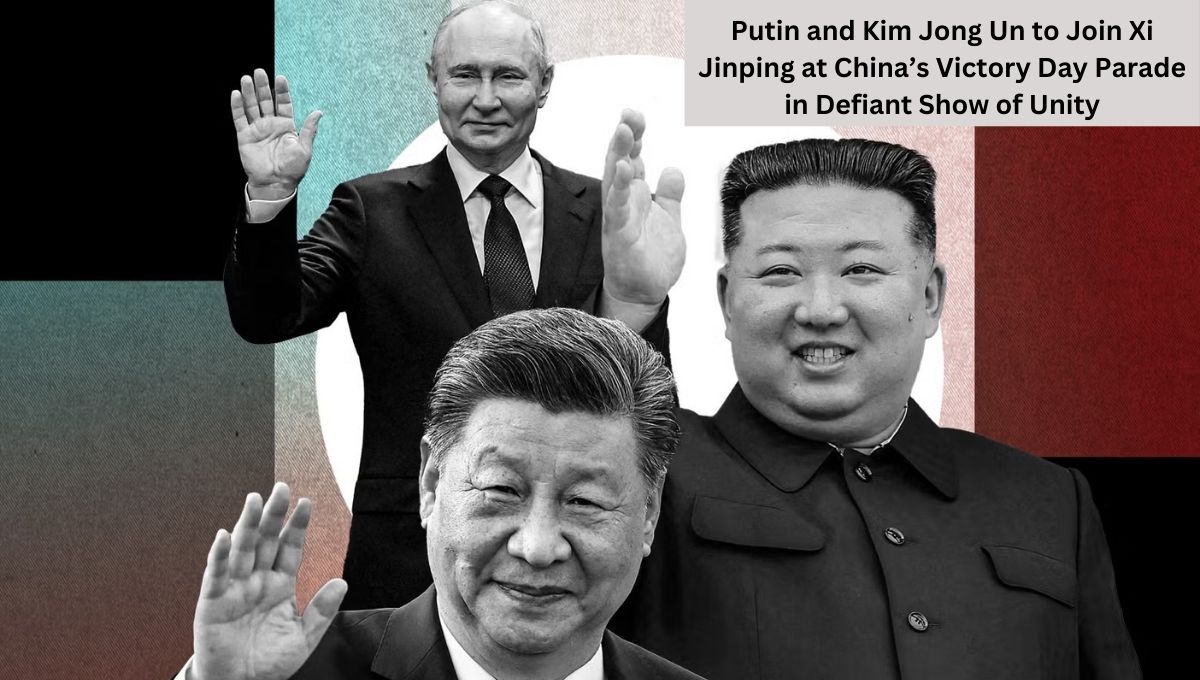
Along with 26 foreign leaders, Putin and Kim Jong Un to Join Xi Jinping at China’s Victory Day Parade in Defiant Show of Unity. Putin and Kim Jong Un to Join Xi Jinping at China’s Victory Day Parade in Defiant Show of Unity. Beijing is preparing for one of its most high-profile military parades in decades, and the stage is set for a moment of extraordinary geopolitical symbolism.
On September 3, 2025, Chinese President Xi Jinping will stand at the historic Tiananmen Square flanked by Russian President Vladimir Putin and North Korean leader Kim Jong Un, in what analysts are calling a defiant show of unity against mounting Western pressure.
The event, marking the 80th anniversary of Japan’s surrender in World War II, is officially being held to commemorate China’s role in ending the war. But the carefully choreographed gathering is about much more than history. It is about power, influence, and a shifting global order.

Putin and Kim Jong Un to Join Xi Jinping at China’s Victory Day Parade in Defiant Show of Unity
The Parade: A Showcase of Military Might
China’s “Victory Day” parade is expected to be one of the largest and most elaborate military spectacles the country has organized in recent years.
According to Assistant Foreign Minister Hong Lei, more than 10,000 troops, 100 aircraft, and hundreds of advanced ground weapons will be on display.
The parade will highlight China’s modernized People’s Liberation Army (PLA), including:
- Hypersonic missiles capable of evading Western defense systems.
- Cutting-edge drones and electronic warfare systems.
- Advanced air-defense and missile-defense systems.
- Strategic long-range missiles designed to demonstrate deterrence capabilities.
Xi Jinping, who has made the modernization of the PLA a cornerstone of his leadership, will personally oversee the parade alongside foreign dignitaries.
“China will use this occasion not just to honor history, but also to send a message to the world about its growing power and global role,” Hong Lei told reporters.
A Guest List That Excludes the West
A total of 26 foreign heads of state and government are confirmed to attend, but not a single major Western leader will be present.
The sole exception is Robert Fico, Slovakia’s Prime Minister, representing the European Union in a move that has raised eyebrows in Brussels.
Among the notable attendees:
- Belarus President Aleksandr Lukashenko
- Iranian President Masoud Pezashkian
- Indonesian President Prabowo Subianto
- Serbian President Aleksandar Vučić
- South Korea’s National Assembly Speaker Woo Won-shik
- Pakistan’s Prime Minister Shehbaz Sharif
- Myanmar junta chief Min Aung Hlaing
Notably absent is Indian Prime Minister Narendra Modi, who will be in China for a Shanghai Cooperation Organization (SCO) summit in Tianjin that same week but will skip the parade.
The United Nations will be represented by Under-Secretary-General Li Junhua, a Chinese diplomat who previously served in Italy, San Marino, and Myanmar.
Putin, Kim, and Xi: A Historic Photo-Op
The presence of Putin and Kim Jong Un alongside Xi Jinping promises an iconic image of defiance to Western capitals.
For Putin, this will be his first major public appearance in Beijing since 2024. Russia remains battered by sanctions imposed after its 2022 invasion of Ukraine, and Moscow’s economy is under increasing strain.
Despite being wanted by the International Criminal Court (ICC), Putin continues to rely on China as a strategic partner and lifeline.
For Kim Jong Un, this marks his first trip to China since 2019. North Korea has faced crushing UN sanctions since 2006 over its nuclear weapons program, but it has found new support through its growing military alliance with Russia.
The Beijing trip offers Kim an invaluable opportunity for international legitimacy and renewed access to Chinese economic support.
And for Xi Jinping, the ability to bring both Putin and Kim to Beijing at the same time is being seen as a diplomatic victory.
“This is Xi showing the world he holds the cards,” one analyst noted. “He is presenting China as the convener of alternative global power, a counterweight to Western alliances.”
Why This Parade Matters
1. A Geopolitical Signal to Washington and Europe
The absence of Western leaders is not accidental. By gathering leaders from the Global South alongside Moscow and Pyongyang, Beijing is presenting itself as the center of a new world order — one that rejects Western dominance.
2. China’s Leverage in U.S. Trade Talks
With a possible Xi–Trump summit looming in October, the timing is critical. The White House has signaled openness to meeting Xi to discuss tariffs, trade disputes, and the TikTok controversy. By hosting Putin and Kim in advance, Xi is strengthening his hand.
3. North Korea’s Dependence on China
Despite growing ties with Russia, North Korea still depends on China for survival. Nearly 90% of North Korea’s imports come from China, making this relationship indispensable. Kim’s appearance in Beijing underscores the importance of reaffirming that alliance.
4. Russia’s Strategic Need for China
As Western sanctions continue to cripple its economy, Russia increasingly relies on Chinese markets for energy exports and dual-use technology that supports its war effort in Ukraine.
Trump, Xi, and the Shadow of Diplomacy
Former U.S. President Donald Trump has expressed renewed interest in meeting Kim Jong Un.
During a recent meeting with South Korea’s President Lee Jae Myung, Trump hinted at a possible return to the Korean Demilitarized Zone (DMZ) for talks.
Trump’s earlier summits with Kim, though high-profile, failed to produce concrete results. Now, as he eyes another diplomatic overture, Xi Jinping’s role has become more central.
Beijing has historically acted as a bridge between Washington and Pyongyang. By hosting Kim before Trump makes his next move, Xi positions himself as the indispensable mediator.
China’s Balancing Act on Ukraine
Officially, China maintains a neutral stance on the war in Ukraine, urging a “peaceful solution.” However, Western governments accuse Beijing of quietly supporting Russia with components and technology used in the battlefield.
The parade comes just months after Moscow and Pyongyang signed a defense pact pledging immediate military support for each other if attacked. This raised alarm across Washington, Seoul, and Tokyo.
Beijing has been cautious not to openly endorse this Moscow–Pyongyang axis, but by hosting both leaders, Xi is signaling tacit support without committing China directly to their military agendas.
Historical Context: Why September 3 Matters
The date of the parade September 3 is symbolic. It marks the day in 1945 when Japan formally surrendered to the Allies, ending its brutal occupation of parts of China.
For Beijing, the anniversary is not only about remembering the devastation of World War II but also about asserting its role as a victorious power that helped shape the postwar order.
The spectacle at Tiananmen Square ties China’s past struggles with its present ambitions: a narrative of resistance, victory, and resurgence.
A Shift Toward an Alternative Global Order?
The alignment of China, Russia, and North Korea at this parade is more than symbolic. It reflects a growing coalition of states resisting U.S.-led hegemony.
This “axis of resistance” is bolstered by other attendees like Iran, Belarus, and Myanmar countries either sanctioned by the West or aligned against it.
“We are witnessing the crystallization of a parallel world order,” said one Beijing-based political analyst. “It may not replace the Western system, but it is an alternative that appeals to leaders feeling isolated or pressured by Washington.”
Conclusion: A Parade with Global Ripples
On September 3, the world will watch as Xi Jinping, Vladimir Putin, and Kim Jong Un stand together on the Gate of Heavenly Peace. The parade will be a carefully staged performance, projecting strength, defiance, and unity.
For Beijing, it is about demonstrating that it can bring pariah leaders into the international fold. For Moscow and Pyongyang, it is about showing they are not alone. And for Washington, Brussels, and Tokyo, it is a reminder that the geopolitical chessboard is shifting.
Whether this event becomes a turning point in global politics or just another symbolic show remains to be seen. But what is certain is that the Beijing parade of 2025 will be remembered as a moment when history, power, and ambition converged.