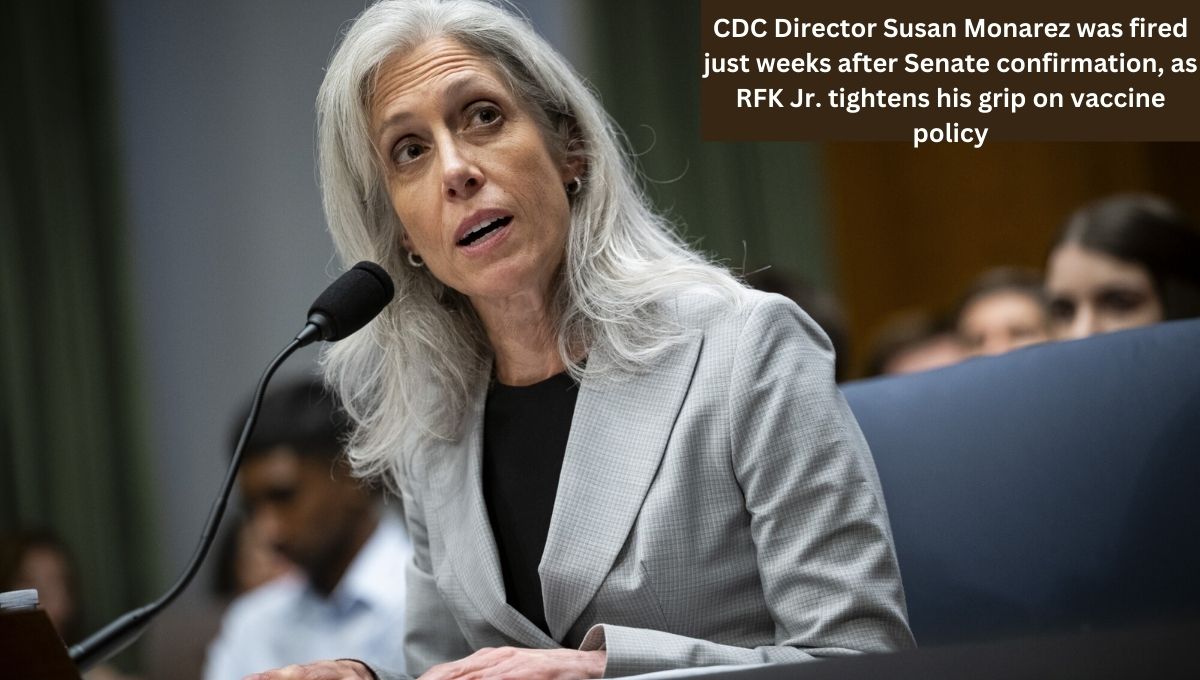
Amid a public health crisis, CDC Director Susan Monarez was fired just weeks after Senate confirmation, as RFK Jr. tightens his grip on vaccine policy. The Centers for Disease Control and Prevention (CDC), once the gold standard of public health leadership, has been thrown into unprecedented turmoil.
Thank you for reading this post, don't forget to subscribe!Just weeks after taking office as the first Senate-confirmed CDC Director, Dr. Susan Monarez has been fired in a move orchestrated by the White House and Health and Human Services (HHS) Secretary Robert F. Kennedy Jr. Her ouster has sparked a mass exodus of senior CDC leaders, escalating concerns that America’s public health system is being politicized at a time of rising disease threats and fragile public trust in vaccines.
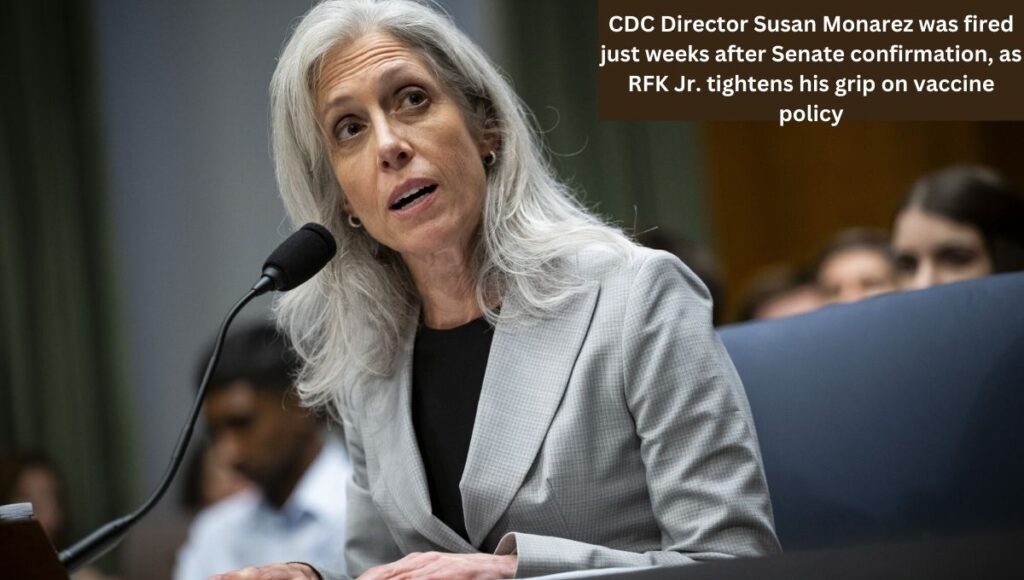
CDC Director Susan Monarez was fired just weeks after Senate confirmation, as RFK Jr. tightens his grip on vaccine policy
A Historic Yet Short-Lived Tenure
Dr. Susan Monarez, 50, was confirmed by the Senate on July 31, 2025, under a new law requiring oversight of CDC leadership.
She brought with her a strong record as deputy director at ARPA-H (Advanced Research Projects Agency for Health), where she spearheaded bold biomedical research initiatives.
Monarez was widely viewed as a science-first leader, stepping into the role after Trump’s controversial first nominee, former Congressman Dave Weldon, faced backlash for his vaccine skepticism.
During her Senate confirmation, Monarez defended the importance of vaccines, calling them “lifesaving tools,” while carefully sidestepping clashes with RFK Jr., a well-known vaccine critic and now HHS Secretary.
But her tenure quickly became the shortest in CDC history.
The Shocking Announcement
On August 27, HHS released a blunt statement:
“Susan Monarez is no longer director of the Centers for Disease Control and Prevention. We thank her for her dedicated service to the American people.”
The White House later clarified that Monarez was fired because she was “not aligned with the President’s agenda.” Officials claimed she refused to resign voluntarily despite “policy differences.”
Monarez’s attorneys, Mark S. Zaid and Abbe David Lowell, disputed the narrative, insisting she had neither resigned nor been properly terminated.
They accused Kennedy of “weaponizing public health for political gain” and punishing Monarez for rejecting “reckless, unscientific directives.”
A Wave of CDC Resignations
Monarez’s ouster triggered an unprecedented exodus of top CDC officials, including:
- Dr. Debra Houry – Chief Medical Officer & Deputy Director
- Dr. Daniel Jernigan – Head of Emerging and Zoonotic Infectious Diseases
- Dr. Demetre Daskalakis – Director of Immunization and Respiratory Diseases
- Dr. Jennifer Layden – Director of Public Health Data & Surveillance
Resignation letters obtained by reporters revealed deep concern over misinformation, politicization of science, and vaccine rollbacks.
- Dr. Houry warned of “the deadly rise of misinformation” as measles cases hit a 30-year high.
- Dr. Daskalakis wrote that he could “no longer serve because of the ongoing weaponization of public health.”
The mass resignations amount to a decapitation of the CDC’s leadership, stripping the agency of its most experienced experts at a critical moment.
A Tumultuous Month: Shooting, Layoffs, and Vaccine Rollbacks
The chaos at the CDC goes beyond Monarez’s firing.
Atlanta CDC Shooting Attack
On August 8, a gunman fired more than 180 rounds into the CDC headquarters in Atlanta, killing a police officer before dying by suicide. He left behind claims that the COVID-19 vaccine had harmed him. Though no CDC employees were killed, the attack traumatized staff and highlighted the growing hostility toward public health institutions.
Massive Layoffs
Earlier this summer, HHS announced 2,400 CDC staff layoffs, later partially reversed by re-hiring about 700.
Divisions handling infectious diseases, environmental threats, and public health data were gutted. Union leaders said staff faced “mistreatment, neglect, and vilification.”
Vaccine Policy Overhaul
Perhaps the most controversial change was Kennedy’s dismantling of the CDC’s vaccine advisory panel (ACIP), replacing independent experts with political appointees.
- COVID-19 vaccines for children and pregnant women were withdrawn.
- Eligibility was restricted to seniors and vulnerable adults.
- The FDA also narrowed approval for updated COVID shots, excluding most younger Americans.
Experts warn these moves could cause preventable outbreaks of measles, polio, and other diseases.
Conflicting Narratives: Fired or Forced Out?
The White House insists Monarez was fired for being “out of step with the President’s health agenda.”
But her lawyers argue she was targeted for refusing to compromise scientific integrity.
“First it was advisory committees. Then it was career scientists. Now it’s Susan Monarez. She will not resign and will not rubber-stamp dangerous policies.” Attorneys for Susan Monarez
This dispute underscores a wider battle between politics and science inside the CDC.
RFK Jr.’s Growing Control of Public Health
RFK Jr.’s appointment as HHS Secretary was controversial from the start. Known for questioning vaccines, he has now gained unprecedented power to reshape U.S. health policy.
Kennedy argues he is not “anti-vaccine,” but continues to suggest links between vaccines and autism a claim disproven by decades of scientific studies.
Under his leadership:
- 22 federally funded mRNA vaccine projects were terminated.
- U.S. support for global health programs has been slashed.
- He promised new autism research, reviving long-debunked theories about vaccines.
At a recent Cabinet meeting, Kennedy claimed “certain interventions are almost certainly causing autism,” a statement echoed by Trump.
The Collapse of Public Health Leadership
Experts warn the U.S. public health system is unraveling:
- Resignations have stripped the CDC of key expertise.
- Morale among remaining staff is at an all-time low.
- Vaccine confidence is eroding as policies narrow access.
- Global partners are questioning America’s commitment to evidence-based health leadership.
Dr. Fiona Havers, a former CDC official, described the agency’s state as “devastating,” saying the exodus of leaders has removed a critical buffer between politicians and scientists.
The Road Ahead: Who Will Lead the CDC?
The White House has not yet named an interim CDC director. Speculation is mounting over whether Trump and Kennedy will appoint a political ally who aligns with their vaccine views or attempt to restore credibility with a respected scientist.
Meanwhile, as respiratory virus season approaches, America faces a dangerous vacuum in public health leadership.
Experts fear that without strong, science-based direction, the country is unprepared for outbreaks, pandemics, or bioterror threats.
Conclusion: Politics vs. Science
The firing of Susan Monarez after just weeks in office represents more than a personnel shake-up. It symbolizes a historic turning point for America’s public health system one where political agendas risk overtaking scientific evidence.
With RFK Jr. consolidating control and Trump supporting his agenda, the CDC faces its greatest crisis of credibility in its 79-year history. Whether science or politics guides public health decisions in the coming years will determine not just the future of the CDC, but the health and safety of millions of Americans.
Also Read: RFK Jr. Fires Entire CDC Vaccine Panel, Sparking Public Health Uproar
Also Read: US health agency leadership turmoil gives Robert Kennedy the upper hand
Related Posts:
- RFK Jr. Fires Entire CDC Vaccine Panel, Sparking…
- CDC Atlanta Shooting: Officer Killed, Vaccine Motive…

- 11 Powerful Shifts in New US Dietary Guidelines That…

- 7 Heartbreaking Facts About Venezuela's Earthquake Disaster

- 7 Shocking Facts About Trump’s $1 Million Gold Card…

- 7 Powerful Shifts: Venezuela to Supply Up to 1,000…