In a battle between guns and growth, Pakistan Slashes Budgets for Health, Environment Amid 20% Hike in Defence Spending Post-India Clash. In a move that underscores its shifting priorities in the aftermath of the May conflict with India, Pakistan has unveiled its federal budget for the fiscal year 2025-26, announcing a massive 20% increase in defence spending while cutting funds for critical public sectors like health and environment.
The budget, presented in the National Assembly by Finance Minister Muhammad Aurangzeb on Tuesday, reveals an allocation of 2.55 trillion Pakistani rupees ($9 billion) to the country’s defence sector marking the steepest rise in over a decade. This hike in the Pakistan defence budget 2025 comes even as the government slashes overall spending by 7%, from 18.9 trillion rupees to 17.57 trillion rupees, in a bid to meet fiscal discipline mandated by the International Monetary Fund (IMF).
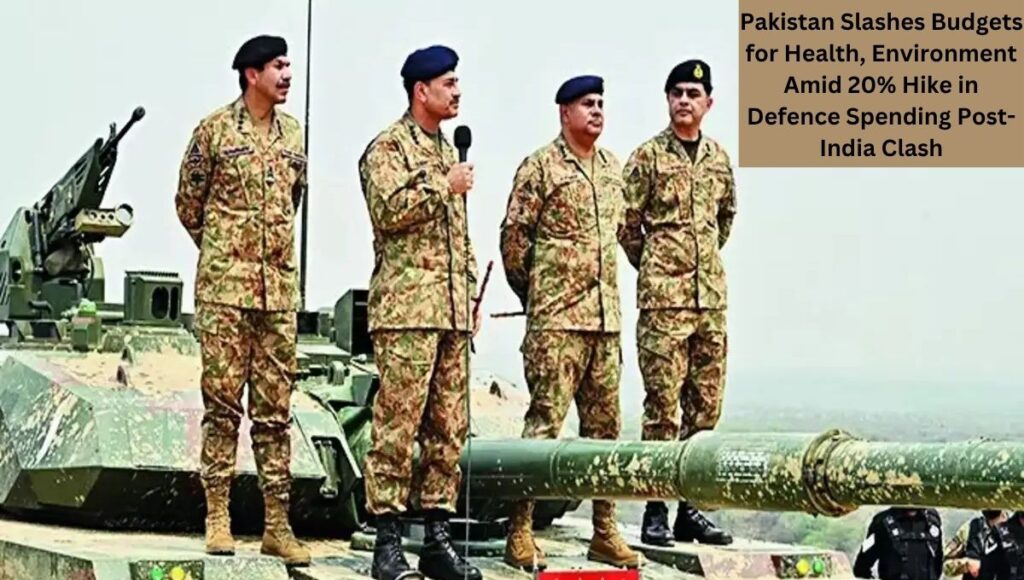
Pakistan Slashes Budgets for Health, Environment Amid 20% Hike in Defence Spending Post-India Clash
Post-Conflict Priorities: Defence Over Development
The record 20% increase in military spending follows a brief but intense military skirmish with India in May, triggered by a deadly terrorist attack in Pahalgam, Indian-administered Kashmir.
India retaliated with precision strikes on terror infrastructure in Pakistan and Pakistan-occupied Kashmir, leading to four days of cross-border hostilities that ended with a ceasefire on May 10.
The Shehbaz Sharif government defended the sharp rise in defence allocations, with Aurangzeb stating that Pakistan’s “security situation remains precarious,” requiring increased military readiness.
Of the total defence outlay, 45% has been earmarked for the Pakistan Army, while the Air Force and ISI receive about 20% each. This spending reportedly includes operational readiness and infrastructure repairs following India’s Operation Sindoor that targeted several Pakistani air bases.
Health and Environment Budgets Slashed
While the military receives a substantial boost, Pakistan’s environment and health sectors have suffered dramatic cuts, drawing criticism from both domestic and international observers.
The environment protection budget has been slashed from 7.2 billion PKR to 3.1 billion PKR, a staggering decline in a country where cities like Lahore are regularly ranked among the most polluted globally.
The health sector has also seen a significant reduction from 52.1 billion PKR last year to just 31.9 billion PKR in the new budget.
These cuts raise serious concerns about Pakistan’s commitment to public welfare, especially amid rising air pollution, the risk of new disease outbreaks, and a fragile healthcare system still reeling from the COVID-19 pandemic.
Ballooning Debt and IMF Pressure
Behind this budget lies the backdrop of an economic crisis that has pushed Pakistan to the brink of default in recent years. Public debt now stands at 76,007 billion PKR, nearly doubling in just four years, with debt servicing alone consuming 8.2 trillion PKR, the largest component of national expenditure.
Just two years ago, inflation touched a record 38.5%, and the country’s foreign reserves dipped below $4 billion, barely enough to cover a few weeks of imports.
It was only a $3 billion IMF bailout alongside loan rollovers from Saudi Arabia, China, and the UAE—that helped Pakistan avert default in 2023.
To keep IMF support, Pakistan has now committed to a 3.9% fiscal deficit target and primary surplus, requiring not only cuts to spending but also higher taxes, with the Federal Board of Revenue’s collection target now set at 14.1 trillion PKR, up nearly 9% from last year.
An Economy in Recovery, But Far Behind Peers
While Pakistan’s government claims economic stability, projecting 4.2% GDP growth in 2025-26, the country still lags behind its South Asian neighbors.
The Asian Development Bank expects regional growth to average 6%, while Pakistan managed just 2.7% in the outgoing fiscal year.
Despite recent interest rate cuts by the central bank and a forecasted inflation drop to 7.5%, experts caution that fiscal reforms alone may not spur growth. Investment remains sluggish, weighed down by IMF-mandated austerity and policy uncertainty.
National Security vs. Human Security
The increased Pakistan military spending has sparked a national debate on whether the country is prioritizing the right sectors during a time of economic fragility. Critics argue that a defence-heavy budget, when public health and environmental sustainability are at stake, reveals a dangerous imbalance.
“The choice between guns and butter is a false one,” says an Islamabad-based economist. “But when you cut food, health, and clean air to buy more weapons, the long-term cost to the nation is much higher.”
In parliament, the defence allocation was met with broad political support, but opposition lawmakers have slammed the lack of transparency, as the budget provides no detailed breakdown of how the defence money will be spent a long-standing tradition in Pakistan’s budgeting process.
Conclusion: Strategic Stability or Socioeconomic Instability?
As tensions with India remain high and the memory of recent skirmishes fresh, Pakistan’s 2025 budget clearly prioritizes military preparedness over social investment. Whether this will deliver security in the true sense or deepen the country’s economic and social vulnerabilities remains to be seen.
In the words of one political commentator, “A stronger military can defend borders, but only a stronger society can ensure peace from within.”
Also Read: Rising Tensions Between India and Pakistan: Strikes, Denials, and Escalation in Kashmir
Also Read: Pakistan’s budget reflects a State under the military
Related Posts:
- 9 Strategic Moves as US Pushes Powerful Locomotive…

- Afghanistan–Pakistan War 2025: Inside the 48-Hour Ceasefire

- 5 Major Takeaways from the US Supreme Court's…

- 5 Key Shifts in Bangladesh–Pakistan Relations as…

- In 8 Moves, EU Targets China-Linked Refineries and…

- 7 Heartbreaking Facts About Venezuela's Earthquake Disaster