Taking a cautious stance, Japan Holds Back on Recognizing Palestinian State Amid US Pressure and Ties with Israel. Japan has decided not to recognise a Palestinian state at the upcoming United Nations General Assembly, according to reports by the Asahi Shimbun. The move reflects Tokyo’s desire to safeguard relations with the United States and avoid straining its delicate ties with Israel.
The decision comes as momentum builds globally, with governments in Britain, France, Canada, Australia, Belgium, and Luxembourg recently announcing recognition of a Palestinian state. These efforts, timed around the UN General Assembly session, have heightened diplomatic pressure on Israel as its military launched a major ground assault on Gaza City this week.
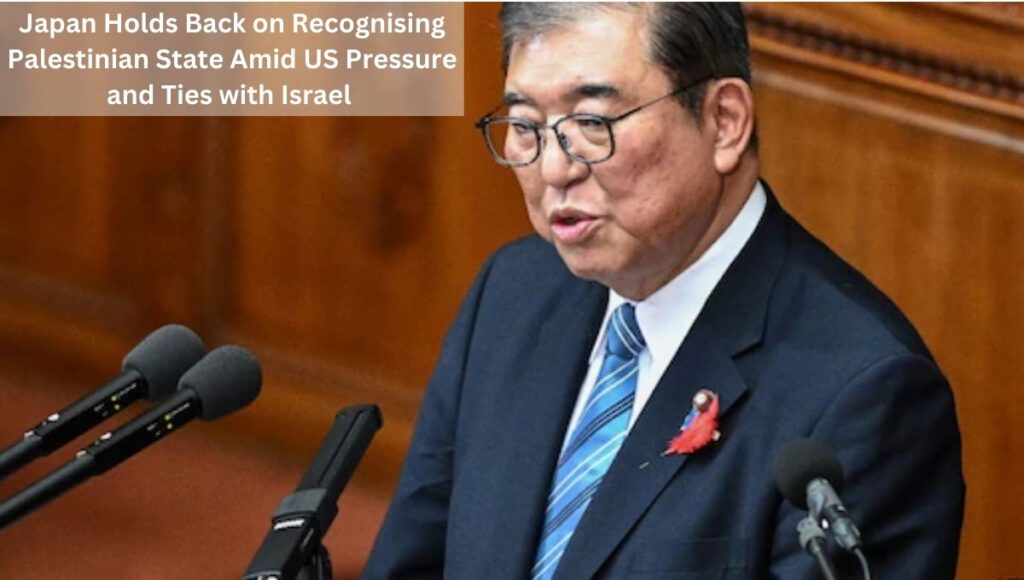
Japan Holds Back on Recognising Palestinian State Amid US Pressure and Ties with Israel
US Pressure and Diplomatic Balancing
According to Japan’s Kyodo news agency, Washington has urged Tokyo through multiple diplomatic channels to refrain from recognising Palestinian statehood at this stage.
In contrast, French Foreign Minister Jean-Noel Barrot pressed Japan to move forward with recognition, aligning with a European-led push for Palestinian statehood.
Balancing these conflicting pressures, Japanese Foreign Minister Takeshi Iwaya told reporters on Tuesday that Tokyo was conducting a “comprehensive assessment, including appropriate timing and modalities, of the issue of recognising Palestinian statehood.”
Chief Cabinet Secretary Yoshimasa Hayashi added that the situation in Gaza remained critical, further complicating Japan’s decision-making.
Japan Skips UN Meeting on Palestinian Statehood
Japanese Prime Minister Shigeru Ishiba is expected to skip a September 22 UN meeting in New York that will focus on advancing the two-state solution.
This signals Japan’s cautious stance, in contrast to nations like France and Britain pushing for immediate recognition. Within the G7 group of advanced economies, countries such as Germany and Italy have also called Palestinian recognition at this stage “counterproductive.”
Japan Supports Two-State Path, But Not Recognition Yet
While Tokyo has not taken the step of full recognition, it did join 142 countries at the UN last Friday in voting for a declaration calling for “tangible, timebound, and irreversible steps” toward a two-state solution.
Notably, India also voted in favour of the declaration, despite maintaining close ties with Israel.
Foreign Minister Iwaya emphasised that recognition alone would not resolve the conflict. He pointed to the challenge of governance in Palestinian territories, particularly the role of Hamas, which Israel regards as a terrorist organisation.
“Recognition requires a governing structure able to control all Palestinian territories,” Iwaya said, suggesting Japan sees political stability as a prerequisite for formal recognition.
Japan’s Middle East Diplomacy
Resource-dependent Japan imports the majority of its crude oil from the Middle East, making regional stability a critical foreign policy priority.
Historically, Tokyo has sought to balance its diplomacy between Arab states and Israel, avoiding actions that could jeopardise its strategic energy interests.
The current crisis, with Gaza under sustained Israeli military operations, places Japan in a difficult position.
Recognising a Palestinian state would align Japan with much of the international community, but risk alienating Washington, its most important security partner, and Israel, a key technological and diplomatic ally.
Global Momentum vs. Caution in Tokyo
Countries pushing for Palestinian recognition argue that it would advance the two-state solution and increase pressure on Israel to halt its military campaign in Gaza.
Supporters say recognition is a necessary step to ensure Palestinian political rights and to revive a stalled peace process.
However, critics—echoed in Japan’s position—argue that premature recognition could harden Israel’s stance and fail to address core security and governance issues.
Germany, despite voting for the UN declaration, stated it does not see recognition as appropriate at this time. Japan appears to be aligning with this cautious approach within the G7.
Outlook: Japan’s Careful Wait-and-See Strategy
As the Gaza crisis escalates and more nations recognise Palestinian statehood, Japan will face increasing scrutiny over its reluctance.
For now, Tokyo seems committed to incremental diplomacy—backing UN resolutions that affirm the two-state principle while delaying recognition until conditions appear more favourable.
Foreign Minister Iwaya summed up Tokyo’s stance:
“Recognition alone would not resolve all issues. The matter is under comprehensive consideration.”
Japan’s position reflects a balancing act between global pressure, US influence, and regional stability—a careful approach that underscores the complexities of Middle East diplomacy in a volatile moment.
Also Read: Japanese lawmakers urge government to recognize Palestine
Also Read: Pro-Palestine Protests Erupt in Italy After Meloni Rejects Statehood
Related Posts:
- Belgium to Recognise Palestine at UN General…

- 5 Major Takeaways from the US Supreme Court's…

- France Formally Recognises Palestine, Joins Wave of…

- 3 Explosive Conditions Iran Sets to End War with US…

- 7 Powerful Facts About Ayatollah Ali Khamenei’s…

- 7 Heartbreaking Facts About Venezuela's Earthquake Disaster