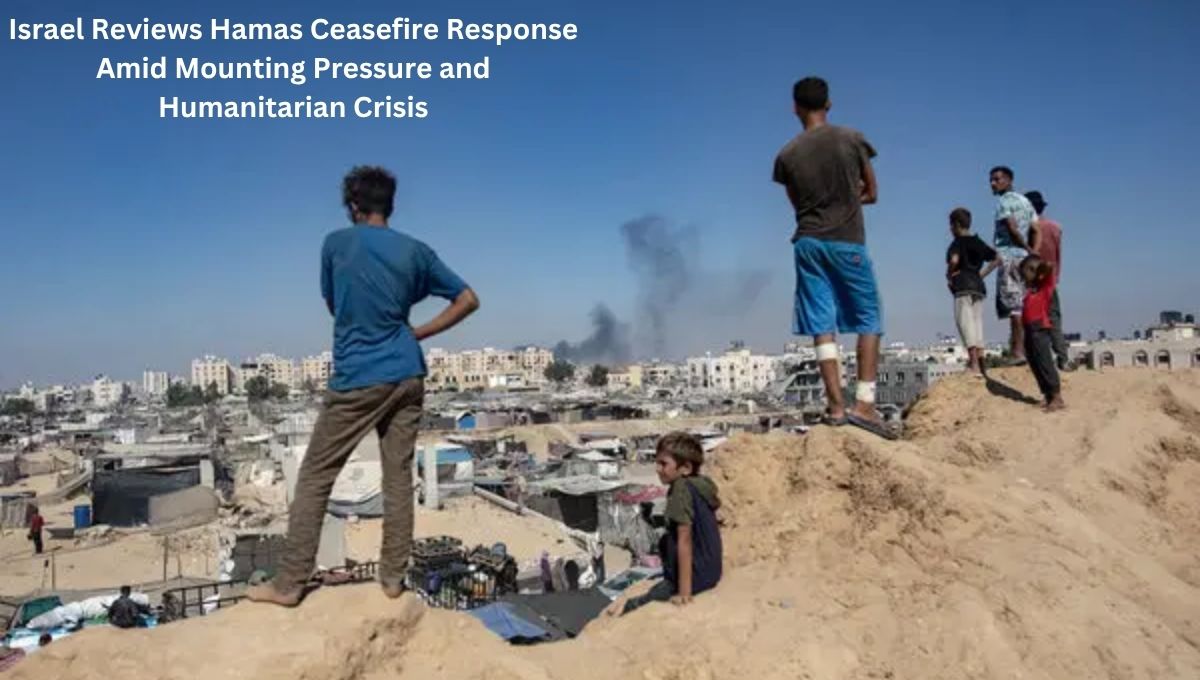
Regarding a proposed ceasefire in Gaza, Israel Reviews Hamas Ceasefire Response Amid Mounting Pressure and Humanitarian Crisis. Israel is reviewing a new response from Hamas regarding a proposed ceasefire in Gaza, as international mediators push both sides toward a truce and growing humanitarian concerns add urgency to the negotiations. While officials note the response is “better than the last,” significant gaps remain, and key players including the United States, Qatar, and Egypt are applying mounting pressure on Hamas to finalize an agreement.
Israel Reviews Hamas Ceasefire Response Amid Mounting Pressure and Humanitarian Crisis
Ceasefire Proposal Under Scrutiny by Israeli Officials
The Office of Israeli Prime Minister Benjamin Netanyahu confirmed Thursday that it had received Hamas’s latest response via international mediators.
Strategic discussions are underway within the Israeli government to determine whether the changes presented by Hamas could form the basis of a viable deal.
An Israeli official speaking to The Jerusalem Post stated that while Hamas’s new stance is “better than the last,” it is still not clear whether it allows real progress. Consultations are expected to continue throughout the day.
This follows a week of intense diplomatic exchanges, as Hamas initially delayed its response and reportedly backtracked on key provisions of the proposal that had previously been agreed upon.
Mediators Reject Hamas’s First Attempt, Demand Seriousness
Earlier in the week, mediators from Qatar and Egypt, meeting with Hamas leaders in Doha, refused to pass along the group’s response to Israel.
According to sources quoted by The Jerusalem Post, the mediators told Hamas bluntly: “This is not a serious response. Go back and draft a new one.”
According to those familiar with the meeting, Hamas had reversed positions on multiple settled points including humanitarian aid distribution, Israeli troop deployment during the proposed 60-day ceasefire, and the number of Palestinian prisoners to be released in exchange for hostages.
Hamas reportedly insisted that all humanitarian aid be routed exclusively through the United Nations, a demand that had not been part of the original framework.
Trump Administration Applies Pressure Through Regional Allies
The Trump administration is playing a direct role in the talks by urging Qatar and Egypt to press Hamas into aligning with Israel’s expectations.
According to US envoy Bishara Bahbah, Hamas’s delays are costing lives daily.
“There is no convincing reason for the delay in responding, nor for demanding nonessential changes,” Bahbah stated.
“Especially considering this is a 60-day negotiation period with no casualties and no bloodshed, during which all details will be discussed.”
The American message to Hamas was clear: “Enough with the stalling and continued bloodshed.”
Netanyahu’s Hardline Position and the Threat of Continued Assault
Despite the renewed diplomatic activity, Israeli Prime Minister Benjamin Netanyahu remains firm.
According to reports from Al Jazeera Arabic citing Israeli media, Netanyahu reiterated that the war in Gaza will not end unless Hamas completely surrenders.
“The moment Hamas lays down its weapons and surrenders, and perhaps we allow it to leave Gaza, only then will the war end,” Netanyahu reportedly said.
He further escalated rhetoric by stating that “Americans who do not support Israel do not support the United States,” aligning US-Israel relations closely with the ongoing military offensive.
U.S. Urges Quick Response: “We Don’t Have Time”
CNN reported that US officials have told Hamas they are “running out of patience” and that a deal must be accepted soon.
The Biden administration had already pressured Israel to drop objections to withdrawing its troops from a southern corridor in Gaza, a major sticking point in earlier rounds.
Sources told CNN that Hamas leader Khalil al-Hayya, based in Qatar, privately supported the new ceasefire proposal but awaited final approval from Gaza-based leadership.
However, a Hamas spokesman later denied this, stating internal consultations were still ongoing.
Internal Divisions and Mixed Signals Within Hamas
While Qatar-based leaders like al-Hayya reportedly favor the ceasefire framework, the final decision lies with Hamas leaders inside Gaza, who would be responsible for its implementation.
This has led to conflicting public statements and stalled progress. Hamas spokesman Bassem Naim flatly denied claims that a decision had been made.
“The movement is still conducting internal consultations and has not yet issued an official response to the proposed proposal,” he said in response to Al Jazeera reports.
Such internal divisions highlight the complexity of reaching an agreement that satisfies all parties not just diplomatically, but also within Hamas itself.
A Deadly Countdown: Humanitarian Crisis Intensifies
While negotiations drag on, the humanitarian situation in Gaza continues to deteriorate rapidly.
According to recent reports, over 193,000 people have been killed or wounded since the conflict began, most of them women and children.
The region faces a deepening famine, collapsed medical services, and near-total infrastructure failure.
These conditions are increasing pressure on all parties to reach an agreement before the toll becomes even more catastrophic.
“The humanitarian tragedy in Gaza should be a rallying point for peace,” said Bahbah. “It’s time to stop the suffering and secure a ceasefire under American guarantees.”
Hostage Deal Central to Ceasefire
At the core of the ceasefire proposal is a hostage exchange deal, wherein Hamas would release 10 living Israeli hostages as well as the bodies of 18 deceased Israelis.
In return, Israel would agree to a phased ceasefire and potentially release a number of Palestinian prisoners.
Despite previous consensus, the latest round of negotiations indicates that Hamas has raised new demands a move that has angered both Israel and mediators alike.
US-Qatar Relations Strengthen to Accelerate Progress
The ongoing discussions also gained momentum after a recent meeting between US President Donald Trump and Qatar’s Prime Minister and Foreign Minister Sheikh Mohammed bin Abdulrahman Al Thani in Washington.
Officials believe this meeting helped clarify final roadblocks, including withdrawal maps and conditions for a permanent ceasefire.
Still, Israeli officials have not confirmed whether high-level meetings such as those between Strategic Affairs Minister Ron Dermer and US envoy Steve Witkoff will take place imminently. “Only if the gaps are small,” an official noted.
Conclusion: Path to Ceasefire Still Unclear, But Pressure Grows
While Hamas’s latest response to the Israel ceasefire proposal appears more constructive than previous attempts, it remains uncertain whether it will be enough to produce an agreement. Major obstacles such as troop withdrawal, humanitarian aid distribution, and prisoner exchanges still need to be resolved.
What is clear is that international patience is wearing thin, and the cost of delay is measured not in diplomacy but in human lives. As US, Israeli, Qatari, and Egyptian officials continue their behind-the-scenes push, the world watches to see whether the pressure and the pain will finally give way to peace.
Also Read: Trump Urges Israel to “Finish the Job” as Gaza Ceasefire Talks Collapse
Also Read: Israel recalls its negotiating team from Doha after Hamas’ response to Gaza ceasefire proposal
Related Posts:
- 5 Major Takeaways from the US Supreme Court's…

- Afghanistan–Pakistan War 2025: Inside the 48-Hour Ceasefire

- 7 Heartbreaking Facts About Venezuela's Earthquake Disaster

- Trump’s 20-Point Gaza Peace Plan Gains Urgent Global…

- Israel–Hamas Ceasefire Under Strain: 4 More Hostage…

- 7 Powerful Facts About Ayatollah Ali Khamenei’s…