
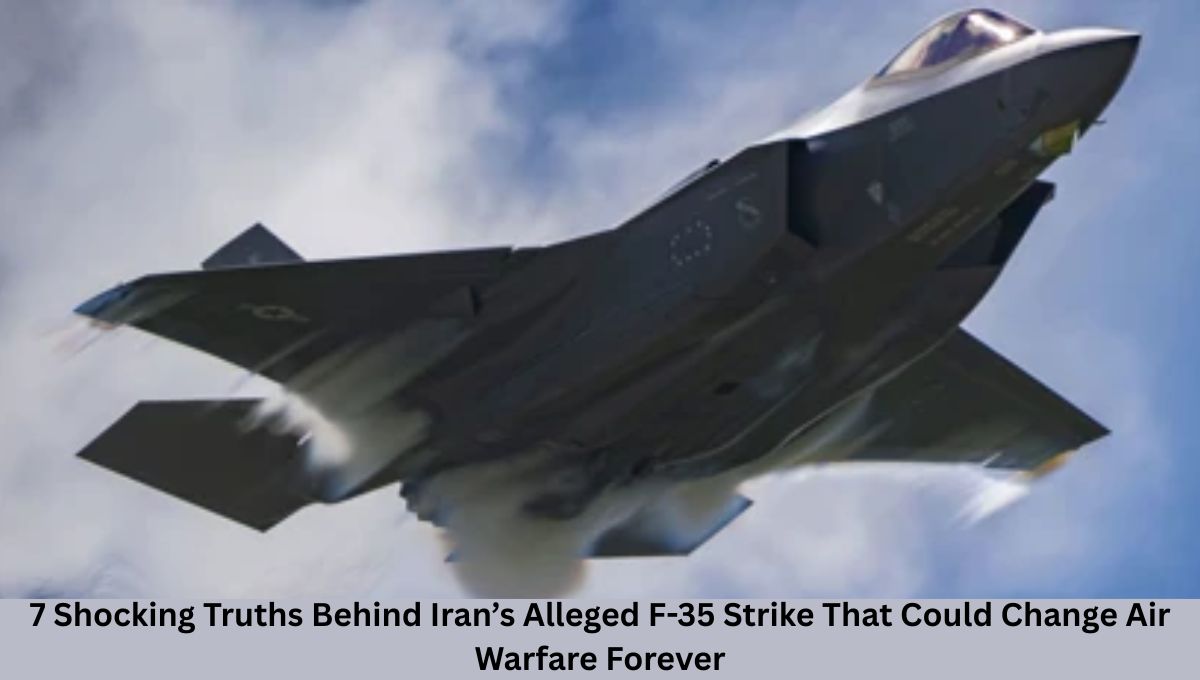
7 Shocking Truths Behind Iran’s Alleged F-35 Strike That Could Change Air Warfare Forever as questions are raised about stealth technology. In the world of military aviation, few platforms symbolize technological dominance like the F-35 stealth fighter. Designed to penetrate the most heavily defended airspace undetected, it represents the cutting edge of modern warfare.
But a recent incident over Iran has shaken that perception. A US Air Force F-35A was forced to make an emergency landing after a combat mission over Iran.
While the Pentagon has confirmed the landing and stated that the pilot is safe, Iran’s Islamic Revolutionary Guard Corps (IRGC) has gone much further — claiming it successfully struck the aircraft.
If verified, this would mark a historic moment:
the first time one of the world’s most advanced stealth fighters has been hit by enemy fire in combat.
More importantly, it raises a deeper question — has the myth of stealth just been broken?
7 Shocking Truths Behind Iran’s Alleged F-35 Strike That Could Change Air Warfare Forever
What Happened: The F-35 Incident Explained
Emergency Landing Raises Questions
According to US Central Command (CENTCOM), the F-35A was conducting a combat mission over Iranian territory when it was forced to divert and make an emergency landing at a US base in the Middle East.
- The aircraft landed safely
- The pilot survived and is in stable condition
- The cause of the incident remains under investigation
While the US has not confirmed hostile fire as the cause, multiple reports suggest the jet may have been struck by Iranian defenses.
Iran’s Claim: A Direct Hit
Iran’s IRGC claims it successfully targeted the aircraft using advanced air defense systems.
A video circulated by Iranian media allegedly shows a missile striking the jet, though this has not been independently verified.
If true, the implications go far beyond a single aircraft.
Why This Incident Matters Globally
The F-35 is not just another fighter jet. It is the backbone of US and allied air power.
Key Facts About the F-35
- Costs over $100 million per unit
- Operated by multiple allied nations worldwide
- Designed for stealth, sensor fusion, and network warfare
- Considered one of the most advanced aircraft ever built
A successful strike against such a platform challenges long-held assumptions about air superiority.
The Core Issue: Stealth Is Not Invisibility
Understanding Stealth Technology
Stealth technology is often misunderstood. It does not make an aircraft invisible — it reduces its detectability, particularly against radar systems.
The F-35 achieves this through:
- Specialized shaping to deflect radar waves
- Radar-absorbent materials
- Internal weapon bays to reduce external signatures
But this approach primarily targets radio-frequency detection systems.
The Limitation: Heat Signature
What stealth cannot fully eliminate is infrared visibility.
Jet engines generate enormous heat, and that heat can be detected using infrared systems — regardless of radar invisibility.
This is where Iran’s approach may have found an opening.
Iran’s “Low-Tech” Solution to a High-Tech Problem
Passive Infrared Tracking Systems
Iran has reportedly developed and deployed air defense systems based on passive infrared sensors rather than traditional radar.
These systems:
- Detect heat signatures instead of radio waves
- Do not emit signals, making them difficult to detect
- Provide little to no warning to targeted aircraft
Why Passive Systems Are Dangerous
Unlike radar systems, passive infrared trackers are effectively silent.
- No radar emissions = no early warning
- Difficult to locate and destroy
- Can operate in coordination with mobile launch systems
This creates a significant tactical advantage, particularly against stealth aircraft.
Lessons from Yemen: A Warning Ignored?
Iran-backed Houthi forces in Yemen had already demonstrated the effectiveness of such systems.
Previous Encounters
- US aircraft were forced to take evasive maneuvers
- Surface-to-air missiles guided by infrared tracking posed real threats
- Even advanced aircraft could not rely solely on stealth
These earlier incidents may have foreshadowed the current situation.
How the Strike May Have Happened
While details remain unclear, defense experts suggest a likely scenario:
Step-by-Step Breakdown
- Infrared sensors detect the F-35’s heat signature
- Tracking systems lock onto the aircraft silently
- A missile — possibly an infrared-guided or loitering munition — is launched
- The aircraft is struck or damaged, forcing diversion
Possible Weapon Systems
- Short-range surface-to-air missiles
- Loitering munitions (e.g., “358” systems)
- Infrared-guided interceptors
Even a near miss could cause enough damage to require an emergency landing.
The Role of Mobile Air Defense Systems
Why Iran’s Defenses Are Hard to Destroy
Iran relies heavily on road-mobile air defense systems.
These systems:
- Can be moved quickly after firing
- Blend into civilian terrain
- Are difficult to track via satellite or reconnaissance
Strategic Advantage
- Survive initial airstrikes
- Continue posing threats deep inside territory
- Force attackers to expend more resources
This mobility complicates US operations significantly.
A Deeper Problem: Expanding Combat Zones
US Operations Moving Deeper Into Iran
According to US military officials, operations have expanded deeper into Iranian territory.
This increases exposure to:
- Dense air defense networks
- Mobile missile systems
- Less predictable threat environments
Western vs Eastern Airspace
- Western Iran: relatively manageable
- Eastern and central regions: heavily defended and more dangerous
The deeper the penetration, the higher the risk.
Historical Parallel: The F-117 Shootdown
This is not the first time a stealth aircraft has faced unexpected vulnerability.
1999 Yugoslavia Incident
During NATO’s campaign:
- A US F-117 Nighthawk was shot down
- The missile system used was decades old
- Operators exploited predictable flight patterns
Key Lesson
Stealth reduces risk — it does not eliminate it.
Implications for the US Military
Operational Reassessment Likely
If the F-35 was indeed hit:
- Flight patterns may change
- Missions may shift to higher altitudes
- Greater reliance on standoff weapons
Increased Costs
- More resources needed for suppression of air defenses
- Higher operational complexity
- Greater risk to personnel and equipment
Impact on Global Military Strategy
Shift in Air Warfare Doctrine
This incident could accelerate changes in how wars are fought:
- Increased focus on multi-spectrum detection
- Greater integration of electronic warfare
- Reduced reliance on stealth alone
Rise of Counter-Stealth Technologies
Countries may invest more in:
- Infrared search and track (IRST) systems
- Passive detection networks
- AI-driven targeting systems
Psychological and Strategic Impact
Perception Matters
Even if damage was limited, the symbolic impact is enormous.
- Challenges US technological superiority
- Boosts morale of opposing forces
- Influences global military perceptions
Signal to Other Nations
Countries observing the conflict may rethink:
- Defense investments
- Procurement strategies
- Alliances and military planning
Other US Aircraft Losses in the Conflict
The F-35 incident comes amid a series of losses:
- Multiple MQ-9 Reaper drones shot down
- F-15 jets lost in friendly fire incidents
- KC-135 tanker crash with fatalities
While not all are due to enemy action, they highlight the risks of sustained operations.
What This Means for Allies
Global F-35 Operators Watching Closely
Over a dozen countries rely on the F-35 for defense.
Potential concerns include:
- Vulnerability in contested environments
- Need for upgraded countermeasures
- Changes in deployment strategies
Is Stealth Becoming Obsolete?
Short Answer: No — But It’s Evolving
Stealth remains a critical advantage, but it is no longer sufficient on its own.
Future of Air Combat
- Multi-domain awareness
- Integrated defense and offense systems
- Continuous technological adaptation
Stealth will remain important — but as part of a broader system.
The Bigger Picture: A War at an Inflection Point
The incident reflects a broader trend in the ongoing conflict:
- Escalation in tactics
- Increased technological competition
- Growing unpredictability
Key Risks Ahead
- Further attacks on high-value assets
- Expansion of conflict zones
- Greater global involvement
Conclusion: A Turning Point in Modern Warfare?
The alleged strike on a US F-35 over Iran could mark a pivotal moment in military history.
Whether or not the aircraft was directly hit by Iranian fire, the incident highlights a critical reality: no system is invulnerable.
The balance between offense and defense is constantly shifting. What was once considered a near-invincible advantage can quickly become a contested domain.
For military planners, policymakers, and global observers, the message is clear:
The future of warfare will not be defined by a single technology — but by how effectively multiple systems work together in an increasingly complex battlefield.
Final Takeaway
This is not just about one aircraft.
It’s about the evolution of warfare itself. And the world is watching closely.
Also Read: 7 Powerful Reasons Trump’s F-35 Deal with Saudi Arabia Is Rewriting Middle East Geopolitics
Also Read: US F-35 Hit By Suspected Iranian Fire, Makes Emergency Landing, What Really Happened Mid-Air?
Related Posts:
- 10 Explosive Signals Trump Says Iran War Could End…

- 10 Explosive Warnings as Donald Trump Calls Iran…

- 3 Explosive Conditions Iran Sets to End War with US…

- 12 Explosive Claims as Donald Trump Says Iran War…

- 10 Explosive Strikes: Israel Bombs Tehran Oil Depots…

- 11 Explosive Warnings as Trump Vows to ‘Knock the…
