

Israel Defense Forces Enter Gaza City, Open ‘Temporary Routes’ as Ground Offensive Intensifies, sparking mass displacement and drawing sharp international criticism. The Israel Defense Forces (IDF) have officially entered Gaza City in a major escalation of the conflict, announcing a temporary evacuation route for civilians even as heavy bombardments continued across the densely populated urban center.
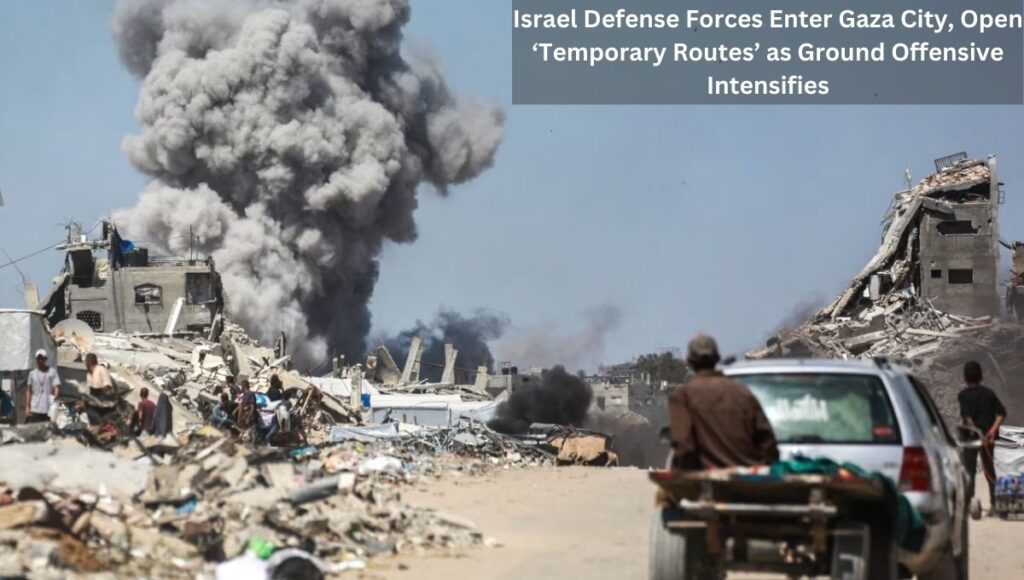
Israel Defense Forces Enter Gaza City, Open ‘Temporary Routes’ as Ground Offensive Intensifies
IDF Opens 48-Hour Evacuation Corridor
On Wednesday, Israeli military spokesperson Avichay Adraee announced that a “temporary transportation route” would remain open for 48 hours along Salah al-Din Street, urging civilians to move south.
The corridor, officials said, was intended to give trapped residents a chance to flee Gaza City before fighting intensifies further.
The move came as Israeli troops advanced block by block through the war-ravaged city, which Israel describes as the “stronghold of Hamas fighters.”
Ground Offensive in Gaza City
The IDF ground campaign began on Tuesday, with soldiers supported by tanks, artillery, and air power pressing deeper into Gaza’s largest urban hub.
Much of Gaza City has already been devastated by weeks of aerial bombardments, reducing residential areas to rubble and forcing thousands to flee in convoys of cars, trucks, and even on foot.
While Israel has not provided a timeline for the operation, military officials have stated the goal is to “destroy Hamas’ military infrastructure.” Israeli media reports suggest the operation could last months, raising fears of prolonged displacement and humanitarian disaster.
Casualties Mount Amid Escalation
According to reports from Al Jazeera, at least 78 Palestinians have been killed since the start of the ground invasion, including entire families buried under collapsed buildings.
One of the deadliest strikes targeted the Zaqout family, with 23 members killed when their home in northern Gaza was bombed. “There were about 50 people inside, including women and children. We pulled the children out in pieces,” said a devastated Abu Abd Zaqout, describing the aftermath.
Residents reported entire residential blocks being levelled overnight in Gaza City’s Daraj neighborhood, with civil defense forces digging through rubble for survivors. At least 20 people were reported killed in Daraj alone.
‘The Bombing Has Been Insane’
Eyewitnesses described the overnight bombardment as relentless. “At night they bombed an entire quarter, three houses and the neighbouring houses,” said resident Mohammed al-Bardawil. “All of the dead are children, elderly people, and women.”
Sami Abu Dalal from Daraj said, “Whole residential blocks were levelled on top of their inhabitants, leaving many dead, missing, or injured.”
Displaced Gazan Ghazi al-Aloul, now sheltering outside al-Quds Hospital, said: “I did not choose this. I was forced after leaving the home where my family and I had been sheltering. The bombardment has been insane for hours.”
Families Struggle to Escape
Thousands of families scrambled to flee Gaza City after receiving evacuation orders. Some reported receiving direct phone calls from Israeli officers, while others said they left after leaflets were dropped from warplanes.
For many, displacement has come at an unbearable financial cost. Lina al-Maghrebi, a mother of three, said she was forced to sell her jewelry to pay for evacuation. “It took us 10 hours to reach Khan Younis, and we paid 3,500 shekels (£735) for the ride. The line of cars and trucks seemed endless.”
The price of survival has skyrocketed: residents say a small truck costs about 3,000 shekels (£630), while tents are being sold for 4,000 shekels (£840). With most families deprived of income since the war began, many cannot afford to leave and remain trapped in the city.
International Response and Condemnation
The ground offensive has drawn strong condemnation from the international community.
- UN Human Rights Council: A new report accused Israel of committing genocide in Gaza, a charge Israel dismissed as “distorted and false.”
- Germany: The German foreign minister criticized the escalation, warning it would deepen humanitarian suffering.
- United Kingdom: Foreign Secretary Yvette Cooper called the operation “utterly reckless and appalling,” warning that it would “only bring more bloodshed and endanger the remaining hostages.”
- United States: U.S. Secretary of State Marco Rubio, visiting the region, struck a different tone. While calling for a “negotiated end to the war,” he also appeared to justify Israel’s offensive, saying, “Sometimes when you’re dealing with a group of savages like Hamas, that’s not possible.”
Netanyahu Vows ‘Powerful Operation’
Israeli Prime Minister Benjamin Netanyahu described the campaign as a “powerful operation” against Hamas’s “last major stronghold.” He pledged to continue until Hamas’s networks are dismantled.
Meanwhile, Israeli Defense Minister Israel Katz declared, “Gaza is burning,” as heavy overnight strikes pounded multiple neighborhoods.
Humanitarian Crisis Deepens
The humanitarian toll continues to mount as food, medicine, and shelter run scarce. Many families, unable to afford evacuation or relocation, remain in destroyed neighborhoods despite constant shelling. Others attempt to sleep outside hospitals or makeshift shelters, fearing further strikes.
Residents described scenes of desperation: families carrying belongings on foot, endless convoys of vehicles along al-Rashid coastal road, and overcrowded shelters in Khan Younis and Rafah.
Civil defense workers, often under fire themselves, continue to dig through rubble in search of survivors. At least 12 bodies were pulled out after more than eight hours of operations in one destroyed neighborhood, authorities reported.
Military Strategy and Intensifying Firepower
The IDF said it was “gradually” moving into Gaza City as part of the “next phase” of the war. The operation combines ground troops, tanks, artillery, airstrikes, and naval shelling. Apache helicopters and drones hover over the city, providing continuous aerial support.
Witnesses reported the use of booby-trapped vehicles and heavy artillery fire as Israeli forces advanced on three main fronts. Overnight strikes targeted the al-Daraj neighborhood, Sheikh Radwan, and the Beach refugee camp.
A City Under Siege
As the ground offensive pushes forward, Gaza City has become the epicenter of one of the deadliest chapters of the conflict. Families face impossible choices: to risk fleeing through bombarded evacuation corridors at great personal cost, or to remain in shattered homes under the constant threat of airstrikes.
With no clear end in sight, international pressure is mounting on Israel to halt its offensive, while the humanitarian crisis in Gaza deepens by the hour.
Related Posts:
- 25 Killed as Israeli Forces Open Fire on Starving…
- Israel Strikes Gaza Kill 70 Despite Trump’s Urgent Plea

- Israel’s Gaza Takeover Plan: What’s Been Achieved…

- ‘Gaza Is Burning’: Israel Orders Full Evacuation of…
- Israel Expands Ground Offensive in Gaza as Global…
- Israel–Hamas Ceasefire Under Strain: 4 More Hostage…
