In 8 Moves, EU Targets China-Linked Refineries and Imposes Russian Energy Ban — EU’s 19th sanctions package. In a major escalation of its response to the war in Ukraine, the European Union (EU) has rolled out a dual-track strategy that combines targeted sanctions against Chinese oil industry players who allegedly help Russia evade restrictions, with a clear roadmap to phase out Russian energy imports entirely by 2028.
The move, described by EU officials as “a defining moment for Europe’s security and energy independence”, signals a broadening of the conflict beyond the battlefield in Ukraine into the realms of trade, energy policy and global diplomacy. In this article we explain the key elements of the package, the figures involved, the reactions from Beijing and Moscow, and what it could mean for the future of European energy and geopolitics.

In 8 Moves, EU Targets China-Linked Refineries and Imposes Russian Energy Ban
What is the EU’s 19th Sanctions Package?
Scope and intention
The EU’s latest sanctions package—its 19th against Russia since 2022—was formally approved by member states on 22 October 2025 and centres on two main pillars:
- Targeting Chinese refineries, trading firms and circumvention entities believed to be assisting Russia’s oil export and revenue pipelines.
- Imposing a phased ban on Russian energy imports (oil, pipeline gas and liquified natural gas – LNG) to be fully in force by 1 January 2028.
In a statement accompanying the package, the European Commission stressed:
“We are now going after those who fuel Russia’s war by purchasing oil in breach of the sanctions. We target refineries, oil traders…”
That framing signals a changed paradigm: for Brussels, the fight against Russia is not just about military aid to Ukraine, but about cutting off Moscow’s ability to finance the war at its source.
Targeting China-linked entities
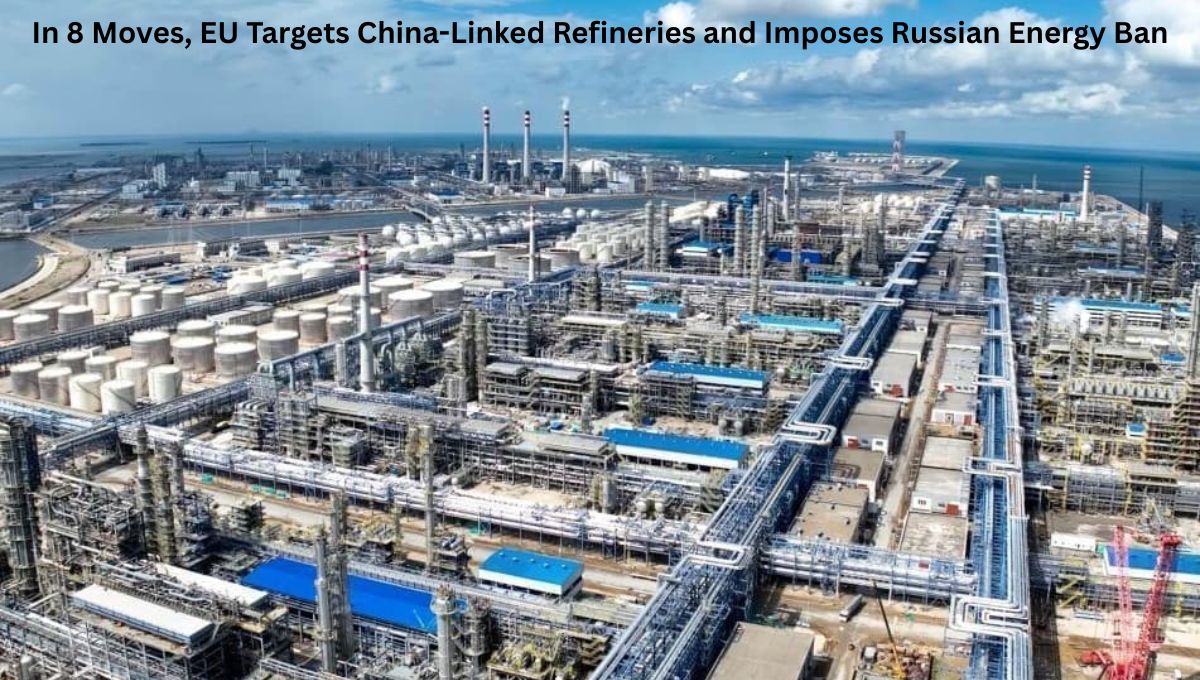
Among the most economically significant moves in this package is the listing of four Chinese entities: two independent oil refineries, one Chinese trading company and a circumvention-related entity operating outside pure oil.
This marks a clear escalation of the EU’s willingness to sanction Chinese industrial actors seen as aiding Russia — a response to long-standing Western concerns that Beijing is functioning as a central node in Russia’s sanctions-evading network.
As EU sanctions envoy David O’Sullivan noted, China continues to claim it is engaged only in “normal trade”.
Brussels acknowledges that previous rounds had listed Chinese banks and dual-use goods suppliers, but the inclusion of major refineries and trading firms signals that the EU now views China’s role as materially affecting Russia’s oil revenues.
Ending Russian Energy Imports — The 2028 Deadline
Ministerial agreement and timeline
On 20 October 2025, EU energy ministers backed a regulation to phase out Russian pipeline oil, gas and LNG imports by 1 January 2028.
Danish Energy Minister Lars Aagaard, under the Danish presidency of the Council, described the proposal as:
“A crucial step to make Europe energy independent. Although we have worked hard and pushed to get Russian gas and oil out of Europe in recent years, we are not there yet.”
The regulation’s key milestones:
- New Russian gas/pipeline/oil contracts prohibited from 1 January 2026.
- Short-term contracts signed before 17 June 2025 may run until 17 June 2026.
- Existing long-term contracts may continue until 1 January 2028.
Linking energy policy and security strategy
This energy-independence push is embedded within the EU’s broader REPowerEU roadmap, designed to reduce reliance on Russian fossil-fuels while accelerating the transition to renewables and diversified supplies.
Its strategic underpinnings are clear: Russia has repeatedly used energy flows as geopolitical leverage, and the EU now sees severing those ties as a security imperative. As High Representative Kaja Kallas put it:
“Russia only negotiates when put under pressure.”
In effect, the energy ban is not only about climate or economics — it is about weakening Moscow’s war machine.
How China Fits Into Europe’s Sanctions Strategy
China’s role and Europe’s rationale
For years, Western officials have accused China of enabling Russia’s war economy via oil purchases, dual-use goods transfers, and shipping/trading networks. The inclusion of Chinese refineries in the sanctions package highlights Brussels’ view that Moscow’s access to the global oil market remains critical to its war finance.
Reuters reported that diplomatic sources stated:
“The Chinese listings are … the most economically significant [so far]” in this sanctions cycle.
EU officials believe that certain Chinese refiners purchase discounted Russian crude — often from the so-called “shadow tanker fleet” — refine it and then move it into international markets, thereby providing Moscow with indirect channels to monetise oil despite Western limits.
Beijing’s response
China has firmly denied sanction-related wrongdoing, maintaining it conducts only “normal trade” with Russia.
Beijing has also argued that cuts would harm global supply chains and jeopardise energy-security for the EU. Some Chinese analysts have pointed out that the EU’s alignment with the US in pressuring China weakens claims of “strategic autonomy”.
Nevertheless, by targeting Chinese entities, Brussels sends a broader message: the war in Ukraine is a global economic contest, not just a European security challenge.
The Shadow Fleet & Blocking Russia’s Revenue Streams
What is the shadow tanker fleet?
One of the central components of Europe’s approach is disrupting the so-called “shadow fleet” of oil tankers used by Russia to evade sanctions and sell oil under false flags or brokered transfers.
French President Emmanuel Macron recently called the shadow tanker operations a “direct channel for war funding” and pledged coordinated action via NATO-aligned and EU-aligned partners.
The 19th sanctions package reportedly lists over 560 vessels, adding 117 in the latest tranche alone.
Why it matters
By restricting shipping, insurance, port access and financing of such vessels, the EU aims to reduce Russia’s ability to covertly export oil. Given that oil and gas remain among Moscow’s largest foreign-exchange earners, this has direct implications for its ability to fund its military operations.
The European Council confirmed that energy imports from Russia still account for a significant revenue stream, and the new measures aim to “make it increasingly harder for Putin to fund this war”.
Reactions Within the European Union
Unified front — but some divisions persist
While the package has broad support, some member states raised concerns previously over energy supply, cost and economic impact. Land-locked or coal-dependent countries like Hungary and Slovakia have voiced opposition.
For instance, Slovakia’s Prime Minister Robert Fico has previously described a Russian-energy ban as “economic suicide”.
Nevertheless, the final text for the 19th package gained enough support to clear the way for adoption. According to Reuters, “Slovakia was the final hold-out after EU countries agreed on the final text last week.”
Eastern Europe’s security framing
Beyond energy, Eastern European countries view this as a matter of security rather than just modules of trade. Kaja Kallas emphasised during a ministerial meeting:
“Ukraine has been ready for an unconditional ceasefire already since February, but Russia has no genuine interest in peace. We all support President Trump’s efforts to end the war, but Putin will only negotiate seriously if he thinks he is losing.”
For many states, the energy shift and sanctions regime is inseparable from their view of Russia as an existential threat.
Global and Strategic Implications
Europe’s claim to strategic autonomy
By coupling China-linked sanctions with Russian energy bans, the EU is signalling that it is not content to be a passive consumer in global energy systems — it wants to be a strategic actor.
Yet some critics argue the move is in fact aligned too closely with Washington’s agenda. Chinese analysts claim the EU is “blindly following” the US on China policy.
Still, Brussels appears to be responding to the reality that energy and trade policy are now tools of geopolitics, not simply economics.
Moscow’s revenue challenge
For Russia, these sanctions come at a critical time. Oil and gas exports have funded large parts of its war effort. By restricting access to key Asian, Chinese and global markets and threatening the energy imports of Europe, the EU aims to blunt Moscow’s ability to generate hard currency.
As one Ukrainian official put it:
“Less money in Russia means fewer missiles in Ukraine.”
The China factor
China now finds itself in an increasingly exposed position: not simply an observer, but a possible enabler of Russia’s strategy. Becoming subject to EU sanctions elevates the risk of broader trade spill-overs, especially in sectors of refining and energy trade.
Beijing must now calculate whether cooperation with Moscow is worth the potential cost of deeper integration with the global financial and trade system.
What Comes Next – The Road Ahead
Implementation challenges
Passing the legislation is only the start. Implementation across 27 member states will require national plans, monitoring systems, documentation of origin for energy imports and coordination on enforcement.
According to the Council press release:
“The proposed regulation introduces a legally binding, step-wise prohibition on both pipeline gas and liquefied natural gas (LNG) imports from Russia, with a full ban to apply from 1 January 2028.”
Member states will be required to submit national diversification plans, detailing how they will replace Russian supplies and develop alternate infrastructure.
Upcoming package 20
EU officials have already indicated that a 20th sanctions package is under preparation. Ukraine’s chief of staff, Andriy Yermak, already said:
“We are not stopping. Package no. 20 is already in the works. The logic is simple – less money in Russia means fewer missiles in Ukraine.”
This suggests further pressure points may include finance, technology transfers and third-country enablers.
Risks and economic implications
Although the transition away from Russian energy is underway, there are cost pressures. Countries reliant on Russian gas and oil face complexities in securing alternate supplies and infrastructure. Some analysts warn of rising energy bills in Central and Eastern Europe.
Furthermore, retaliation is a real possibility. China may impose countermeasures against European firms or institutions, escalating trade tensions.
The broader geopolitics
This package reflects a shift from dealing with Russia as a “regional aggressor” to treating the conflict as part of a global competition involving supply-chains, finance and allied coordination. Europe, China, Russia and the United States are all engaged in this evolving chess-board of energy and influence.
Why This Matters for the World
Energy markets
Global energy markets will be watching how effectively the EU phases out Russian imports and how Russia responds. If the EU proceeds as planned, demand for non-Russian oil, gas and LNG will surge, reshaping supply routes and alliances.
China-EU relations
The sanctioning of Chinese refineries introduces a new tension point in EU-China trade relations. While both sides remain economically interlinked, the war in Ukraine is now a pivot point. China must decide whether to risk economic or financial fallout for its links with Russia.
The message to autocracies
The linkage of energy, trade and security means that authoritarian states which rely on fossil-fuel exports to underwrite military ambitions may face broader push-back. Europe is drawing a line: economic dependence on aggression is no longer acceptable.
For everyday citizens
For European citizens, this may translate into higher energy bills and investment in new infrastructure (renewables, LNG terminals, pipelines). But it also means a more secure energy future not shaped by a hostile neighbour’s geopolitics.
Conclusion: A New Era in Sanctions and Energy Policy
The EU’s 19th sanctions package marks a strategic pivot: instead of simply reacting to Russia’s invasion of Ukraine, Europe is proactively redesigning its energy and trade architecture — and dragging China into the frame.
By listing Chinese refineries, sanctioning the shadow tanker fleet and setting a firm deadline to end Russian energy imports, Brussels is sending a message: economics, security and energy are now inseparable.
As President Macron, Commissioner von der Leyen and others have made clear, this is not a one-off policy but a structural shift. Whether the EU can execute the plan, manage the associated costs and maintain unity among 27 member states remains to be seen.
But the direction is unmistakable: less dependence, more autonomy, and wider geopolitical ambition. For Russia, China and Europe alike, the rules of the game just changed.
Also Read: Trump Slaps China with 104% Tariff in Escalating Trade War, Signals Major Pharma Duties Ahead