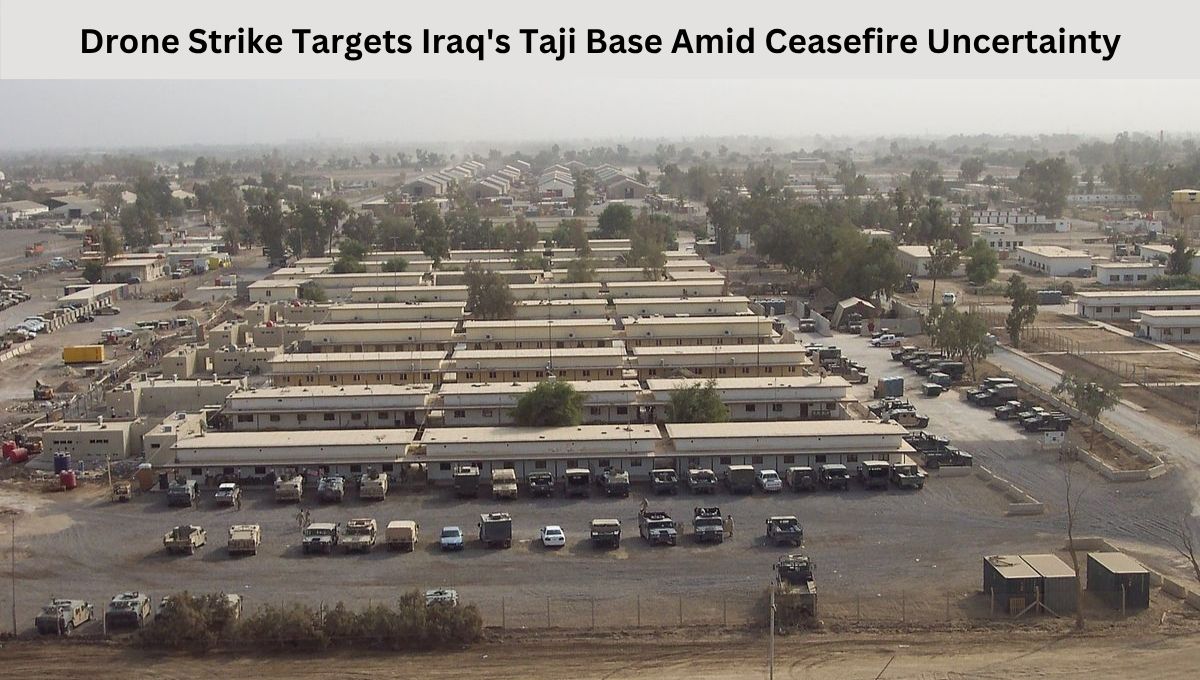
Unidentified Drone Strike Targets Iraq’s Taji Base Amid Ceasefire Uncertainty. Tensions in the Middle East spiked once again early Tuesday as unidentified drones targeted Iraq’s Taji military base, located just 20 kilometers north of Baghdad. The attacks, which caused material damage but no casualties, come amid ongoing uncertainty surrounding a fragile ceasefire between Iran and Israel.
Drone Strike Targets Iraq’s Taji Base Amid Ceasefire Uncertainty
What Happened at Taji Base?
According to Lieutenant General Walid al-Tamimi, speaking to Iraq’s state news agency INA, an unidentified drone struck a radar post within the Taji base. Another drone reportedly crashed near a power generator, confirmed by government security spokesman Saad Maan.
AFP reported that the drone strikes targeted a radar system and caused only material damage. While the extent of the destruction is still being assessed, no injuries were reported.
Second Drone Incident Near US Troops
Around the same time, a second drone was reported to have fallen in the Radwaniya district, approximately 10 kilometers west of Baghdad International Airport. This area hosts US troops deployed as part of the anti-jihadist coalition. Again, no casualties were confirmed.
No Claim of Responsibility
No group has claimed responsibility for the drone attacks as of this report. Iraqi military sources confirmed that “so far” Iran has not directly attacked any bases hosting US forces in Iraq.
Context: Iran Strikes US Base in Qatar
The drone incidents followed a dramatic escalation late Monday when Iran launched missiles at Al-Udeid Air Base in Qatar, a key US military facility in West Asia.
The strike was in retaliation for the US bombing of three Iranian nuclear facilities Fordow, Natanz, and Esfahan using B-2 bombers.
The US strikes, conducted under “Operation Rising Lion,” were coordinated with Israeli forces.
The Israel Defense Forces stated the operation was a “crucial step” in stopping Iranian aggression and halting nuclear development.
Trump Announces Ceasefire But Violence Continues
Just hours before the drone attacks, US President Donald Trump announced a “complete and total ceasefire” between Iran and Israel.
According to Trump, the agreement was reached in phases and was expected to be implemented within 12 hours.
Posting on Truth Social, Trump wrote, “It has been fully agreed by and between Israel and Iran that there will be a complete and total ceasefire… for 12 hours, at which point the War will be considered ended.”
Trump credited Israeli Prime Minister Benjamin Netanyahu and unnamed Iranian officials for reaching the ceasefire, with US Vice-President J.D. Vance and Secretary of State Marco Rubio reportedly helping broker the deal.
Ceasefire Deadline Missed
Iran’s foreign minister stated that Iran would stop its attacks if Israel ceased operations by 4 a.m. local Tehran time Tuesday.
But nearly an hour after that deadline passed, Israeli warning sirens sounded, and fresh Iranian missile launches were reported.
This suggests that the ceasefire agreement if it ever existed in concrete terms is either collapsing or was never fully operational.
Explosions and Social Media Reactions
Moments after Trump’s ceasefire announcement, videos surfaced on X (formerly Twitter) showing fires at Camp Taji. Users claimed a radar system and surface-to-air missile launcher had been hit.
“Radars were bombed at Taji camp, unclear who did it,” one user posted. These reports have fueled further speculation about the identity of the attackers and whether rogue militias or state actors are involved.
Strategic Importance of Taji Base
The Taji base has long been a strategic asset for both Iraqi and US forces. Before the 2020 withdrawal of US-led coalition troops, the base housed up to 2,000 personnel. It was frequently targeted by Iran-backed militias using rockets and drones.
Since being handed over to Iraqi security forces, the base has remained a flashpoint, particularly during times of heightened regional conflict.
Is the Ceasefire Real?
The apparent contradiction between Trump’s ceasefire announcement and ongoing hostilities has raised serious questions. While Washington insists a ceasefire was agreed upon, neither Israel nor Iran has officially confirmed it.
Military analysts suggest that even if a deal was reached, communication breakdowns or hardliners on both sides may be acting independently of their governments.
Broader Implications for US Troops in Iraq
Though the latest drone strikes caused no casualties, they highlight the persistent threat to American personnel stationed in Iraq and surrounding regions.
The fact that a drone reached Taji base once a well-fortified US post underscores the vulnerability of these installations.
As tensions escalate, US and coalition forces may need to reassess their defensive protocols and readiness in the region.
Conclusion: Uncertainty Reigns in the Middle East
The drone attacks on Taji base serve as a stark reminder that while diplomatic efforts may be underway, the situation in the Middle East remains volatile. With Iran striking US targets, Israel on high alert, and drone warfare increasing in frequency, a comprehensive and lasting peace remains elusive.
As of now, the so-called ceasefire appears to be on shaky ground, with on-the-ground events contradicting political proclamations. The international community watches closely, hoping that cooler heads will prevail before the conflict escalates into a broader regional war.
Also Read: Trump Brokers Fragile Iran-Israel Ceasefire After Nuclear Strikes; India Welcomes Truce
Also Read: Whose mystery drones are targeting radar sites at Iraq military bases? – analysis
Related Posts:
- 7 Stunning Strikes: Iran Claims Destruction of US…

- Drone Sightings Shut Copenhagen and Oslo Airports,…

- Bangladesh Fighter Jet Crashes into Dhaka School, Killing 19

- Afghanistan–Pakistan War 2025: Inside the 48-Hour Ceasefire

- Israel–Hamas Ceasefire Under Strain: 4 More Hostage…

- 7 Crucial Developments as Thailand–Cambodia…