

At the annual summit in Singapore, Pentagon Chief Warns of Imminent China Threat, Urges Asian Allies to Boost Defense Spending. U.S. Secretary of Defense Pete Hegseth made headlines this weekend at the Shangri-La Dialogue in Singapore, warning that the China threat is real and potentially imminent.
Speaking to military leaders, diplomats, and analysts at Asia’s most important defense forum, Hegseth urged Asian allies to ramp up defense spending and prepare for growing regional instability.
In his first appearance at the annual summit since assuming the Pentagon’s top post in January, Hegseth struck a blunt tone, declaring, “Beijing is credibly preparing to potentially use military force to alter the balance of power in the Indo-Pacific.”
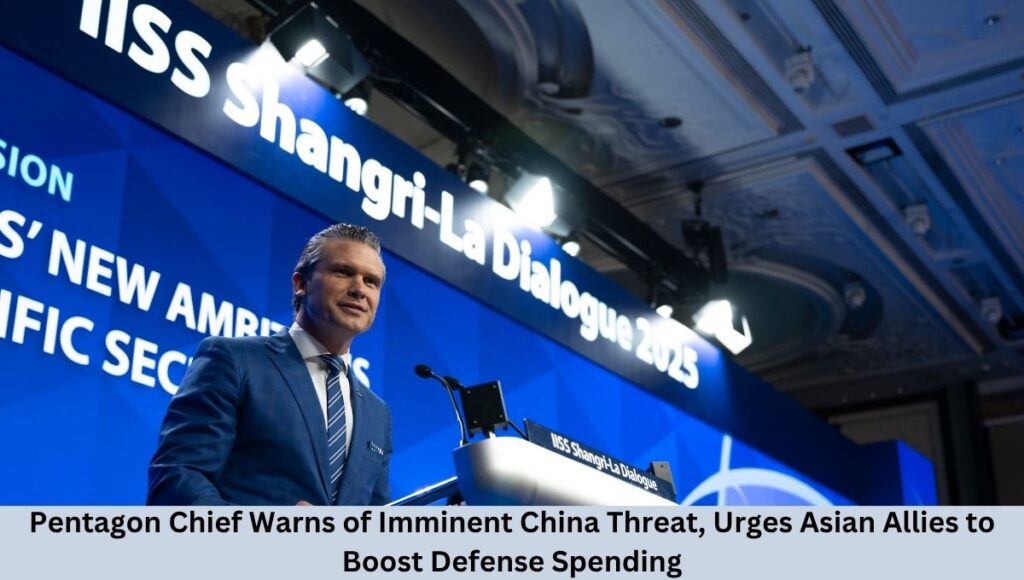
Pentagon Chief Warns of Imminent China Threat, Urges Asian Allies to Boost Defense Spending
China’s Military Ambitions Center on Taiwan
Much of Hegseth’s remarks focused on China’s aggressive posture toward Taiwan, a self-ruled democratic island that Beijing claims as its own. Warning of devastating consequences should China invade, the Secretary said the U.S. would not stand idly by.
“China is not only building the military for an invasion,” Hegseth said, “they are training and rehearsing for it.” He referenced intelligence assessments suggesting Chinese President Xi Jinping has targeted 2027 as a potential deadline for the People’s Liberation Army (PLA) to achieve full invasion capability though this goal remains officially unconfirmed.
US to Allies: Step Up or Risk Instability
A major theme of Hegseth’s speech was the need for increased defense spending among U.S. allies in Asia. He drew direct comparisons to Europe, where NATO countries have recently increased military budgets in response to Trump administration pressure.
“How can it make sense for Europe to spend more while key allies and partners in Asia spend less in the face of a more formidable threat?” he asked. Defense spending in Asia averaged only 1.5% of GDP in 2024, according to the International Institute for Strategic Studies (IISS) a figure that has remained static for over a decade.
Hegseth pointed to Estonia as an example of a smaller nation stepping up, and urged regional powers like Japan, South Korea, and Australia to take greater responsibility for collective security.
Hegseth Unveils New US Initiatives in Indo-Pacific
In an effort to strengthen partnerships, Hegseth highlighted several new US-led defense initiatives. Among them:
- A radar repair and logistics center in Australia
- Expanded cooperation on unmanned aerial systems (drones)
- A push for joint industrial partnerships to boost indigenous defense capabilities across Southeast Asia
The Pentagon chief emphasized that the US commitment to Indo-Pacific security is long-term, saying, “We are not going anywhere. America is here to stay.”
China’s Fierce Rebuttal: “Groundless Accusations”
Beijing wasted no time in responding. China’s Foreign Ministry said it had “lodged solemn representations” with the United States and warned Washington “not to play with fire” over Taiwan.
In a strongly worded statement released early Sunday, Beijing “strongly deplored” Hegseth’s remarks and accused the United States of stoking regional tensions. Chinese naval chief Admiral Hu condemned the Pentagon chief’s speech as “provocative and baseless,” suggesting it was intended to incite confrontation in the Asia-Pacific.
“The so-called China threat is nothing but a fabricated pretext to justify a larger U.S. military presence in Asia,” Admiral Hu told reporters in Singapore.
Absence of China’s Defense Minister Raises Eyebrows
Notably absent from this year’s forum was China’s Defense Minister Dong Jun, who was expected to attend but canceled last minute. Instead, a lower-ranking academic delegation was sent in his place. Some analysts believe the move was deliberate, intended to avoid direct confrontation with the United States.
Others speculate Dong Jun may be caught in an ongoing anti-corruption purge inside the PLA several Chinese generals have recently disappeared from public view. This absence, combined with the intensifying rhetoric, underscores the diplomatic chill currently defining US-China relations.
Balancing Power in the South China Sea
Hegseth also took aim at China’s territorial ambitions in the South China Sea, accusing Beijing of “illegally seizing and militarizing” islands and disrupting international shipping routes.
Despite a 2016 international ruling rejecting its sweeping claims, China continues to assert near-total control over the waterway. Hegseth warned that these actions not only threaten freedom of navigation, but also risk drawing the region into conflict.
In response, Beijing’s Foreign Ministry claimed that navigation has “never been an issue” and accused the U.S. of “turning the Indo-Pacific into a powder keg.”
US Approach: Cooperation Without Preaching
While emphasizing the China threat, Hegseth also outlined a “common sense” foreign policy vision aligned with President Trump. He noted that the U.S. is “not here to pressure countries to adopt our ideology” or “preach about climate change.”
Instead, he said, “We want to work with you where our shared interests align—security, sovereignty, and economic prosperity.”
Critics, however, argue that this approach lacks moral clarity. U.S. Senator Tammy Duckworth, a Democrat attending the forum, called Hegseth’s tone “patronizing,” adding that America’s strength lies in its values including support for human rights and international law.
Conclusion: Security Risks in Asia Continue to Escalate
As the strategic rivalry between the U.S. and China intensifies, regional security remains on a knife’s edge. Hegseth’s warning at the Shangri-La Dialogue has made it clear: Washington sees Beijing not just as a long-term competitor, but a near-term military threat particularly in Taiwan and the South China Sea.
Whether Asian allies heed the call to increase their defense spending remains uncertain. But one thing is clear: the Indo-Pacific security architecture is undergoing a major shift, and China’s next move will be closely watched by both friends and foes alike.
Also Read: NATO Chief Warns BRICS of 100% Tariffs Over Russian Trade
Related Posts:
- 5 Major Takeaways from the US Supreme Court's…

- In 8 Moves, EU Targets China-Linked Refineries and…

- 7 Heartbreaking Facts About Venezuela's Earthquake Disaster

- China’s Rare Earth Export Curbs: Bold New Move

- China Hosts SCO Summit 2025 and Military Parade as…
- 7 Big Takeaways: Macron’s High-Stakes China Visit…
