
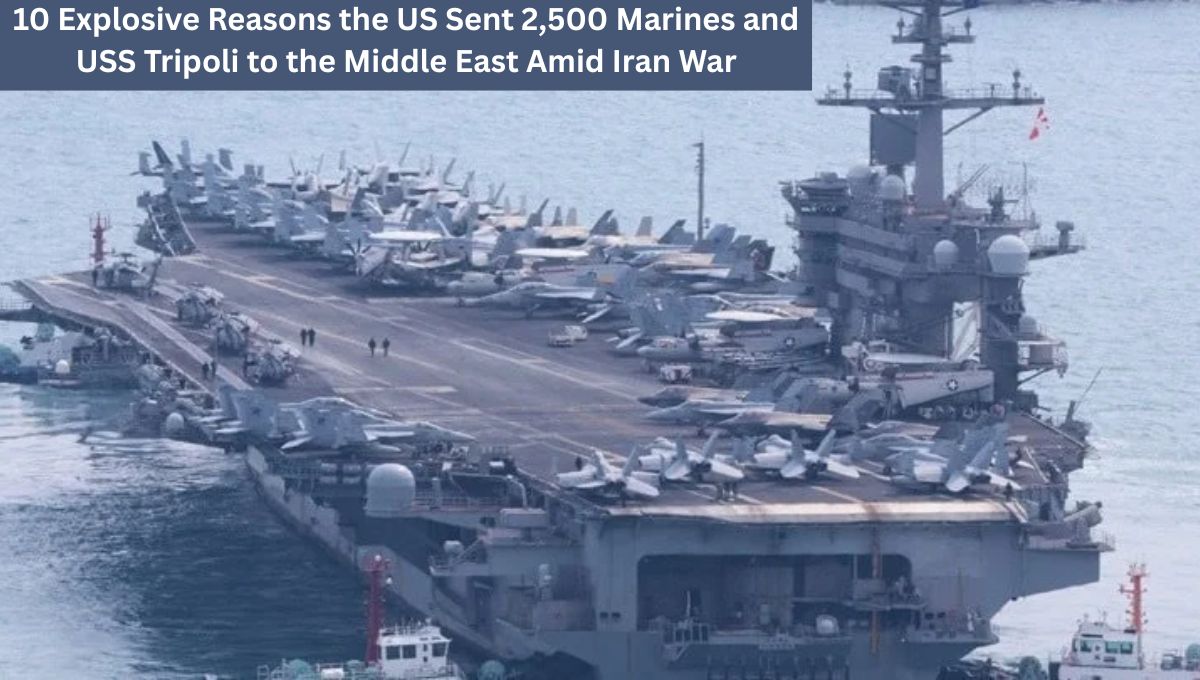
10 Explosive Reasons the US Sent 2,500 Marines and USS Tripoli to the Middle East Amid Iran War, raising fears of a wider regional conflict. The United States is significantly expanding its military presence in the Middle East as the conflict involving Iran, Israel, and American forces intensifies. In a major escalation, Washington has ordered approximately 2,500 Marines and a powerful amphibious assault ship to move toward the region.
Thank you for reading this post, don't forget to subscribe!The deployment includes elements of the 31st Marine Expeditionary Unit (MEU) and the amphibious assault ship USS Tripoli. The move comes amid growing regional instability, missile strikes, drone attacks, and mounting fears that the war could spiral into a wider conflict affecting global energy markets and international security.
According to a U.S. official speaking to The Associated Press, the deployment represents a major reinforcement of American forces in the Middle East. The Marine unit is typically based in Japan but has now been ordered to move toward the conflict zone, where U.S. and Israeli forces have been striking Iranian military targets for nearly two weeks.
Meanwhile, Iran has continued to launch missile and drone attacks on Israel and Gulf states while disrupting shipping in the strategically critical Strait of Hormuz, a route through which about 20 percent of the world’s traded oil passes.
The decision to send additional Marines and warships underscores the seriousness of the crisis. While U.S. officials say the deployment does not necessarily signal an imminent ground invasion, it provides commanders with a wide range of options if the conflict escalates further.
Here are 10 key reasons behind the U.S. deployment of Marines and the USS Tripoli—and what it could mean for the future of the Middle East conflict.
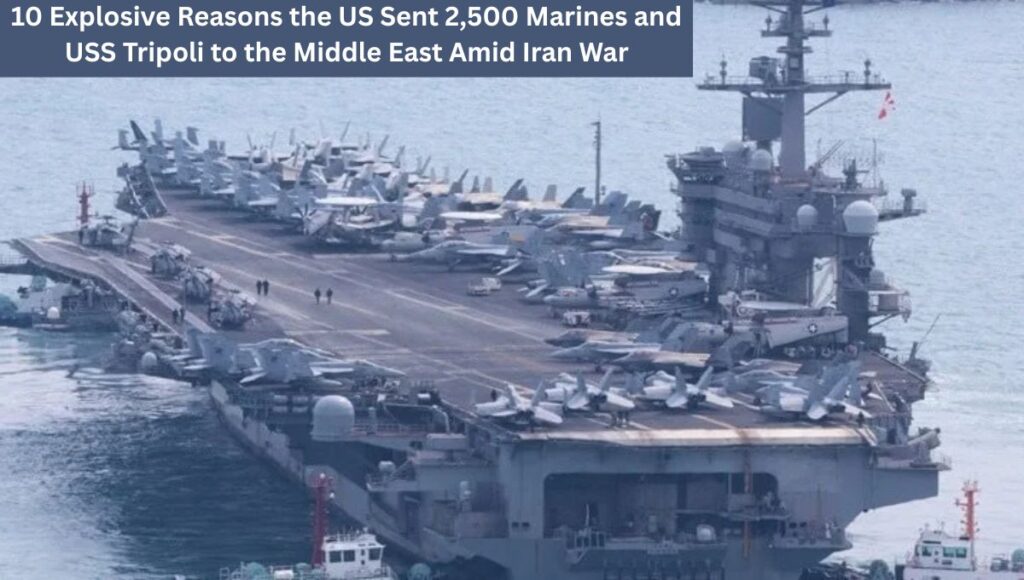
10 Explosive Reasons the US Sent 2,500 Marines and USS Tripoli to the Middle East Amid Iran War
1. The US Is Reinforcing Its Military Presence in the Region
One of the primary reasons for the deployment is to strengthen the American military presence in the Middle East.
The region already hosts tens of thousands of U.S. troops across various bases and naval facilities.
However, the rapidly escalating war between Iran and Israel has prompted Washington to increase its readiness.
Defense officials say the arrival of additional Marines and naval assets will provide greater flexibility for commanders operating under the authority of United States Central Command.
CENTCOM oversees U.S. military operations across the Middle East, including areas such as Iraq, Syria, the Persian Gulf, and parts of Central Asia.
With the conflict intensifying, military planners want to ensure they have sufficient forces available to respond quickly to emerging threats.
2. The Deployment Includes the Powerful USS Tripoli
At the center of the deployment is the amphibious assault ship USS Tripoli.
This massive vessel is part of the America-class amphibious assault ships, which function somewhat like smaller aircraft carriers.
The ship can carry:
- More than 1,600 Marines
- Multiple helicopters
- Tilt-rotor aircraft
- Short-takeoff fighter jets such as the F‑35B Lightning II
- Landing craft and armored vehicles
Because it operates as a floating base at sea, the USS Tripoli allows U.S. forces to conduct missions without relying on nearby land bases.
This flexibility is particularly valuable in regions where political or logistical constraints may limit access to airfields or ports.
If it joins the American naval forces already operating in the region, the Tripoli would become one of the largest ships deployed near Iranian waters.
Only the aircraft carrier USS Abraham Lincoln would be larger in the current U.S. fleet presence.
3. The 31st Marine Expeditionary Unit Is a Rapid-Response Force
The Marine unit accompanying the Tripoli is the 31st Marine Expeditionary Unit (31st MEU).
A Marine Expeditionary Unit is one of the most versatile formations in the U.S. military. Each MEU is designed to respond quickly to crises anywhere in the world.
The typical structure of an MEU includes four main components:
Command Element
The command headquarters responsible for coordinating operations.
Ground Combat Element
An infantry battalion equipped with armored vehicles, artillery, and reconnaissance units.
Aviation Combat Element
Aircraft squadrons that provide air support, transport, and reconnaissance.
Logistics Combat Element
Support units responsible for supplies, maintenance, medical services, and transportation.
Before deploying, MEUs undergo months of training to prepare for missions ranging from combat operations to humanitarian assistance.
4. Marines Can Conduct Amphibious Assaults
One of the most significant capabilities of a Marine Expeditionary Unit is the ability to conduct amphibious assaults.
This means troops can launch operations from ships directly onto hostile shorelines. Such operations involve landing craft, helicopters, and amphibious armored vehicles.
While officials emphasize that the current deployment does not necessarily signal preparations for an invasion of Iran, the capability remains an important option if circumstances change.
Historically, amphibious forces have been used in numerous conflicts where rapid military intervention was required.
5. The Deployment Could Protect Shipping in the Strait of Hormuz
Another key objective of the deployment is protecting maritime traffic in the Strait of Hormuz.
This narrow waterway connects the Persian Gulf to the global ocean and is one of the most important energy transit routes in the world.
About one-fifth of the world’s oil supply passes through the strait every day. Recent Iranian actions have raised concerns about disruptions to shipping in the region.
Tehran has reportedly threatened commercial vessels and increased naval activity near the strait. Such actions have already pushed oil prices higher and sparked fears of a global energy crisis.
By deploying Marines and additional naval forces, the United States aims to ensure the safe passage of commercial shipping through the waterway.
6. The War Between Iran and Israel Is Expanding
The deployment also comes amid a rapidly expanding conflict involving Iran and Israel. Since the war began in late February, both sides have launched hundreds of attacks.
Iran has fired missiles and drones toward Israeli targets and has also targeted U.S. positions across the Gulf region.
At the same time, Israeli and American aircraft have carried out extensive bombing campaigns against Iranian military infrastructure.
According to U.S. Defense Secretary Pete Hegseth, more than 15,000 enemy targets have been struck since the war began.
The scale of the attacks highlights how quickly the conflict has escalated.
Before the arrival of the USS Tripoli, the U.S. Navy already had a significant naval presence in the region.
Earlier this week, American officials confirmed that 12 naval vessels were operating in the Arabian Sea.
These included:
- The aircraft carrier USS Abraham Lincoln
- Eight guided-missile destroyers
- Several support vessels
If the USS Tripoli joins this fleet, it will further strengthen American naval capabilities in the region.
The growing concentration of warships reflects Washington’s determination to deter Iranian attacks and maintain control of key maritime routes.
8. The Deployment Provides Options for Evacuating Civilians
Marine Expeditionary Units are not used only for combat operations. They are frequently deployed for non-combat missions, including evacuating civilians during crises.
If the conflict spreads to additional countries in the region, American citizens and foreign nationals may need to be evacuated quickly.
MEUs are particularly well suited for such operations because they carry aircraft capable of transporting large numbers of people.
In previous conflicts, Marines have conducted evacuation missions from embassies and conflict zones across the Middle East and Africa.
9. Iran Has Continued Attacking Regional Infrastructure
Another factor driving the deployment is Iran’s ongoing attacks across the region.
Iranian forces have reportedly launched missile and drone strikes targeting:
- Israeli cities
- Gulf state infrastructure
- Military bases hosting U.S. forces
In some cases, these attacks have targeted oil facilities and financial infrastructure.
Such actions have heightened fears that the war could expand into a broader regional conflict involving multiple countries.
10. The US Is Preparing for Multiple Possible Scenarios
Ultimately, the deployment of Marines and the USS Tripoli is about preparing for uncertainty.
Military planners must consider a wide range of potential developments.
These include:
- Escalating missile attacks
- Threats to shipping routes
- Attacks on U.S. bases
- Humanitarian crises
- The need for evacuation operations
By positioning forces close to the region, the United States ensures it can respond quickly to whatever scenario unfolds.
Conclusion
The deployment of 2,500 Marines and the USS Tripoli represents one of the most significant military moves in the Middle East since the conflict with Iran began.
While U.S. officials insist the move does not necessarily signal an impending invasion, it clearly reflects growing concern in Washington about the trajectory of the war.
With missile strikes continuing, shipping routes threatened, and regional tensions rising, the arrival of additional American forces is likely to play a major role in shaping the next phase of the conflict.
For now, the deployment serves as a powerful signal that the United States is preparing for a potentially prolonged and unpredictable crisis in one of the world’s most strategically important regions.
Also Read: Why is USS Tripoli is being sent to the Middle East. Pentagon ramps up efforts amid Hormuz reports
Related Posts:
- 3 Explosive Conditions Iran Sets to End War with US…

- 7 Powerful Facts About Ayatollah Ali Khamenei’s…
- 5 Major Takeaways from the US Supreme Court's…

- 9 Explosive Claims as Trump Says US Winning Iran War

- 7 Heartbreaking Facts About Venezuela's Earthquake Disaster

- In 8 Moves, EU Targets China-Linked Refineries and…
