
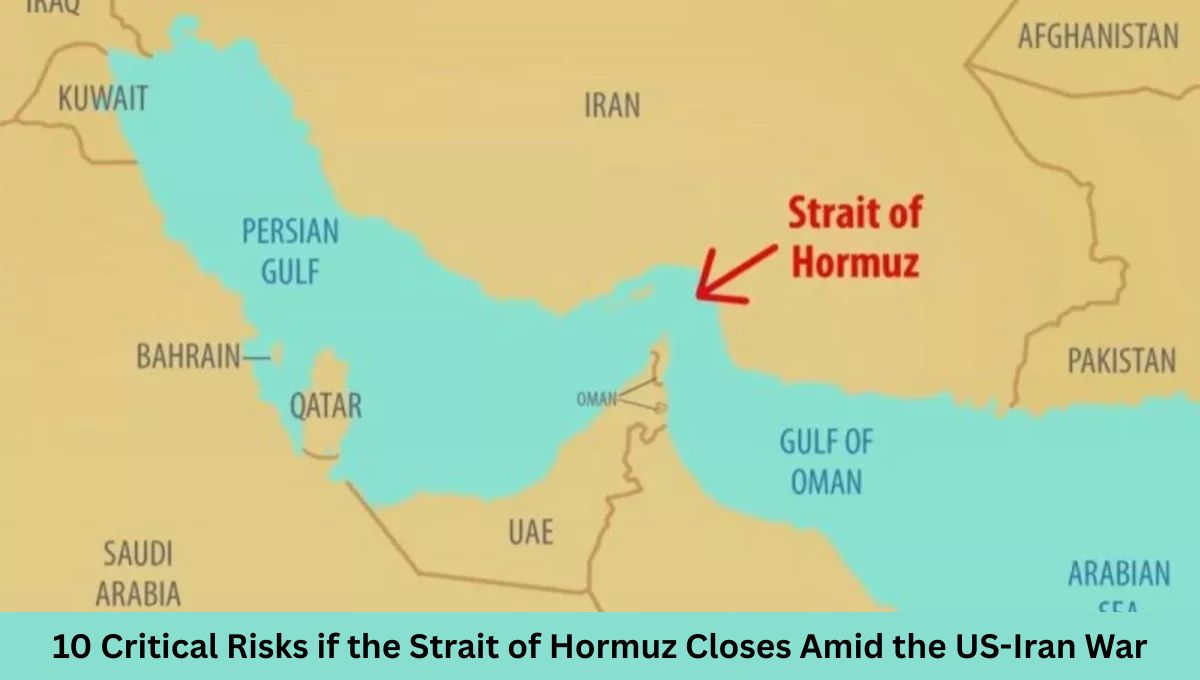
10 Critical Risks if the Strait of Hormuz Closes Amid the US-Iran War, a route for nearly a quarter of global seaborne oil. The escalating conflict between the United States, Israel, and Iran has pushed one of the world’s most vital energy arteries to the brink of paralysis.
The Strait of Hormuz—a narrow maritime corridor linking the Persian Gulf to the Gulf of Oman—has seen tanker traffic collapse amid rising military tensions and Iranian threats to block oil shipments. Global leaders and economic institutions are increasingly worried that a prolonged closure of this strategic passage could trigger a worldwide economic shock.
According to warnings from the United Nations Conference on Trade and Development (UNCTAD), the disruption of shipping through Hormuz could ripple across energy markets, supply chains, and food systems. The situation has already rattled global oil markets, pushed energy prices higher, and created fears of a broader supply chain crisis.
This article explores the 10 critical global risks if the Strait of Hormuz closes during the US-Iran war, explaining why this narrow waterway matters so profoundly to the global economy.

10 Critical Risks if the Strait of Hormuz Closes Amid the US-Iran War
Why the Strait of Hormuz Is So Important
The Strait of Hormuz is widely regarded as the most strategically important oil chokepoint in the world. The waterway lies between Iran to the north and Oman and the United Arab Emirates to the south.
At its narrowest point, the strait is only about 21 miles wide. Yet despite its small size, it carries an enormous share of the world’s energy supply.
According to UNCTAD and global energy data:
- Around 20 million barrels of oil per day passed through the strait in 2024.
- That represents roughly 25% of global seaborne oil trade.
- Nearly one-fifth of global oil consumption depends on this route.
- Large volumes of liquefied natural gas (LNG) also transit the waterway.
Major oil exporters relying on this corridor include:
- Saudi Arabia
- Iraq
- Kuwait
- Qatar
- Bahrain
- United Arab Emirates
- Iran
Most shipments are destined for energy-hungry Asian markets such as China, India, Japan, and South Korea.
If the strait becomes fully blocked, the global energy system would face one of its most severe disruptions in modern history.
The War That Triggered the Crisis
The crisis intensified after US and Israeli forces launched strikes against Iran in late February. Tehran responded with missile and drone attacks while threatening to block shipping through the Strait of Hormuz.
Iran’s Revolutionary Guard has warned that it will not allow oil exports through the passage if hostilities continue.
Iranian officials have even stated that vessels attempting to cross the strait must obtain permission or risk being targeted.
These threats have already caused major disruption. Shipping traffic through the strait has reportedly fallen by as much as 97% since the conflict escalated.
Hundreds of ships have been forced to anchor outside the waterway as oil companies and shipping firms assess the risks.
1. A Massive Global Oil Supply Shock
The most immediate consequence of a Hormuz closure would be a dramatic drop in global oil supply.
The Middle East produces a large share of the world’s crude oil, and much of that output must pass through the strait to reach international markets.
If shipments halt completely:
- Refineries worldwide could run short of crude oil.
- Strategic reserves may need to be released.
- Production cuts could spread across Gulf oilfields.
Already, oil prices have surged sharply during the conflict. At one point, global benchmark crude prices climbed to around $119 per barrel, the highest level in years.
If the disruption continues, analysts warn prices could potentially rise toward $150 per barrel. Such a spike would send shockwaves through the global economy.
2. Severe Energy Shortages in Asia
Asia would be the region hardest hit by a Hormuz closure.
In 2024:
- 84% of crude oil transported through the strait was destined for Asian markets.
- 83% of LNG shipments through the waterway also went to Asia.
Countries heavily dependent on Gulf energy include:
- China
- India
- Japan
- South Korea
- Pakistan
- Bangladesh
These nations rely heavily on Middle Eastern imports for fuel, electricity, and industrial production. Governments across Asia are already scrambling to mitigate the disruption.
Some have introduced fuel price caps, reduced energy exports, or imposed conservation measures. If the closure continues, energy shortages could spread quickly across the region.
3. Global Inflation Could Surge
Energy prices play a major role in shaping global inflation. When oil prices rise sharply, the cost of producing and transporting goods increases.
This often leads to higher prices for:
- Transportation
- Electricity
- Manufacturing
- Consumer goods
Economists warn that a prolonged Hormuz shutdown could push inflation significantly higher worldwide.
Consumers would likely feel the impact through higher fuel prices, increased shipping costs, and rising retail prices.
4. Food Prices Could Rise Worldwide
One of the less obvious but potentially devastating consequences of a Hormuz closure is food inflation.
Energy and agriculture are deeply interconnected. Oil and gas are essential inputs for:
- Farm machinery
- Fertilizer production
- Food transportation
When energy costs rise, agricultural production becomes more expensive. The United Nations has warned that disruptions in Hormuz could raise food prices globally.
Gas prices influence fertilizer costs, while higher fuel prices raise the cost of transporting food from farms to markets.
For many developing countries already facing economic strain, this could worsen food insecurity.
5. Fertilizer Supply Chains Could Collapse
Another major concern is fertilizer supply.
Approximately one-third of global fertilizer trade passes through the Strait of Hormuz. The Gulf region is a major producer of nitrogen-based fertilizers used in agriculture.
If shipments are blocked during key planting seasons, farmers worldwide could struggle to access essential inputs.
This could reduce crop yields and amplify food price spikes in the months ahead.
6. Global Shipping and Supply Chains Could Break Down
The strait is not just an oil corridor. It is also a major route for shipping other commodities and industrial materials.
A shutdown could disrupt global trade flows, affecting industries such as:
- Automotive manufacturing
- Electronics production
- Petrochemicals
- Plastics
- Metals
Shipping companies have already begun suspending routes through the Middle East.
Insurance premiums for vessels operating in the region have soared dramatically—some increasing by as much as 1,000 percent due to war risk.
Without affordable insurance, many shipping firms simply refuse to operate in the area.
7. Oil Tanker Attacks Could Trigger Environmental Disasters
Another major risk is environmental damage. Tankers traveling through the Strait of Hormuz carry millions of barrels of crude oil.
If even one of these vessels were struck or sank, the resulting oil spill could devastate marine ecosystems.
Experts warn that such a disaster could damage:
- Coral reefs
- Mangrove forests
- Seagrass habitats
The Persian Gulf contains fragile ecosystems that support fisheries and coastal economies. An oil spill during wartime could have long-lasting environmental consequences.
8. Global Manufacturing Could Face Raw Material Shortages
The Middle East is also an important exporter of industrial materials.
For example:
- The Gulf region supplies large amounts of aluminum.
- Petrochemical feedstocks used in plastics manufacturing transit through Hormuz.
- Key industrial inputs for electronics and automotive production depend on Gulf exports.
A prolonged disruption could tighten supply chains for global manufacturing. Industries across Europe, North America, and Asia could face rising costs and production delays.
9. Energy Infrastructure Damage Could Prolong the Crisis
Even if the strait eventually reopens, the recovery may take time. Airstrikes and drone attacks have already damaged energy infrastructure across the region.
Several refineries and oil facilities have reportedly been hit during the conflict. Restarting these facilities could take weeks or months, depending on the extent of the damage.
Oilfields that shut down during the crisis may also struggle to resume full production quickly.
10. A Global Economic Slowdown Could Follow
Ultimately, the combined effects of energy shortages, inflation, and supply chain disruptions could slow global economic growth.
History shows that major oil shocks often trigger economic downturns.
The oil crises of the 1970s, for example, led to severe recessions across many developed economies.
If the Strait of Hormuz remains closed for an extended period, economists warn that similar conditions could emerge again.
Can the Strait Be Reopened?
Reopening the Strait of Hormuz during wartime would be extremely difficult.
Naval escorts could theoretically protect commercial ships, but the narrow shipping lanes make vessels vulnerable to:
- Missiles
- Naval mines
- Drone attacks
- Fast attack boats
Military analysts say any attempt to reopen the corridor while hostilities continue would be highly dangerous.
A lasting solution may ultimately depend on a ceasefire or diplomatic agreement.
Strategic Reserves: The World’s Emergency Backup
To cushion the shock, major energy powers are preparing emergency measures.
The International Energy Agency has announced plans to release hundreds of millions of barrels of oil from strategic reserves held by member countries.
Similarly, the United States plans to release oil from its Strategic Petroleum Reserve to stabilize markets.
These reserves can temporarily offset supply disruptions, but they are not a long-term solution if the conflict continues.
The Broader Geopolitical Stakes
The crisis surrounding the Strait of Hormuz highlights how geopolitical conflicts can rapidly threaten the global economy.
Energy security remains one of the most sensitive aspects of international relations. For decades, the Persian Gulf has been a focal point of strategic competition among global powers.
Control over critical shipping routes like Hormuz gives regional actors significant leverage over global markets.
The Road Ahead
The fate of the Strait of Hormuz now depends largely on how the US-Iran conflict evolves.
If tensions de-escalate, shipping traffic could gradually resume and energy markets may stabilize.
But if hostilities intensify or Iran fully blocks the waterway, the consequences could be severe. From oil prices to food costs, the ripple effects would reach far beyond the Middle East.
The world is now watching closely as one of the most critical chokepoints in global trade sits at the center of a dangerous geopolitical confrontation.
Also Read: 7 Stunning Strikes: Iran Claims Destruction of US THAAD Systems and Billion-Dollar Radar in Gulf War
Also Read: Iran sends millions of oil barrels to China through Strait of Hormuz even as war chokes the waterway
Related Posts:
- 3 Explosive Conditions Iran Sets to End War with US…

- 7 Critical Ways Iran’s Yuan Oil Plan Could Shake the…
- 9 Explosive Claims as Trump Says US Winning Iran War

- 7 Powerful Facts About Ayatollah Ali Khamenei’s…

- 10 Powerful Revelations from the Trump–Putin Call on…

- In 8 Moves, EU Targets China-Linked Refineries and…
