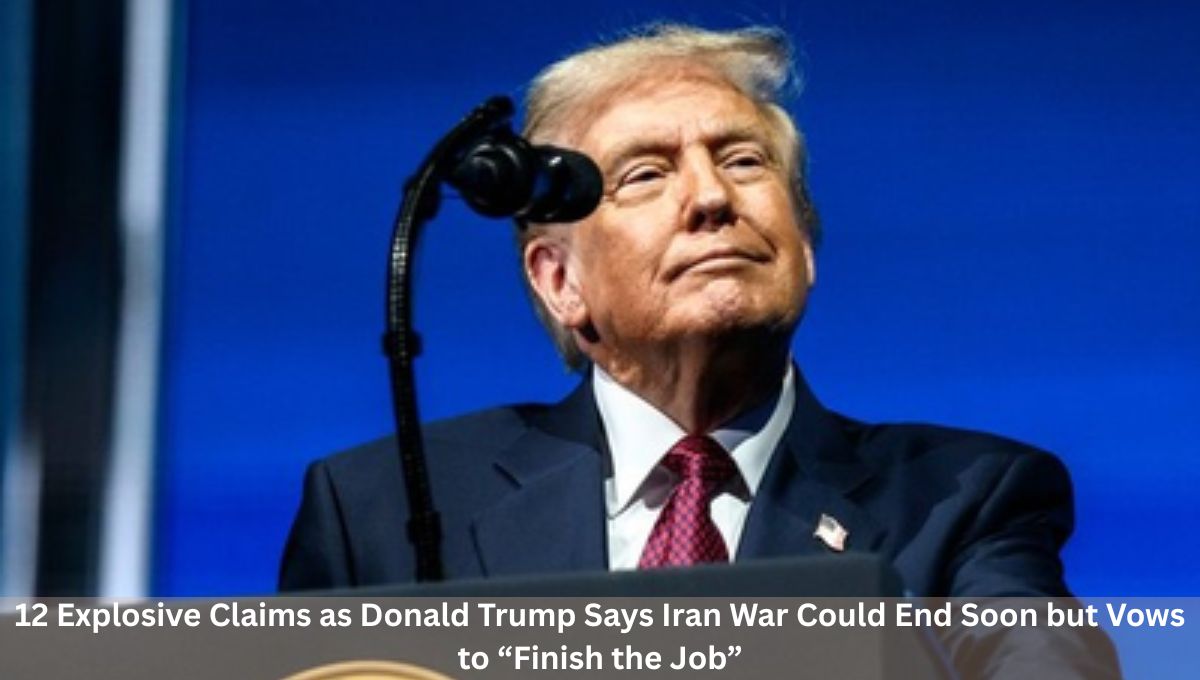
12 Explosive Claims as Donald Trump Says Iran War Could End Soon but Vows to “Finish the Job” amid Strait of Hormuz crisis. The ongoing military confrontation between the United States, Israel, and Iran has entered a new phase of uncertainty as US President Donald Trump signals that the conflict could end soon while simultaneously insisting that Washington must “finish the job.”
In a series of statements to reporters, media outlets, and supporters, Trump has claimed that American forces have inflicted unprecedented damage on Iran’s military infrastructure. At the same time, US and Israeli officials suggest the campaign may continue for weeks as strategic objectives remain unresolved.
The war, which began with coordinated US-Israeli strikes aimed at dismantling Iran’s military and nuclear capabilities, has already triggered regional instability, rising oil prices, and fears of a broader Middle East conflict.
Trump’s latest remarks — including claims that Iran has been hit harder than “virtually any country in history” — highlight both the scale of the military campaign and the uncertainty surrounding how and when the war might end.
12 Explosive Claims as Donald Trump Says Iran War Could End Soon but Vows to “Finish the Job”
Trump Claims the US Has Hit Iran Harder Than Any Nation in History
Speaking outside the White House, Trump declared that the United States has inflicted devastating blows on Iran’s military and strategic infrastructure.
According to the president, American forces have carried out massive operations targeting Iranian missile sites, naval vessels, and drone production facilities.
“We have hit them harder than virtually any country in history has been hit, and we’re not finished yet,” Trump said.
He framed the campaign as a response to what he described as decades of Iranian aggression in the Middle East.
“They are paying the price for 47 years of damage they caused to the world,” Trump added.
These remarks reflect the administration’s narrative that the conflict is both a strategic military operation and a form of historical retaliation against Iran’s regional activities.
Trump Says the War Could End “Any Time”
Despite his aggressive rhetoric, Trump also suggested the conflict could end quickly.
In a brief phone interview with Axios, the US president claimed that American forces have already destroyed most of Iran’s military targets.
“There’s practically nothing left to target in Iran,” Trump said. He added that the timeline for ending the war depends largely on his own decision. “Any time I want it to end, it will end.”
The statement underscores Trump’s repeated claims that the military campaign is ahead of schedule and has exceeded initial expectations.
However, officials in Washington and Israel say no formal directive has yet been issued to halt operations.
“We Don’t Want to Leave Early”: Trump Vows to Finish the Job
While suggesting the war could conclude soon, Trump simultaneously emphasized that the United States must complete its mission.
During remarks at a rally in Hebron, Kentucky, the president told supporters that withdrawing prematurely could allow Iran to rebuild its military capabilities.
“We don’t want to leave early, do we? We’ve got to finish the job,” Trump said.
His comments illustrate the balancing act between declaring victory and ensuring Iran’s military infrastructure cannot recover quickly.
Trump also argued that previous operations against Iran did not permanently neutralize the country’s military potential, which he said prompted the latest campaign.
Trump Claims Iran’s Military Has Been “Virtually Destroyed”
The US president has repeatedly asserted that Iran’s armed forces have suffered catastrophic losses since the conflict began.
According to Trump, American and Israeli strikes have eliminated key elements of Iran’s military power.
He claimed:
- Iran’s air force has been destroyed
- Radar and anti-aircraft systems have been wiped out
- Missile capabilities have been reduced by around 90 percent
- Drone capacity has dropped by roughly 85 percent
“They’ve lost their navy. They’ve lost their air force. They don’t have radar,” Trump said during a speech.
Although independent verification of these claims remains limited, the scale of the bombing campaign has reportedly been enormous.
US Central Command officials say thousands of targets across Iran have been struck since the start of the war.
Thousands of Strikes Across Iran
American military officials have confirmed a massive bombing campaign inside Iran.
According to US Central Command, more than 5,500 targets have been hit during the conflict, including military bases, missile depots, naval facilities, and industrial sites connected to weapons production.
Strike waves have been launched nearly every hour during the most intense phases of the campaign.
Targets reportedly include:
- Missile factories
- Drone production facilities
- Naval bases
- Military command centers
The scale of these operations reflects Washington’s strategy of rapidly degrading Iran’s ability to wage sustained military operations.
The Strait of Hormuz Crisis
One of the most critical aspects of the conflict involves the Strait of Hormuz, a narrow waterway through which roughly 20 percent of the world’s oil supply passes.
Iran’s Islamic Revolutionary Guard Corps has reportedly taken steps to disrupt shipping in the strait. US intelligence recently indicated that Iran had begun deploying mines in the waterway.
Trump said American forces responded by destroying Iranian vessels involved in the operation.
“We hit their mine-laying boats,” he said, adding that dozens of vessels had been targeted. The confrontation around Hormuz has triggered fears of a global energy crisis.
Oil prices have surged amid concerns that the vital shipping route could be completely blocked.
Oil Markets and Global Economic Impact
The conflict has already had significant economic consequences.
With shipping disrupted in the Strait of Hormuz, energy markets around the world have experienced sharp volatility.
Analysts warn that prolonged disruptions could cause:
- Higher global oil prices
- Supply shortages in some regions
- Increased inflation in major economies
In response to rising energy prices, Trump announced that the International Energy Agency plans to release hundreds of millions of barrels of oil from emergency reserves.
The move aims to stabilize global energy markets while the conflict continues.
Iran Continues Missile and Drone Attacks
Despite the scale of US and Israeli strikes, Iran has continued launching missile and drone attacks against targets in the region.
Iranian forces have reportedly targeted:
- Israeli cities
- US military bases in the Middle East
- Energy facilities in Gulf states
Countries such as the United Arab Emirates, Qatar, Saudi Arabia, Bahrain, Kuwait, and Oman have also faced security threats as the conflict spreads across the region.
The ongoing exchanges highlight that Iran retains some operational capabilities despite the damage claimed by US officials.
Iran’s Conditions for Ending the War
Iranian leaders have indicated that they are willing to end the conflict, but only under specific conditions.
Iranian President Masoud Pezeshkian has reportedly demanded:
- Compensation for damage caused by US-Israeli strikes
- Guarantees that Iran will not be attacked again
- International oversight of any future agreements
These conditions suggest that negotiations may be difficult, particularly given the scale of destruction and political hostility between the two sides.
The Rise of Mojtaba Khamenei
Another major development in the conflict has been the leadership transition inside Iran.
Following the death of Supreme Leader Ali Khamenei during the initial US-Israeli strikes, Iran’s Assembly of Experts appointed his son Mojtaba Khamenei as the new supreme leader.
The decision has been widely interpreted as a sign of defiance against Western pressure.
Some analysts argue that the leadership change could strengthen hardline factions within Iran’s political system.
Trump has expressed opposition to Mojtaba Khamenei’s rise but declined to say whether it would affect the outcome of the war.
Uncertainty Over the War’s Endgame
Despite Trump’s claims that the war could end soon, many officials and analysts remain uncertain about the long-term strategy.
Critics in Washington have questioned what will happen if Iran simply rebuilds its military capabilities after the bombing stops.
Democratic Senator Chris Murphy raised this concern after receiving a classified briefing from administration officials.
“The question that stumped them:
What happens when you stop bombing and they restart production?” Murphy said.
He warned that repeated military campaigns could lead to an endless cycle of conflict.
Political Pressure Inside the United States
Domestic politics may also influence decisions about the war’s duration. Several opinion polls suggest that American public support for the conflict remains limited.
Surveys by major polling organizations indicate that only about one-third of Americans believe the military operation has made the country safer.
Many voters are also worried about economic consequences, particularly rising fuel prices. Analysts say these concerns could push the administration to seek a quicker resolution to the conflict.
Israel Signals the War May Continue
While Trump has suggested the war could end soon, Israeli leaders have taken a different tone.
Israeli Defense Minister Israel Katz recently stated that military operations would continue without a strict timeline.
“The operation will continue without any time limit until we achieve all objectives,” Katz said.
This position reflects Israel’s determination to ensure Iran’s military capabilities are permanently weakened.
It also highlights potential differences between Washington and Tel Aviv over the conflict’s duration.
A Conflict With Global Consequences
The war between the United States, Israel, and Iran has already become one of the most significant geopolitical crises of the decade.
Its consequences extend far beyond the battlefield.
The conflict has affected:
- Global oil markets
- International shipping routes
- Middle Eastern security dynamics
- Diplomatic relations between major powers
Countries around the world are closely monitoring the situation as the possibility of escalation remains.
Trump’s Mixed Signals About Victory
Throughout the conflict, Trump has delivered mixed messages about whether the United States has already achieved victory. At times he has suggested the war is essentially over.
At other moments he has insisted the campaign must continue until Iran’s military power is completely eliminated.
“You never like to say too early you won,” Trump said at a recent rally. “But we won.”
Despite that claim, he also emphasized that the United States would remain engaged in the fight.
“We don’t want to go back every two years,” he said, suggesting the current campaign must prevent Iran from rebuilding.
What Happens Next?
The coming weeks may determine whether the conflict moves toward de-escalation or expands further.
Key factors include:
- Iran’s ability to continue military retaliation
- The security of shipping routes in the Strait of Hormuz
- Political pressure inside the United States and Israel
- Diplomatic efforts by international actors
While Trump insists the war could end whenever he chooses, the broader geopolitical realities suggest the path to peace may be far more complicated.
For now, the Middle East — and much of the world — remains on edge as one of the most consequential conflicts in recent history continues to unfold.
Also Read: 10 Explosive Strikes: Israel Bombs Tehran Oil Depots as Iran War Enters Dangerous New Phase
Also Read: We won in the first hour: Trump claims Iran war victory, vows to finish job
Related Posts:
- 3 Explosive Conditions Iran Sets to End War with US…
- 11 Explosive Warnings as Trump Vows to ‘Knock the…

- 10 Explosive Warnings as Donald Trump Calls Iran…
- 10 Explosive Signals Trump Says Iran War Could End…
- 10 Explosive Signals: Trump Rates Iran War “15/10”…
- 9 Explosive Claims as Trump Says US Winning Iran War