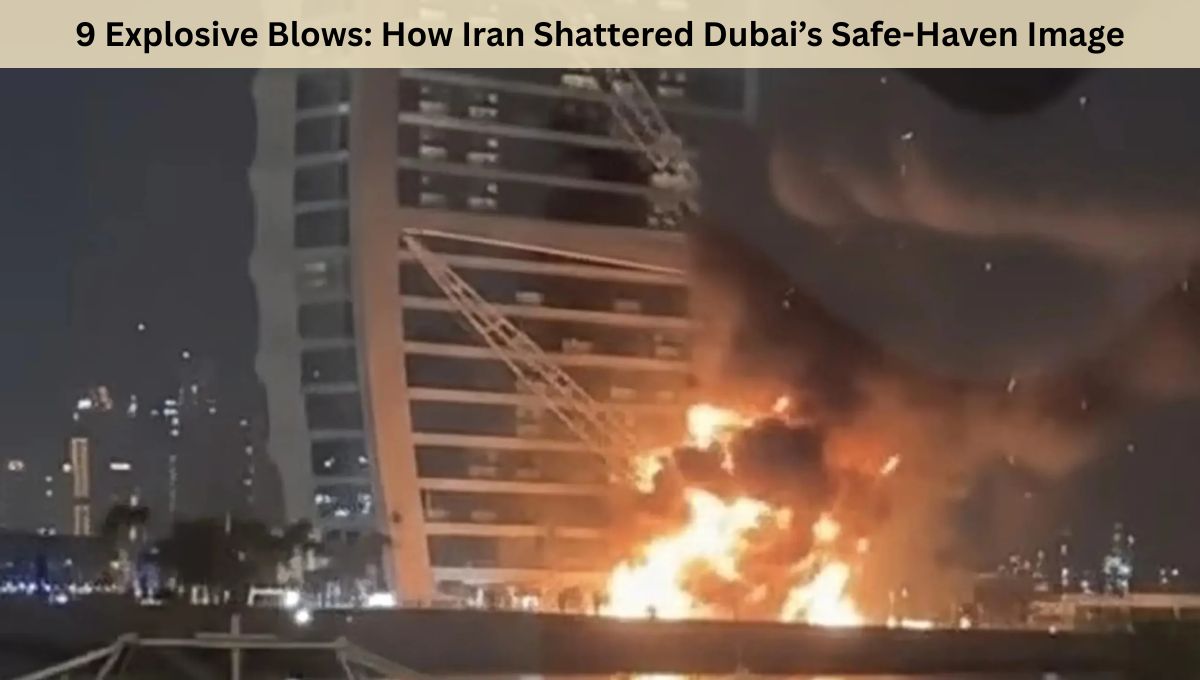
9 Explosive Blows: How Iran Shattered Dubai’s Safe-Haven Image as its drones and missiles hit the Gulf. For decades, Dubai sold the world a powerful idea: that it was insulated from the Middle East’s turbulence. A city of glass towers, luxury hotels and global finance, Dubai marketed itself as a neutral, safe, rules-based hub—far from war, ideology and missiles.
That illusion shattered over a single weekend.
As Iran launched hundreds of drones and ballistic missiles across the Gulf in retaliation for joint US–Israeli strikes that killed Iran’s Supreme Leader, explosions rattled apartment towers, airports were damaged, luxury hotels burned and foreign workers were killed.
For the first time in its modern history, Dubai was directly touched by regional war.
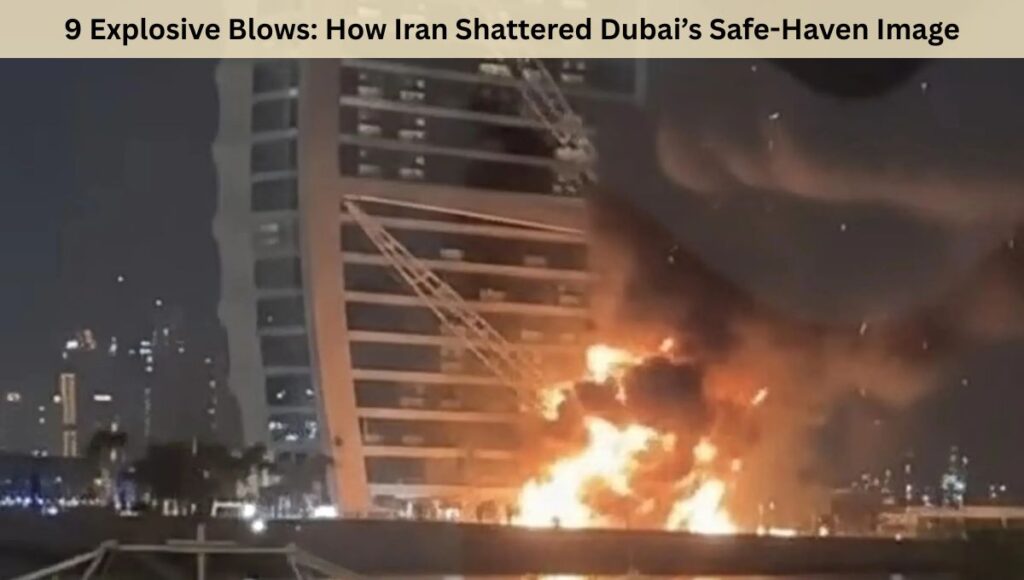
9 Explosive Blows: How Iran Shattered Dubai’s Safe-Haven Image
Iran’s Retaliation Spreads Across the Gulf
Iran’s response was sweeping, calculated—and unprecedented in scale.
According to Iran’s defence ministry, more than 200 drones and 137 ballistic missiles were launched toward Gulf states hosting US assets or aligned with Washington.
Targets included:
- United Arab Emirates
- Qatar
- Bahrain
- Kuwait
- Oman
While most projectiles were intercepted, enough got through—or fell as debris—to cause civilian casualties, fires and infrastructure damage.
The Gulf, long viewed as a refuge from regional chaos, was suddenly on the front line.
Dubai’s Shock Moment
In Dubai, residents described a night of confusion and disbelief. Windows shook. Air-defence interceptors streaked across the sky.
What many first mistook for fireworks quickly became unmistakable:
incoming missiles and drones.
Blasts were reported near:
- Palm Jumeirah
- Burj Al Arab
- Jebel Ali port zone
A fire broke out near luxury hotels, while Dubai International Airport sustained partial damage, disrupting flights and injuring passengers and staff.
At least four people were injured in Dubai alone, while airspace closures stranded thousands of travelers across Asia, Europe and Africa.
Abu Dhabi Hit as Foreign Workers Bear the Brunt
In Abu Dhabi, falling debris from intercepted drones struck near the international airport, killing one Asian national and injuring seven others.
Fragments also hit Etihad Towers, which houses diplomatic missions, including Israel’s embassy.
Across the Gulf, foreign workers—who make up the majority of the population—were disproportionately affected:
- Kuwait: A drone hit the airport, injuring nine workers
- Qatar: At least 16 people injured
- Oman: A drone struck housing near Duqm port, injuring an expatriate worker
The dead in the UAE included Pakistani, Nepali and Bangladeshi nationals, underscoring how the human cost fell largely on migrant communities.
UAE Air Defences Under Unprecedented Strain
The UAE’s military response was massive.
Over two days, authorities said they:
- Destroyed 172 ballistic missiles
- Intercepted 817 drones
- Shot down cruise missiles and sea-bound projectiles
Still, 21 drones reportedly struck civilian areas, and debris caused widespread material damage.
Satellite images captured thick black smoke rising over parts of Dubai, a sight unthinkable just days earlier.
“Nothing Was Valued More Than Safety”
Cinzia Bianco, a Gulf specialist at the European Council on Foreign Relations, summed up the moment bluntly:
“There was nothing they valued more than the perception of safety. That perception has been shaken.”
Dubai had spent decades cultivating ties with Iran—remaining one of its largest trading partners—in part to preserve that sense of insulation.
But Iran’s retaliation spared no Gulf state, not even Oman, long a mediator between Tehran and Washington.
The Broader Context: From Shadow War to Open Confrontation
The Gulf strikes followed a dramatic escalation.
Joint US–Israeli attacks on Iran killed senior leaders, including Supreme Leader Ali Khamenei, ending nearly four decades of his rule.
Iran responded not just against Israel or US bases—but across the wider region.
Missiles and drones targeted:
- US military installations
- Radar systems
- Ports, airports and logistics hubs
Iran’s Islamic Revolutionary Guard Corps (IRGC) declared all US assets in the region “legitimate targets.”
Doha, Manama and the Fear of a Multi-Front War
Explosions were also reported in:
- Doha
- Manama
Qatar said it intercepted 18 ballistic missiles, while Bahrain reported shooting down 45 missiles and nine drones—some aimed near the headquarters of the US Navy’s Fifth Fleet.
Sirens echoed across cities once considered among the safest in the Middle East.
Airspace Closed, Global Aviation Disrupted
The attacks triggered one of the most severe aviation disruptions in recent memory. Airspace over the UAE, Qatar, Bahrain and Kuwait was temporarily closed.
Flights between Asia, Europe and North America were canceled or rerouted. Dubai’s role as a global aviation crossroads suddenly became a vulnerability.
Hotels extended stays for stranded passengers, while governments scrambled to manage tens of thousands of disrupted journeys.
Financial Hubs in Contingency Mode
Dubai and Abu Dhabi’s rise as global financial centers also faced a stress test.
Major banks and hedge funds—including JPMorgan, Citigroup and BlackRock—activated business-continuity plans, with staff told to work from home or shelter in place.
Hedge funds based in the Dubai International Financial Centre reviewed evacuation routes, with some executives relocating staff via Oman.
“This is a first in terms of wartime-related safety issues,” said one senior fund executive.
Energy Markets and the Strait of Hormuz Risk
Governments across Europe and the Middle East warned that continued escalation could destabilise global energy markets.
The potential closure of the Strait of Hormuz—through which a significant share of the world’s oil flows—remains a central fear.
Even rumors of disruption sent oil prices higher and rattled global markets.
UAE Leadership Issues Rare Public Rebuke to Iran
UAE President Mohammed bin Zayed Al Nahyan issued unusually sharp warnings to Tehran.
His diplomatic adviser Anwar Gargash said:
“Your war is not with your neighbours. Return to reason before the circle of isolation and escalation widens.”
The message reflected a wider Gulf consensus:
Iran’s actions risk alienating even those states that had sought dialogue.
Has the Illusion of Insulation Been Broken?
For years, Dubai thrived on a promise:
certainty in an uncertain region.
The latest strikes do not mean the city is unsafe in absolute terms. Its air defences worked. Institutions remained functional. Markets reopened.
But something fundamental changed. For the first time, the Gulf’s most polished oasis experienced war not as a distant headline—but as a lived reality.
Conclusion: A Region Re-Pricing Risk
Dubai will recover. So will Abu Dhabi, Doha and Manama. Yet the events of these days have re-priced geopolitical risk across the Gulf.
Investors, travelers and governments now confront a harder truth:
In a tightly interconnected Middle East, no city—no matter how wealthy or well-defended—is completely insulated.
The safe-haven image that underpinned Dubai’s rise has not vanished—but it has cracked.
What happens next depends on one question the world is now asking with urgency:How long will this war last?
Also Read: 5 Shocking Explosions Near Burj Khalifa: Dubai Caught in Iran’s Expanding War
Also Read: ‘Dubai’s nightmare’: Iranian strikes shatter calm of UAE business hub
Related Posts:
- 5 Major Takeaways from the US Supreme Court's…

- 7 Powerful Facts About Ayatollah Ali Khamenei’s…

- 3 Explosive Conditions Iran Sets to End War with US…

- 7 Heartbreaking Facts About Venezuela's Earthquake Disaster
- 9 Explosive Claims as Trump Says US Winning Iran War

- 10 Explosive Warnings as Donald Trump Calls Iran…