
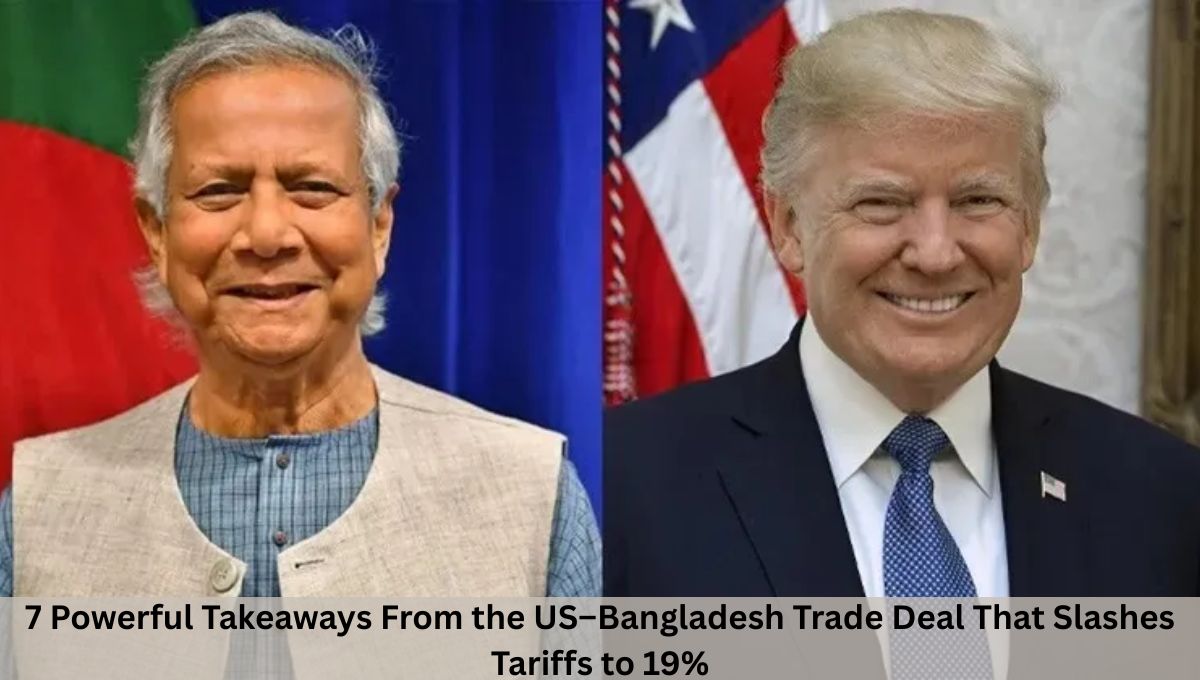
7 Powerful Takeaways From the US–Bangladesh Trade Deal That Slashes Tariffs to 19% and granting zero duty on select garments. The United States and Bangladesh have finalised a sweeping new reciprocal trade agreement that cuts US tariffs on Bangladeshi goods to 19 percent, offers zero-duty access for selected textile and apparel exports, and significantly expands market access for American industrial and agricultural products.
The agreement, signed on Monday after nine months of negotiations, marks the most comprehensive reset in US–Bangladesh trade relations in decades and positions Bangladesh as the first South Asian country to complete a full reciprocal trade deal under President Donald Trump’s latest tariff framework.
For Bangladesh — the world’s second-largest garment exporter — the deal provides critical relief to its export-driven economy at a politically sensitive moment, just days before national elections following months of interim rule.
For Washington, the pact advances Trump’s “reciprocal trade” doctrine by prying open one of South Asia’s most protected markets while strengthening supply chains aligned with US economic and national security interests.
7 Powerful Takeaways From the US–Bangladesh Trade Deal That Slashes Tariffs to 19%
From 37% to 19%: How Bangladesh Secured Tariff Relief
When the Trump administration first unveiled sweeping “reciprocal tariffs” last year, Bangladesh was hit with a punitive 37 percent rate, sparking alarm across its textile and apparel sector.
Following intense negotiations:
- August reduction: Tariffs were cut from 37% to 20%
- Final deal: Tariffs are now reduced further to 19%
While the one-percentage-point cut may appear modest, trade experts note that in high-volume, low-margin industries like garments, even a 1% shift can translate into hundreds of millions of dollars in competitiveness gains.
More importantly, the agreement introduces a pathway to zero tariffs — a first for Bangladesh under Trump’s trade regime.
Zero Reciprocal Tariffs: A Game Changer for Garments
How the Zero-Tariff Mechanism Works
Under the deal, Washington has committed to creating a special mechanism that allows certain Bangladeshi textile and apparel products to enter the US market at a zero reciprocal tariff rate.
However, the benefit is conditional.
- Eligible garments must be produced using US-origin inputs, such as:
- American cotton
- US-manufactured man-made fibres
- The volume of zero-tariff access will be linked directly to:
- Bangladesh’s imports of US textile inputs
In effect, the mechanism ties Bangladesh’s export advantage to increased purchases from American farmers and manufacturers, reinforcing Trump’s trade philosophy that market access must flow both ways.
Why This Matters Globally
Bangladesh supplies clothing to nearly every major US brand, including:
- Levi Strauss
- Fruit of the Loom
- VF Corp (Vans, Timberland, The North Face)
Zero-duty access for even a portion of exports could:
- Lock Bangladesh deeper into US-centric supply chains
- Reduce sourcing volatility for global brands
- Shift production decisions away from competing exporters
Textiles Are Bangladesh’s Economic Backbone
The stakes could not be higher for Dhaka.
- Textiles and garments account for over 80% of Bangladesh’s export earnings
- The sector employs around 4 million workers
- It contributes roughly 10% of GDP
The industry is still recovering from:
- Rising energy costs
- Currency volatility
- Tougher compliance demands
- Political upheaval following the 2024 student-led uprising that toppled the previous government
Bangladesh’s interim leader Muhammad Yunus described the deal as a decisive step to:
“Protect jobs and strengthen Bangladesh’s position in the global textile supply chain.”
What the US Gets: Market Access Across Key Sectors
While tariff headlines focus on Bangladesh’s gains, the agreement delivers wide-ranging concessions to American exporters.
Preferential Access for US Goods
Bangladesh has agreed to grant broad preferential entry to US products, including:
Industrial Goods
- Chemicals
- Medical devices
- Machinery
- Automobiles and auto parts
- ICT equipment
Agricultural Products
- Soybeans and soy products
- Dairy
- Beef and poultry
- Tree nuts and fruit
- Wheat, corn, rice, and cereal grains
Many tariffs will be:
- Cut to zero immediately
- Or reduced by 50% initially, then phased out over 5–10 years
Non-Tariff Barriers: A Quiet but Crucial Shift
Beyond tariffs, the deal tackles long-standing non-tariff barriers that have frustrated US companies.
Bangladesh has committed to:
- Recognising US vehicle safety and emissions standards
- Accepting FDA certifications for pharmaceuticals and medical devices
- Removing import restrictions on remanufactured goods
- Digitising customs procedures
- Adopting “sound regulatory practices”
For multinational firms, these measures may prove as valuable as tariff cuts, reducing compliance costs and delays.
Labour, Environment, and Forced Labour Commitments
In a notable development, the agreement embeds binding labour and environmental commitments.
Bangladesh has pledged to:
- Uphold internationally recognised labour rights
- Strengthen freedom of association and collective bargaining
- Prohibit imports made with forced or compulsory labour
- Enforce environmental protection laws
- Tackle corruption and market distortions tied to state-owned firms
For global buyers increasingly sensitive to ESG standards, these provisions could:
- Improve Bangladesh’s sourcing reputation
- Reduce reputational risks
- Align the country with emerging trade norms
Big-Ticket Commercial Deals: Boeing, Energy, Agriculture
The agreement is backed by a series of major commercial commitments.
Aircraft and Defence
- Biman Bangladesh Airlines plans to purchase 14 Boeing aircraft
- Options for additional orders are included
- Bangladesh will also acquire unspecified US military equipment
Energy and Agriculture
- Around $3.5 billion in US agricultural imports
- An estimated $15 billion in US energy purchases over 15 years
These commitments strengthen US export figures while deepening long-term bilateral ties.
How Bangladesh Compares With India
Bangladesh’s 19% tariff rate places it just above India’s 18% rate, agreed last week under an interim arrangement.
Key differences:
- Bangladesh’s deal is finalised
- India’s agreement still requires further negotiations
- Bangladesh is the first South Asian country to complete a reciprocal trade pact with Washington
For years, Bangladeshi manufacturers feared losing US clients to India after facing steeper tariffs. The new deal largely levels the playing field.
Political Timing: Trade Deal on the Eve of Elections
The agreement arrives at a critical political moment.
- Bangladesh goes to the polls on Thursday
- The country has been under interim rule since August 2024
- Former Prime Minister Sheikh Hasina fled to India amid unrest
For the interim government, the trade pact:
- Signals economic credibility
- Reassures investors and exporters
- Demonstrates diplomatic effectiveness under pressure
What This Means for Global Supply Chains
From a global perspective, the US–Bangladesh trade deal reflects broader trends:
- Friend-shoring of supply chains
- Linking trade access to input sourcing
- Blending tariffs with labour, environmental, and security goals
- Using trade agreements as geopolitical tools
For apparel brands, the deal may:
- Stabilise sourcing from Bangladesh
- Encourage use of US raw materials
- Reduce exposure to tariff shocks
Final Analysis: A Strategic Win With Long-Term Implications
The US–Bangladesh Agreement on Reciprocal Trade is more than a tariff adjustment.
It is a strategic recalibration of economic relations that reshapes incentives across textiles, agriculture, manufacturing, and investment.
For Bangladesh, it offers:
- Tariff relief
- Conditional zero-duty access
- Supply chain security
- Global credibility
For the United States, it delivers:
- Expanded export markets
- Supply chain influence
- Labour and environmental leverage
- Geopolitical alignment in South Asia
As global trade fragments into blocs and bilateral deals, this agreement stands out as a template for how trade, politics, and security increasingly intersect in the post-globalisation era.
Also Read: China, Pakistan, Bangladesh Push to Replace SAARC: Strategic Bloc Raises Alarm Bells in India
Also Read: India and Bangladesh both signed trade pacts with US. Who got a better deal?
Related Posts:
- 5 Major Takeaways from the US Supreme Court's…

- 7 Heartbreaking Facts About Venezuela's Earthquake Disaster

- 11 Explosive Revelations From Ted Cruz’s Leaked…

- In 8 Moves, EU Targets China-Linked Refineries and…

- 7 Powerful Facts About Ayatollah Ali Khamenei’s…

- 7 Powerful Measures: Trump Sanctions Russian Oil…
