

7 Explosive Reasons Trump Warns China Could “Eat Them Up” — fierce attack on Canada.US President Donald Trump has sharply escalated tensions with Canada, accusing Ottawa of undermining North American security by rejecting his proposed “Golden Dome” missile defence project over Greenland and instead strengthening economic ties with China.
In a blistering post on Truth Social, Trump warned that Beijing could “eat them up” within a year, framing Canada’s China pivot as both a strategic and security threat.
The remarks mark one of the most confrontational episodes in modern US–Canada relations, unfolding against a backdrop of intensifying global rivalry, renewed tariff wars, and competing visions for the future of the international order.
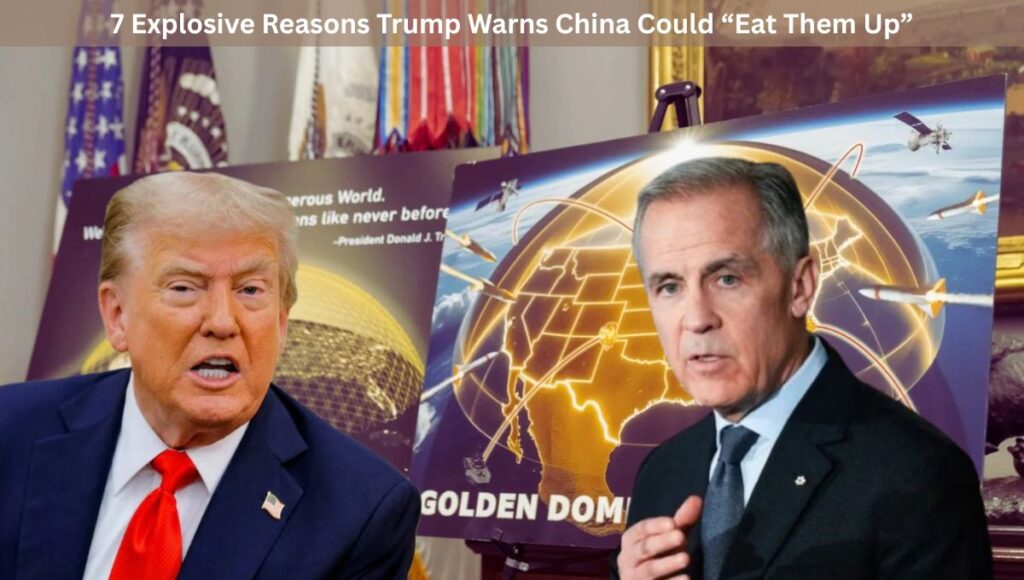
7 Explosive Reasons Trump Warns China Could “Eat Them Up”
What Is the Golden Dome Missile Defence System?
The Golden Dome is an ambitious US-led missile defence initiative envisioned as a continental shield over North America.
Modelled loosely on Israel’s Iron Dome but vastly larger in scope, the system would integrate ground-based and space-based interceptors capable of detecting and neutralising ballistic, cruise, and hypersonic missile threats at every phase of launch.
Greenland, an autonomous territory of Denmark, plays a central role in Trump’s plan due to its strategic Arctic location.
The island offers a critical vantage point for early-warning radar systems and interceptor deployment, making it a cornerstone of any northern hemisphere missile defence architecture.
The Trump administration estimates the Golden Dome will cost roughly USD 175 billion. However, the Congressional Budget Office has warned that space-based components alone could cost between USD 161 billion and USD 542 billion over a 20-year period, raising serious questions about affordability and long-term sustainability.
“China Will Eat Them Up”: Trump’s Truth Social Outburst
Trump’s anger spilled onto social media after Canada signalled its opposition to hosting or endorsing the Golden Dome project over Greenland.
Writing on Truth Social, Trump said Canada was rejecting protection from the United States while choosing closer economic engagement with Beijing.
“Canada is against The Golden Dome being built over Greenland, even though The Golden Dome would protect Canada,” Trump wrote. “Instead, they voted in favour of doing business with China, who will ‘eat them up’ within the first year!”
The language underscored Trump’s belief that Canada’s security is inseparable from US military power and that any strategic drift toward China represents a direct threat to North American stability.
World Economic Forum Clash in Davos
The dispute intensified at the World Economic Forum in Davos, where both leaders delivered sharply contrasting messages.
Trump used his address to criticise Canadian Prime Minister Mark Carney, accusing Canada of enjoying US security and economic benefits without sufficient gratitude.
“Canada gets a lot of freebies from us,” Trump said. “They should be grateful, but they’re not. I saw your Prime Minister yesterday; he wasn’t so grateful.”
Trump went further, asserting that Canada’s survival depends on American protection. “Canada lives because of the United States. Remember that, Mark, the next time you make your statements,” he said.
Carney, speaking earlier at Davos, warned that the world had entered “an era of great power rivalry” and cautioned against tariff coercion and unilateral pressure by dominant states — remarks widely interpreted as a veiled criticism of Washington.
Mark Carney’s China Trade Pivot
Fueling Trump’s anger is Canada’s recent trade agreement with China, announced by Carney on January 17.
The deal opens more than USD 7 billion in export markets for Canadian businesses and workers, according to the Prime Minister’s Office.
Under the agreement, Canada agreed to cut its 100 per cent tariff on Chinese electric vehicles in exchange for sharply reduced Chinese tariffs on Canadian agricultural products, including canola seeds. Beijing is set to lower its tariff on canola from 84 per cent to around 15 per cent.
Chinese EV exports to Canada will initially be capped at 49,000 vehicles per year, rising to approximately 70,000 over five years.
The arrangement reverses tariffs imposed in coordination with Washington in 2024 amid concerns about market dumping.
Carney defended the move as pragmatic economic diversification, arguing that China has become a more predictable trading partner than the United States.
“Our relationship has progressed in recent months with China. It is more predictable and you see results coming from that,” Carney said in remarks quoted by CBS News.
Canada’s Tariff Pressures From Washington
Canada’s pivot comes amid mounting trade pressure from the United States. Ottawa faces a 35 per cent levy on its goods, alongside a blanket 50 per cent tariff on imported metals and a 25 per cent tariff on non-US automobiles.
While Washington and Beijing have engaged in their own tariff brinkmanship — including threats of 100 per cent duties — a meeting between Trump and Chinese President Xi Jinping resulted in partial exemptions on certain Chinese products until November 10, 2026.
For Canadian policymakers, the volatility of US trade policy has reinforced arguments for diversifying partnerships beyond their largest trading partner.
Trump’s Strategic Obsession With Greenland
Greenland has long occupied an outsized place in Trump’s geopolitical thinking. Rich in critical minerals and positioned at the gateway to the Arctic, the island has become increasingly important as climate change opens new shipping routes and intensifies competition among the US, China, and Russia.
Trump has argued that control or influence over Greenland is essential for US missile defence, Arctic dominance, and long-term national security.
His insistence that the Golden Dome cannot succeed without Greenland has alarmed allies and drawn criticism from Denmark, which retains sovereignty over the territory.
Canada’s reluctance to endorse the project has therefore been interpreted by Trump not merely as policy disagreement, but as strategic defiance.
Diplomatic Fallout: Board of Peace Snub
Relations deteriorated further after Trump withdrew Canada’s invitation to his proposed “Board of Peace,” a US-led initiative aimed at resolving global conflicts.
The withdrawal was widely seen as retaliation for Carney’s Davos remarks and Canada’s refusal to align with Washington on defence and trade.
The snub underscored how quickly personal grievances and policy disputes have translated into diplomatic consequences under Trump’s leadership style.
Carney Pushes Back on US Claims
Upon returning to Canada, Carney forcefully rejected Trump’s assertions of dependency. “Canada doesn’t live because of the United States. Canada thrives because we are Canadian,” he said in a national address.
While reaffirming the importance of the bilateral partnership, Carney stressed Canadian sovereignty and the right to pursue independent trade and foreign policy decisions.
“We are masters in our home. This is our country, our future, and the choice is up to us,” he said.
A Long History of Provocation
Trump’s recent remarks are part of a broader pattern. He has repeatedly floated the idea of Canada becoming the 51st US state and has shared altered maps portraying Canada, Greenland, Venezuela, and Cuba as part of US territory.
Canada’s ambassador to the United Nations, Bob Rae, previously dismissed Trump’s Golden Dome vision as resembling a “protection racket,” highlighting Ottawa’s discomfort with the proposal.
The Cost and Feasibility Debate
Beyond diplomacy, the Golden Dome faces intense scrutiny over cost and feasibility. Defence analysts warn that space-based interceptors remain technologically complex and financially risky, with uncertain effectiveness against advanced hypersonic weapons.
Critics argue that the project could spark a new arms race, encouraging adversaries to develop countermeasures rather than enhancing global security.
What This Means for US–Canada Relations
The Golden Dome dispute has exposed deep fractures in a relationship once considered among the world’s most stable alliances.
Trade disputes, diverging China strategies, and conflicting visions of global leadership are reshaping the dynamics between Washington and Ottawa.
While both sides insist the partnership remains strong, the rhetoric suggests a period of prolonged tension is likely, particularly as Trump continues to frame loyalty in stark, transactional terms.
A Defining Moment for North America
As geopolitical competition intensifies, Canada finds itself navigating between economic pragmatism and strategic alignment, while the United States pushes for unified defence under American leadership.
Whether the Golden Dome becomes a symbol of continental security or a flashpoint for alliance fracture may depend less on technology than on diplomacy — and on whether Washington and Ottawa can reconcile sovereignty with shared security in an increasingly divided world.
Also Read: Trump Unveils $175 Billion ‘Golden Dome’ Missile Defence Plan to Counter Global Threats
Also Read: Trump warns China could ‘eat up’ Canada for opposing Greenland Golden Dome
Related Posts:
- 7 Explosive Reasons Denmark Warned Trump to Stop…

- Why Trump’s ‘Golden Dome’ Missile Defense System…

- Trump Unveils $175 Billion ‘Golden Dome’ Missile…

- Trump Offers Canada Free Entry Into ‘Golden Dome’…

- North Korea Slams Trump’s $175 Billion 'Golden Dome'…
- 9 Explosive Developments as Trump Taps Greenland Envoy
