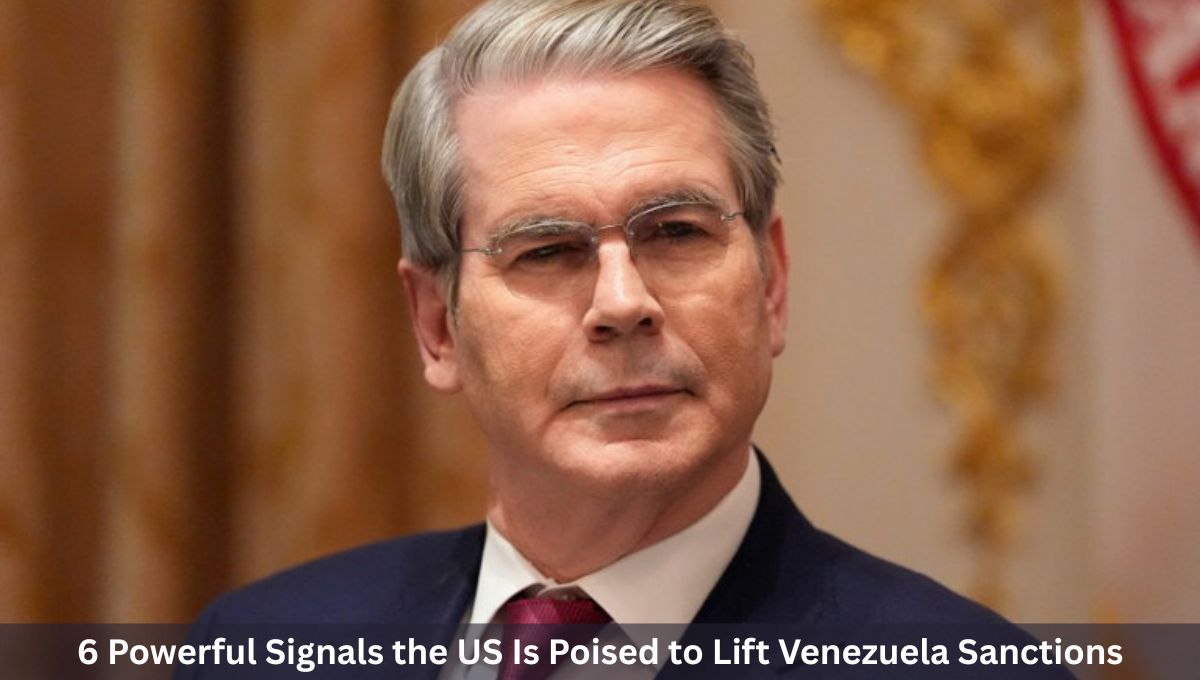
6 Powerful Signals the US Is Poised to Lift Venezuela Sanctions next week. The United States may lift additional sanctions on Venezuela as early as next week, signaling a dramatic shift in Washington’s policy toward the oil-rich nation following the capture of longtime leader Nicolás Maduro.
U.S. Treasury Secretary Scott Bessent said in an interview with Reuters that the Trump administration is actively examining further sanctions relief to facilitate Venezuelan oil sales, unlock billions of dollars in frozen international assets and encourage the return of American energy companies to a country whose economy has been crippled for years.
The comments mark one of the clearest indications yet that the US is preparing to move quickly from military intervention to economic restructuring in Venezuela, with oil exports, financial stabilization and multilateral re-engagement at the center of the strategy.

6 Powerful Signals the US Is Poised to Lift Venezuela Sanctions
“It Could Be as Soon as Next Week”
Asked directly when more sanctions might be lifted, Bessent did not hedge.
“It could be as soon as next week,” he told Reuters, declining to specify which measures would be removed.
The Treasury secretary’s remarks come just days after US forces captured Nicolás Maduro in Caracas and flew him to New York to face federal drug trafficking and narco-terrorism charges — an operation that has already reshaped Venezuela’s political landscape.
De-Sanctioning Venezuelan Oil
At the core of Washington’s near-term plans is oil.
“We’re de-sanctioning the oil that’s going to be sold,” Bessent said during a visit to a Winnebago Industries engineering facility.
The Treasury Department is reviewing sanctions rules that currently restrict how Venezuelan oil — much of it stored on ships — can be sold and how the proceeds can be repatriated.
“How can we help that get back into Venezuela, to run the government, run the security services and get it to the Venezuelan people?” Bessent said, describing the administration’s internal analysis.
US sanctions have long blocked international banks, traders and insurers from dealing with Venezuela without special licenses, making even basic oil transactions legally risky.
Why Oil Is Central to the Strategy
Venezuela holds the world’s largest proven crude oil reserves, yet years of sanctions, mismanagement and underinvestment have left production at a fraction of its potential.
For the Trump administration, restoring oil exports serves several objectives at once:
- Reviving Venezuela’s collapsed economy
- Generating revenue to stabilize the interim government
- Reducing incentives for migration
- Creating conditions for US corporate re-entry
- Limiting the influence of rival powers such as China and Russia
Oil, in short, is the financial engine Washington believes can power Venezuela’s recovery.
Unlocking Nearly $5 Billion in Frozen IMF Funds
Beyond oil, Bessent revealed a potentially transformative move: deploying Venezuela’s frozen assets at the International Monetary Fund.
According to the Treasury secretary, nearly $5 billion worth of IMF Special Drawing Rights (SDRs) could be used to help rebuild Venezuela’s economy.
Venezuela currently holds 3.59 billion SDRs, worth about $4.9 billion at recent exchange rates. However, sanctions and diplomatic isolation have left Caracas unable to access them.
“The US Treasury would be willing to convert Venezuela’s IMF SDRs to dollars for use in rebuilding the country,” Bessent said.
SDRs are reserve assets composed of a basket of major currencies — dollars, euros, yen, sterling and Chinese yuan — and can be exchanged for hard currency with IMF approval.
IMF and World Bank Re-Engagement After Two Decades
Bessent also confirmed he plans to meet next week with the heads of both the IMF and the World Bank to discuss renewed engagement with Venezuela.
“The two institutions have already reached out,” he said.
The move would mark a historic shift. The IMF has not formally engaged with Venezuela in more than 20 years, and its last comprehensive assessment of the Venezuelan economy dates back to 2004.
Venezuela paid off its final World Bank loan in 2007, after which then-President Hugo Chávez declared the country would “no longer have to go to Washington” for funding.
World Bank Exploring Early Assistance
A source familiar with internal World Bank discussions said the institution is in the early stages of examining how it could assist Venezuela.
The source noted that the bank has previously moved quickly after regime changes, including in:
- Afghanistan
- Syria
- Gaza
- Ukraine
Early involvement could include technical assistance, emergency funding frameworks and institutional rebuilding rather than large-scale loans.
Sanctions and the $150 Billion Debt Problem
One of the biggest obstacles facing Venezuela’s recovery is its estimated $150 billion debt pile, widely viewed as unsustainable without restructuring.
US sanctions have prevented international banks and creditors from engaging with the Venezuelan government, making negotiations nearly impossible.
Financial institutions have repeatedly cited sanctions as the primary barrier to any comprehensive debt deal — a problem Washington now appears willing to address.
Trump’s Executive Order on Venezuelan Oil Revenue
On Friday evening, President Donald Trump signed an executive order blocking courts or creditors from seizing Venezuelan oil revenues held in US Treasury accounts.
The order declares that such funds must be protected to promote:
“Peace, prosperity and stability” in Venezuela.
The administration framed the move as necessary to prevent legal chaos while economic reforms are implemented.
Encouraging US Oil Companies to Return
Sanctions relief is also designed to lure US energy companies back into Venezuela — though enthusiasm varies widely.
Bessent said he believes smaller, privately held firms will move fastest.
“Private companies can move quickly and will come in very quickly,” he said. “They haven’t talked about financing at all.”
Chevron’s Expanding Role
Chevron, which maintained a limited presence in Venezuela even under sanctions, is expected to deepen its involvement.
“Chevron has been there a long time and will continue to be there,” Bessent said. “I believe that their commitment will greatly increase.”
Chevron’s existing infrastructure and relationships give it a strategic advantage as restrictions ease.
Oil Majors Remain Cautious
Not all energy giants are convinced.
Executives from companies such as Exxon Mobil, whose Venezuelan assets were nationalized twice, have expressed deep reservations.
Exxon CEO Darren Woods reportedly described Venezuela’s oil sector as currently “uninvestable,” citing legal uncertainty, degraded infrastructure and political risk.
Is Venezuela’s Oil Sector Ready?
Industry experts warn that restarting large-scale production will require:
- Massive capital investment
- Legal guarantees against expropriation
- Infrastructure rehabilitation
- Skilled labor rebuilding
- Environmental remediation
Energy Secretary Chris Wright has said the often-quoted $100 billion investment figure represents the scale of reconstruction needed, not a firm pledge from companies.
Export-Import Bank Could Back Financing
Bessent suggested the US Export-Import Bank could play a role in guaranteeing financing for Venezuela’s oil sector.
Such guarantees could lower risk for US firms while maintaining Washington’s leverage over the pace and direction of investment.
Trump’s Broader Vision for Venezuela
President Trump has framed the post-Maduro phase as both a moral and economic opportunity.
In a Truth Social post, he said interim Venezuelan authorities would transfer 30–50 million barrels of sanctioned oil to the United States, with proceeds controlled by the US government to benefit both countries.
The oil would be shipped directly to US ports and sold at market prices, Trump said.
Skepticism From Analysts
Energy analysts caution that expectations must be managed.
“There’s a process,” said analyst Thomas O’Donnell. “You can begin gradually. It’s not just a matter of making big investments overnight.”
Others note that Venezuela previously had to reopen its oil fields to private companies in the 1990s due to technical limitations — a reminder of the structural challenges ahead.
Why This Matters Globally
The potential lifting of Venezuela sanctions carries implications far beyond Caracas:
- Global oil supply and prices
- US-Latin America relations
- IMF and World Bank credibility
- Precedents for post-regime-change engagement
- Competition with China and Russia in the region
Washington’s approach could become a template — or a cautionary tale.
A High-Stakes Economic Pivot
Less than two weeks after a dramatic military operation removed Nicolás Maduro from power, the United States is signaling a rapid pivot to economic state-building.
By easing sanctions, unlocking frozen funds and inviting multilateral lenders back in, the Trump administration is betting that financial normalization can stabilize Venezuela faster than prolonged isolation ever did.
Whether that gamble succeeds will depend on execution, transparency and the willingness of global institutions — and markets — to trust that this time, Venezuela’s recovery will be different.
For now, one thing is clear:
after years of maximum pressure, Washington is preparing to turn the page.
Also Read: 7 Explosive Truths Behind Trump’s $2 Billion Venezuela Oil Gamble
Also Read: US Treasury to Lift Venezuela Sanctions Next Week to Boost Oil Sales