7 Explosive Turns as Trump Rejects Putin Attack Claim while peace talks hang in the balance.US President Donald Trump has publicly dismissed Russia’s claim that Ukraine launched a drone attack on a residence used by President Vladimir Putin, saying American officials found no evidence that Kyiv targeted the property.
Trump’s remarks marked a sharp shift from his initial reaction, when he said he was “very angry” after Putin personally raised the allegation during a phone call.
Speaking to reporters aboard Air Force One on Sunday night, Trump said US intelligence reviews concluded that while “something happened fairly nearby,” it had “nothing to do” with a Ukrainian strike on Putin’s residence. “I don’t believe that strike happened,” Trump said, undercutting Moscow’s narrative at a sensitive moment in peace negotiations.
The alleged incident was first reported by Russia’s Defence Ministry last week, which released video footage of what it described as a downed Ukrainian drone near a presidential residence in Russia’s Novgorod region. Kyiv immediately rejected the accusation, calling it a fabricated or exaggerated claim designed to derail diplomacy.
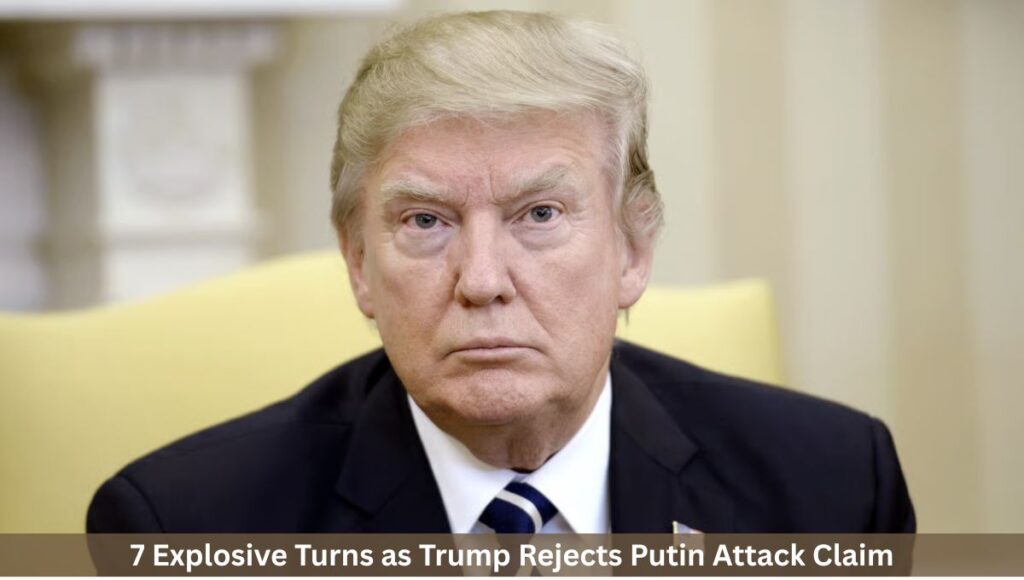
7 Explosive Turns as Trump Rejects Putin Attack Claim
Ukraine and Allies Cry False Flag
Ukraine’s government moved quickly to deny any involvement, accusing Moscow of staging or embellishing the episode as a pretext to harden its negotiating stance. Ukrainian officials said Russia provided no verifiable evidence linking Kyiv to an attack on Putin’s residence.
Western governments also expressed skepticism. Several officials said the footage released by Russia failed to establish when or where the drone was downed, or whether it was even aimed at a high-value target. Analysts noted that Moscow did not explain how it determined the drone’s intended destination.
The Russian Defence Ministry claimed that 91 long-range drones were launched from Ukraine’s Sumy and Chernihiv regions in a “thoroughly planned” operation. It said Russian air defenses intercepted the drones, causing no damage and no injuries. However, Reuters and other independent observers were unable to verify the claims.
A senior Ukrainian Foreign Ministry spokesperson described the video as “laughable,” insisting that no such attack took place. “We are absolutely confident that Ukraine did not target any residence of Vladimir Putin,” the spokesperson said.
Trump’s Reversal and the Intelligence Review
Trump’s dismissal of the Kremlin’s account followed an internal US review involving intelligence agencies, including the CIA, according to American officials familiar with the matter. The assessment reportedly concluded that Ukraine did not attempt to strike Putin’s residence, reinforcing Kyiv’s denial.
The reversal highlights Trump’s balancing act as he seeks to broker an end to the nearly four-year-long Russia–Ukraine war. While Trump has frequently criticized Ukrainian President Volodymyr Zelenskyy in the past, he has also shown growing frustration with Putin, particularly over what he views as Russian efforts to stall negotiations.
Last week, Trump shared a New York Post editorial questioning the credibility of Moscow’s claim and accusing Putin of standing in the way of peace. The editorial argued that the alleged attack fit a pattern of Russian disinformation designed to justify continued aggression.
Timing Raises Diplomatic Suspicions
The timing of Russia’s allegation raised eyebrows in Washington and European capitals. It surfaced just as Ukraine and the United States were coordinating updates to a US-backed peace framework aimed at halting the conflict.
European leaders are expected to meet in France this week to discuss the proposed ceasefire plan, which Zelenskyy has said is “90 percent ready.” Remaining obstacles include territorial questions, particularly whether Ukraine would be asked to concede land seized by Russia since the invasion began.
Ukrainian officials have suggested that Moscow deliberately raised the residence attack claim to poison the diplomatic atmosphere and justify a tougher position at the negotiating table. The Kremlin, for its part, said the alleged incident would force it to review its stance on peace talks.
Russian Strikes Kill Two in Kyiv
As diplomatic tensions simmered, violence on the ground continued. Ukrainian authorities reported that overnight Russian attacks on the Kyiv region killed two civilians, marking the first reported civilian deaths in the capital in 2026.
According to Ukraine’s State Emergency Service, a Russian strike ignited a fire at a medical facility in Kyiv’s Obolonskyi district, where an inpatient ward was operating. After firefighters extinguished the blaze, responders found a body inside the building. A woman was injured, and at least 25 people were evacuated.
In the broader Kyiv region, Governor Mykola Kalashnyk said Russian attacks damaged towns and villages and struck critical infrastructure. A man in his 70s was killed in the Fastiv district southwest of the capital, and parts of the region were left without electricity.
Russia has not yet commented publicly on the overnight strikes.
Kyiv’s First Civilian Deaths of 2026
The deaths in Kyiv underscored the fragility of hopes for de-escalation. Although the front lines have largely stabilized in recent months, Russia continues to launch drone and missile attacks across Ukraine, frequently targeting energy infrastructure and urban areas.
Ukrainian officials say such strikes are intended to pressure civilians and weaken morale, especially during winter months. Russia denies deliberately targeting civilians, despite repeated documentation of strikes hitting residential buildings, hospitals, and power facilities.
The Kyiv deaths follow a period of relative calm in the capital, making them particularly jarring for residents who had begun to believe the city was safer from direct attack.
Kremlin’s Narrative and Skepticism
The Kremlin has framed the alleged drone incident as evidence of Ukrainian recklessness and as justification for a more rigid negotiating posture. Kremlin spokesperson Dmitry Peskov said Russia would not tolerate attacks on its leadership or symbols of state power.
Critics argue that Moscow’s narrative strains credibility. They point out that Russia has repeatedly accused Ukraine of dramatic plots without providing corroborating evidence, while simultaneously conducting large-scale attacks on Ukrainian cities.
Analysts also note that Russia has a history of invoking security threats to rally domestic support and deflect attention from battlefield setbacks or economic strain.
Trump’s Peace Push Under Pressure
Trump has repeatedly said he wants to end the war in Ukraine, emphasizing the human cost of continued fighting. He has cited estimates that 25,000 to 30,000 soldiers are killed each month on both sides, calling the conflict a “bloodbath” that must be stopped.
During recent talks at his Mar-a-Lago resort, Trump and Zelenskyy reportedly made progress on several elements of a peace plan. Trump even suggested he would be willing to visit Ukraine to help persuade lawmakers to accept difficult compromises.
However, Putin has shown little sign of softening his demands. Moscow continues to insist on far-reaching concessions, including recognition of Russian control over occupied territories and limits on Ukraine’s future military capabilities.
Wider Geopolitical Context
The dispute over the alleged residence attack comes amid broader geopolitical tensions involving Russia. Moscow has maintained close ties with Iran, launched satellites on Tehran’s behalf, and supported Venezuelan President Nicolas Maduro, whose government has faced renewed pressure from Washington.
A recent investigative report also suggested that a Russian “shadow fleet” vessel that sank off the coast of Spain last year may have been transporting sensitive nuclear-related components to North Korea, highlighting concerns about Moscow’s global activities.
These actions have fueled skepticism in Washington that Putin is acting in good faith as a peace broker.
Europe Watches Closely
European governments have largely aligned with Washington in questioning Russia’s claim about the alleged drone attack. Leaders in Paris, Berlin, and Brussels are expected to push for stronger guarantees that any ceasefire would be respected by Moscow.
At the same time, European officials are wary of a deal that could freeze the conflict on terms favorable to Russia, fearing it would reward aggression and set a dangerous precedent.
What Comes Next
With Trump now openly rejecting the Kremlin’s account of the alleged attack on Putin’s residence, pressure is mounting on Moscow to clarify its position and engage constructively in talks.
For Ukraine, the episode reinforces long-standing concerns that Russia uses misinformation to manipulate diplomatic processes. For the United States, it underscores the challenge of mediating between two deeply mistrustful adversaries.
As civilians continue to die in Kyiv and elsewhere, the gap between rhetoric and reality remains stark. Whether Trump’s skepticism marks a turning point in negotiations or simply another chapter in a protracted conflict remains to be seen.
For now, the war grinds on, even as claims, counterclaims, and fragile hopes for peace collide on the global stage.
Also Read: 11 Crucial Takeaways from Trump–Zelensky Talks That Could Shape Ukraine’s Fate
Also Read: Trump Signals Russia Blocking Path to Peace as US Intel Rejects Putin’s Claim, Voters Grow Skeptical