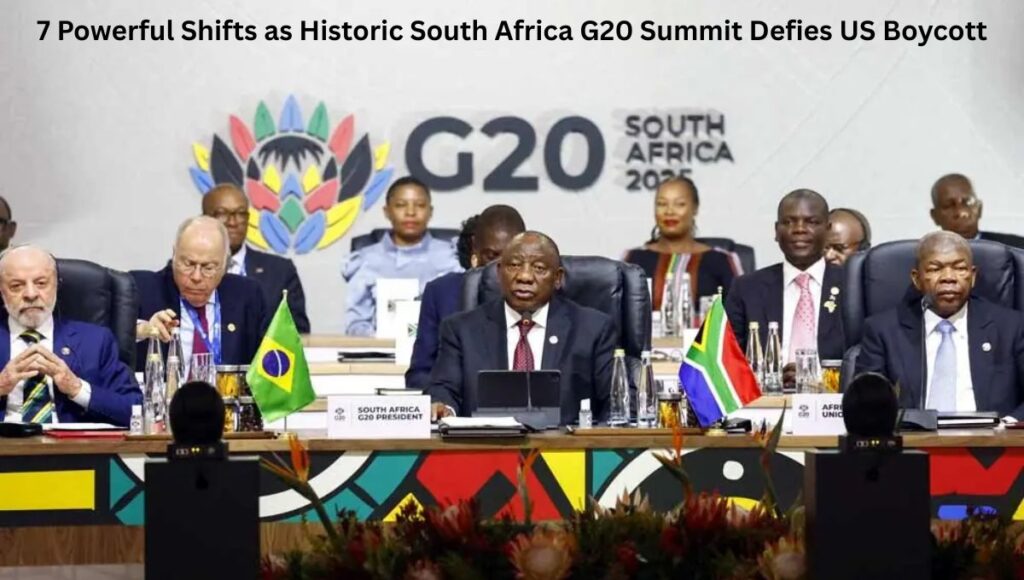
7 Powerful Shifts as Historic South Africa G20 Summit Defies US Boycott, prioritizing territorial integrity, climate action, debt relief and Global South concerns. The first-ever G20 Summit hosted on African soil unfolded in Johannesburg under the shadow of intensifying geopolitical tensions, global economic uncertainty and a highly unusual boycott by the United States.
Yet, despite the absence of the world’s largest economy and its strongest military power, leaders from across the world’s top economies achieved what many had deemed politically impossible just days earlier: unanimous adoption of a landmark joint declaration.
The declaration reasserts foundational global principles—especially territorial integrity, peaceful dispute resolution and adherence to the UN Charter—while sharply elevating the priorities of the Global South, including climate resilience, food security, digital inclusion, debt reform and equitable growth.
In the words of South African President Cyril Ramaphosa:
“We should not allow anything to diminish the value and impact of the first African G20 presidency.”
The document’s approval at the start of the summit, not the end, was unprecedented—and symbolic. It signaled a desire among G20 members to demonstrate unity at a moment when multilateralism is facing severe strain.
7 Powerful Shifts as Historic South Africa G20 Summit Defies US Boycott
A Historic Declaration Adopted Despite US Boycott
Reaffirmation of Territorial Integrity and Rejection of Force
At the heart of the declaration lies a firm reminder that “no state should use force or threats to alter internationally recognised borders.”
This line—rooted in the UN Charter—was widely interpreted by diplomats as directed at Russia, Israel and Myanmar, though none were named.
The G20 stressed that all nations must refrain from territorial acquisition through aggression, a message that resonates amid conflicts in:
- Ukraine
- Gaza and the Occupied Palestinian Territories
- Sudan
- Democratic Republic of Congo
The declaration’s language went further than last year’s, offering a stronger, more explicit stance against coercion, even without consensus from Washington.
Condemnation of Terrorism in All Forms
The document reaffirmed a long-standing G20 principle:
“Terrorism in all forms and manifestations must be condemned.”
This line maintains continuity with earlier summits, though geopolitical divisions have recently made agreement on this point more complicated.
Why the Declaration Matters: Multilateralism Under Threat
The declaration acknowledges the stark reality facing the world:
- Geopolitical rifts are widening
- Global economic fragmentation is accelerating
- Debt vulnerabilities are deepening
- Climate change intensifies humanitarian crises
Lamola, South Africa’s Minister of International Relations, framed the moment succinctly:
“This G20 is not about the US. It is about all the 21 members.”
The willingness of G20 countries to proceed without the US signals a dramatic shift in global governance—one in which middle powers and the Global South are increasingly shaping the agenda.
Macron’s Warning: Is the G20 “Reaching the End of a Cycle”?
French President Emmanuel Macron, known for his provocative geopolitical assessments, issued a stark warning in Johannesburg.
He suggested that the G20 was “at risk” if it could not effectively respond to global crises and rally around shared priorities. Drawing a parallel with his 2019 remark that NATO was “brain dead,” Macron’s comments reflected broader concerns:
- Difficulty finding common ground on Ukraine
- Absence of key powers (US, Russia, China’s President Xi)
- The weakening of collective mechanisms for crisis response
He emphasized that the absence of the US—coupled with its unilateral Ukraine peace plan—threatened to further fracture global unity.
Yet Macron’s critique contained a silver lining:
He argued that the void left by Washington could allow other nations to step up and reset the multilateral agenda.
Trump’s No-Show: Political Theatre or Strategic Withdrawal?
US President Donald Trump boycotted the summit, repeating discredited claims about violence against South Africa’s white population. He also objected to:
- South Africa’s focus on climate action
- Its pro–Global South agenda
- The inclusion of climate-language he opposes
- Calls to strengthen debt relief mechanisms
Trump initially said he would send Vice President JD Vance, but later declared that no US officials would attend—a move analysts say was intended to delegitimize the summit.
Only days before the event, Washington abruptly announced it would send a low-level diplomat to the handover ceremony ONLY, refusing to attend the working sessions.
South African officials firmly rejected the idea of handing over leadership to a junior US representative.
How the US Boycott Shaped the Summit’s Tone
The boycott had three big effects:
1. It strengthened Global South solidarity.
Without the US pushing back on climate, debt or development language, the declaration leaned heavily into these themes.
2. It allowed consensus-building without political obstruction.
Analysts argue that negotiations were smoother—ironically—because American negotiators were absent.
3. It highlighted the shifting balance of influence within global governance.
As Prof. Richard Calland noted:
“The absence of President Trump may create more space for real consensus.”
European Pushback on Trump’s Ukraine Plan
Even without attending, Trump dominated the diplomatic agenda.
His 28-point unilateral Ukraine peace proposal—seen as highly favourable to Moscow—sparked a swift response from Europe.
Macron, Starmer and Germany’s Merz coordinated an emergency meeting, joined by:
- Canada
- Japan
- Australia (initially)
- EU leaders
They warned the US plan would:
- Force Ukraine to cede territory
- Limit Ukraine’s military capabilities
- Undermine European security
- Violate the core G20 principle that “borders must not be changed by force”
The united front underscored a growing US–Europe rift over Ukraine policy.
PM Narendra Modi’s Vision: Centering the Global South
Indian Prime Minister Narendra Modi, attending his 12th G20 Summit, praised South Africa’s leadership and highlighted India’s commitment to Integral Humanism—the idea that development must balance people, society and nature.
Modi proposed six major global initiatives:
- G20 Global Traditional Knowledge Repository
- Africa Skills Multiplier Programme
- Global Healthcare Response Team
- Satellite Data Partnership for Developing Nations
- Critical Minerals Circularity Initiative
- A global framework to counter the drug–terror nexus
Modi emphasized disaster resilience, food security, and climate finance—issues central to the Global South.
He also strongly advocated for greater representation of developing countries in global governance, building momentum from India’s push last year that added the African Union as a permanent G20 member.
Key Themes of the Historic South Africa G20 Declaration
1. Territorial Integrity & Sovereignty
Reaffirmed the UN Charter, rejecting forceful redrawing of borders.
2. Climate Change & Clean Energy
Despite US objections, the declaration includes robust climate language:
- Recognizes seriousness of global warming
- Praises ambitious renewable energy targets
- Calls for adaptation support for poorer nations
- Criticizes “weaponisation of dependencies” (a veiled reference to China’s rare earth restrictions)
3. Debt Crisis in Developing Nations
High debt levels are hindering:
- Healthcare
- Education
- Infrastructure
- Climate resilience
The declaration reaffirms commitment to the G20 Common Framework for Debt Treatments.
4. Critical Minerals and Value Addition
A breakthrough line states:
“Critical minerals should become catalysts for value-addition, not just raw material exports.”
This is a major win for African economies.
5. Human Rights and Non-Discrimination
The document stresses:
- Gender equality
- Freedom of religion
- Protection of migrant workers and refugees
- Anti-corruption and whistleblower protections
6. Digital Public Infrastructure & AI
Leaders recognized opportunities and risks of:
- Artificial Intelligence
- Digital public goods
- Emerging technologies
And called for equitable access.
7. Food Security & Hunger Reduction
Reaffirmed:
- The right to be free from hunger
- Need for political will to expand food access
Africa’s Moment: A Presidency Focused on Equity and Inclusion
South Africa centered its presidency on narrowing global inequalities through:
- Cheaper borrowing for developing countries
- Increased climate financing
- Local processing of minerals
- Strengthening multilateralism
The EU signed a significant pact with South Africa to bolster mineral extraction and processing—aligning with Africa’s push to retain more value domestically.
Ramaphosa said the aim was to:
“Bridge the developmental divide between the Global North and South.”
Geopolitical Fractures: The G20’s Growing Identity Crisis
As Macron warned, the G20’s ability to address global crises is under immense pressure. The summit exposed deep fractures:
1. US–South Africa rift over climate and development
Washington rejects South Africa’s pro-Global South and climate-focused agenda.
2. US–Europe rift over Ukraine peace terms
Trump’s unilateral plan has split traditional allies.
3. Tension between China and the West over rare earths and security
Von der Leyen criticized economic coercion, indirectly targeting Beijing.
4. Russia’s absence due to ICC warrant
Putin’s no-show underscored legal and geopolitical isolation.
5. China’s Xi Jinping also absent
Represented by Premier Li Qiang, signaling uncertainty in Beijing’s G20 engagement.
Despite these divisions, leaders forged consensus—a rare achievement in today’s polarized geopolitics.
Why This G20 Declaration Matters for the Global South
This is arguably the most Global South–centric G20 document ever adopted.
It prioritizes:
- Climate impacts on vulnerable countries
- Disaster adaptation
- Debt relief
- Local value addition in minerals
- Fairer global financial reform
- Food security
- South–South cooperation
The declaration acknowledges that years of broken promises from wealthy nations have deepened mistrust.
UN Secretary-General António Guterres praised South Africa for putting developing-country priorities “clearly upon the table.”
Conclusion: A New Multilateral Era—With or Without the US?
The South Africa G20 Summit will be remembered for several historic firsts:
- First-ever G20 on African soil
- A landmark declaration adopted despite a major-power boycott
- The strongest statement on territorial integrity in years
- Reinforced commitment to climate action and debt relief
- Unified pushback on unilateral geopolitical proposals
- A bold assertion of Global South leadership
As multilateral institutions face existential pressure, this summit demonstrated that global cooperation is still possible—even without the participation of the world’s most powerful country.
Whether the G20 is truly “reaching the end of a cycle,” as Macron warned, remains to be seen.
But in Johannesburg, the world’s emerging powers made one thing clear:
Multilateralism will not be held hostage by any single nation. South Africa’s presidency may ultimately mark the beginning of a more inclusive, equitable era of global governance—one defined not by great-power diktats, but by collective human priorities.
Also Read: Trump to Host 2026 G20 Summit at His Florida Golf Club, Says He ‘Won’t Profit’ from Event
Also Read: Historic South Africa G20 summit declaration prioritises developing world
Related Posts:
- 7 Key Highlights That Will Shape the High-Stakes G20…

- 7 Critical Twists in the US–South Africa G20 Showdown

- 7 Explosive Developments as Trump Bars South Africa…

- 5 Major Takeaways from the US Supreme Court's…

- In 8 Moves, EU Targets China-Linked Refineries and…

- 7 Powerful Facts About Ayatollah Ali Khamenei’s…