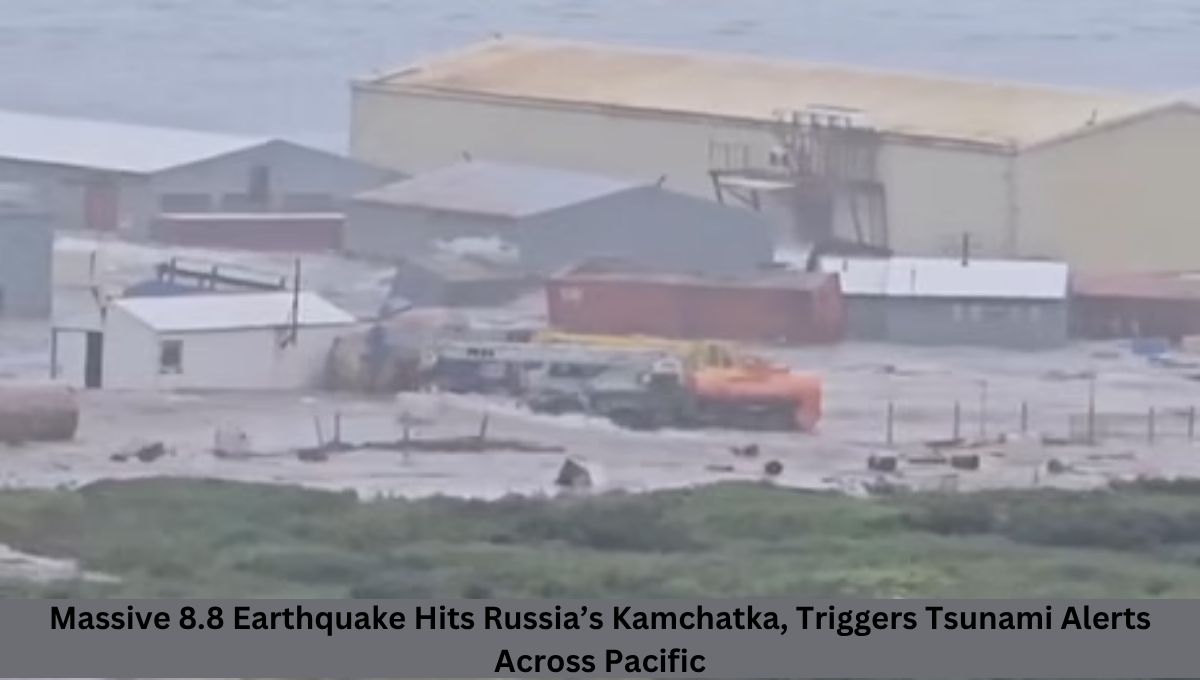
On July 30, 2025,a Massive 8.8 Earthquake Hits Russia’s Kamchatka, Triggers Tsunami Alerts Across Pacific. A powerful 8.8 magnitude earthquake struck near Petropavlovsk-Kamchatsky in Russia’s Far East, sending shockwaves across the Pacific Rim. One of the strongest earthquakes recorded globally since 2011, the temblor has triggered tsunami warnings and mass evacuations in Russia, Japan, Hawaii, and the U.S. West Coast. Experts say this earthquake is eerily reminiscent of the 1952 Kamchatka earthquake, which set off 30-foot waves in Hawaii.
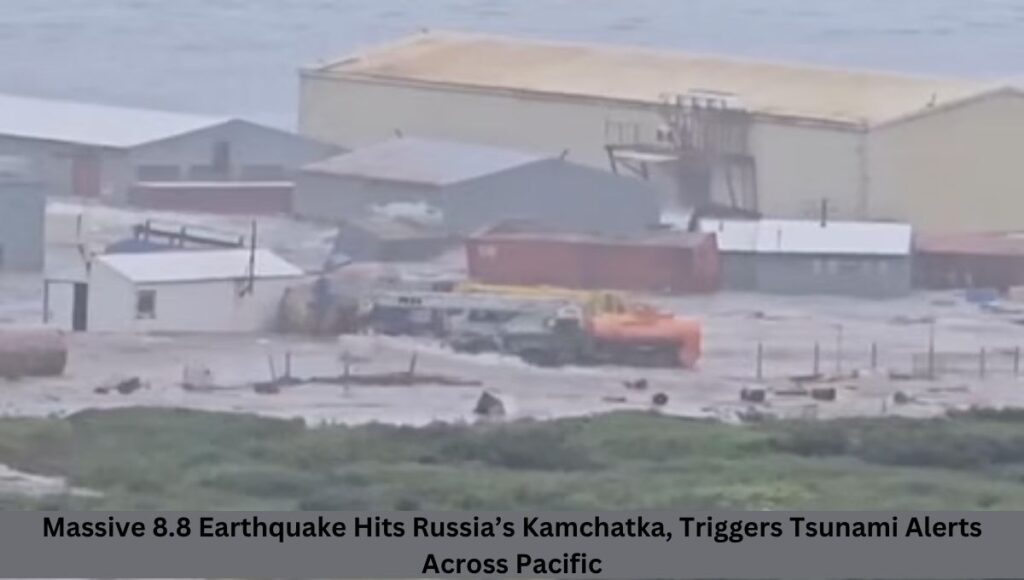
Massive 8.8 Earthquake Hits Russia’s Kamchatka, Triggers Tsunami Alerts Across Pacific
Earthquake Today: What Happened in Kamchatka?
At 8:25 a.m. Japan time, the 8.8 magnitude earthquake struck at a shallow depth of 20.7 kilometers (12.8 miles), about 119 kilometers (74 miles) east-southeast of Petropavlovsk-Kamchatsky, a city of 180,000 residents.
The US Geological Survey (USGS) later confirmed the earthquake was caused by shallow reverse faulting along the Kuril-Kamchatka subduction zone a notorious seismic hotspot where the Pacific Plate subducts beneath the North American Plate.
The quake caused structural damage, power outages, and mobile service disruptions in Petropavlovsk-Kamchatsky. Several aftershocks, including one as strong as 6.9, followed the main tremor.
Tsunami Warnings Across the Pacific
The earthquake triggered immediate tsunami alerts in several countries:
- Russia: Waves between 3 to 4 meters (10–13 feet) were recorded in parts of Kamchatka. Coastal town Severo-Kurilsk reported flooding and evacuations.
- Japan: The Japan Meteorological Agency recorded a 40-centimeter (1.3-foot) wave in Tokachi, Hokkaido.
- Hawaii: Tsunami sirens blared in Honolulu; waves of 3–10 feet are expected across the islands. Evacuation protocols were activated.
- U.S. West Coast: States like California, Oregon, and Washington issued tsunami advisories. Crescent City in Northern California anticipates 6-foot waves in its harbor.
- Philippines: Authorities warned of potential 1-meter (3 feet) waves along the eastern coastline.
- New Zealand: Issued alerts for “strong and unusual currents” and unpredictable surges despite being 9,600 km from the epicenter.
Why Was This Quake So Destructive?
The destructive power of the Kamchatka earthquake lies in its shallow depth.
According to the USGS, shallow quakes (depths of 0–70 km) are generally more damaging because they release energy closer to the Earth’s surface, leading to stronger ground shaking and increased risk to life and property.
In contrast, deeper earthquakes tend to lose energy before reaching the surface. The 8.8 magnitude quake’s proximity to coastal settlements and its shallow depth made it especially dangerous.
The Historic 1952 Kamchatka Earthquake
This week’s earthquake has revived memories of the 1952 Kamchatka quake, one of the strongest earthquakes of the 20th century.
That event, occurring on November 4, 1952, measured 9.0 in magnitude and generated a massive tsunami that hit Hawaii with waves up to 9.1 meters (30 feet).
Although Russia reported no fatalities in 1952 due to the region’s sparse population, the tsunami severely damaged Hawaii’s coastline, especially Hilo.
Fortunately, no lives were lost in Hawaii either, as early warning systems were in place.
Reactions From Officials and Experts
Kamchatka Governor Vladimir Solodov called the 2025 quake “serious and the strongest in decades.”
Russia’s Emergency Situations Minister Sergei Lebedev confirmed multiple injuries and urged residents to avoid the coastline.
In Hawaii, Assistant Professor Helen Janiszewski from the University of Hawaii labeled the quake as one of the top ten most severe tremors in recorded history.
Seismologist Dr. Lucy Jones noted that while major loss of life is unlikely in the Americas, damage to waterfront infrastructure particularly in Hawaii and parts of California is expected.
Infrastructure and Transportation Disruptions
- Japan: Ferries and trains were suspended or delayed in Hokkaido, Aomori, and the Tokyo region. Sendai Airport closed its runway temporarily.
- Russia: Authorities continue to monitor for aftershocks and have advised against coastal travel for the next month.
- Hawaii: Roads near coastal areas are closed, and shelters have been opened for evacuees.
- Oregon and California: The Oregon Department of Emergency Management warned of dangerous currents and urged people to stay away from beaches and marinas.
Could This Be a Precursor to More Activity?
Interestingly, earlier in July 2025, a series of powerful undersea quakes, the largest registering 7.4, were detected near Kamchatka.
Seismologists are now studying whether those quakes foreshadowed this major event.
The Geophysical Survey of the Russian Academy of Sciences warned that aftershocks could persist for up to a month, and further seismic activity cannot be ruled out.
Nuclear Safety in Japan
Despite the proximity of the quake to Japan, nuclear power plants reported no abnormalities.
At the Fukushima Daiichi nuclear plant, about 4,000 workers moved to higher ground as a precaution.
Looking Ahead: Preparedness and Resilience
This earthquake underscores the critical importance of tsunami preparedness and early warning systems.
Although the tremor caused significant disruption, early evacuation efforts and public alerts helped minimize casualties.
Residents along the Pacific Rim are advised to remain alert, follow local emergency instructions, and avoid shorelines until all tsunami warnings are lifted.
Final Thoughts
The July 30, 2025 Kamchatka earthquake is now marked in history as one of the most powerful and wide-reaching seismic events in recent decades. While it shares geological and historical parallels with the 1952 Kamchatka earthquake, its global ramifications highlight how interconnected and vulnerable Pacific nations remain to natural disasters.
As tsunami alerts continue across nations from Russia to New Zealand, the focus now shifts to recovery, resilience, and understanding whether this major quake is a singular event or a harbinger of more to come.
Also Read: Over 200 Inmates Escape Malir Jail After Karachi Earthquake: One of Pakistan’s Worst Jailbreaks
Also Read: Epicentre Of Huge 8.8 Earthquake Was Close To Russian Nuclear Submarine Base, Concerns Raised
Related Posts:
- Magnitude 7.4 Earthquake Strikes Russia’s Kamchatka,…
- Why the Kamchatka 8.8 Earthquake Didn't Turn into a…
- Magnitude 7.8 Earthquake Struck Russia’s Kamchatka,…
- Drake Passage Earthquake: 7.5-Magnitude Quake…
- 600-Year Dormant Russian Volcano Erupts After…

- 6.3-Magnitude Earthquake Devastates Northern Afghanistan