
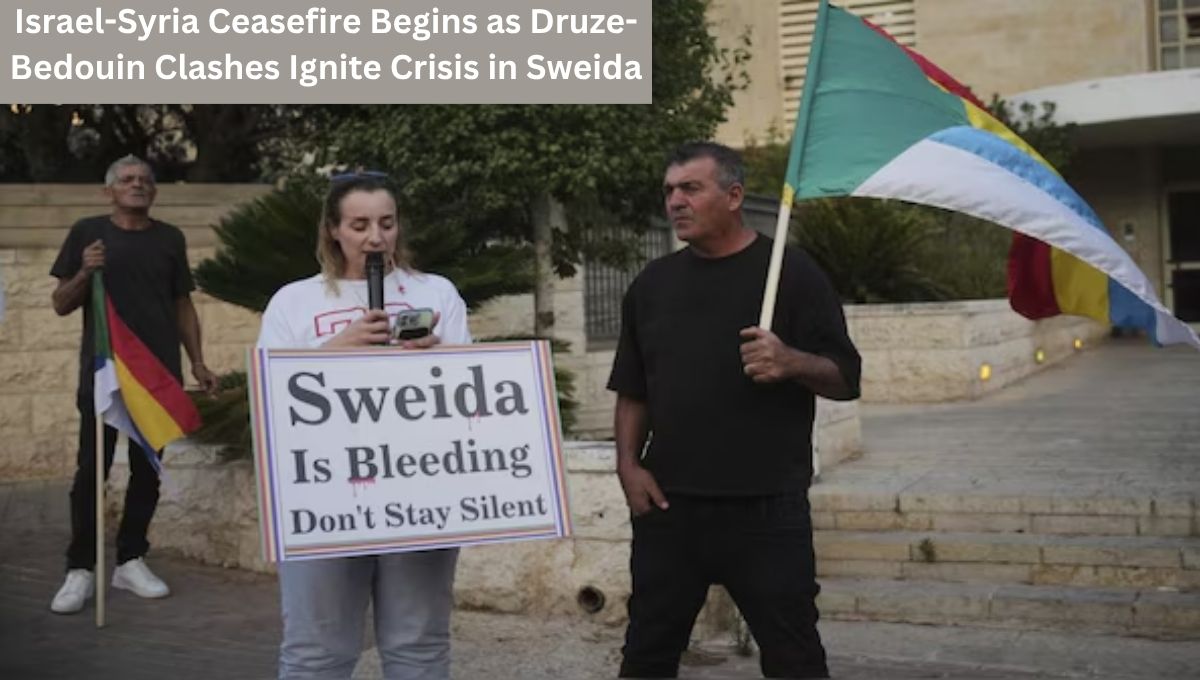
A fragile Israel-Syria Ceasefire Begins as Druze-Bedouin Clashes Ignite Crisis in Sweida. A tenuous ceasefire between Israel and Syria came into effect Friday after a week of sectarian violence between Druze militias and Bedouin tribes in southern Syria’s Sweida province. Brokered by the United States, the agreement aims to halt the bloodshed that has left at least 321 people dead and thousands displaced in what has become one of Syria’s deadliest sectarian episodes in years.
Despite the announcement, fighting on the ground has not completely stopped, exposing the fragile nature of the truce. The Syrian interim government, led by President Ahmed al-Sharaa, has deployed internal security forces to Sweida under an Israeli-agreed 48-hour humanitarian window.
Israel-Syria Ceasefire Begins as Druze-Bedouin Clashes Ignite Crisis in Sweida
US Brokered the Ceasefire: Will It Hold?
Tom Barrack, US Ambassador to Turkey and Special Envoy for Syria, confirmed the ceasefire via social media, noting it had backing from Turkey, Jordan, and other regional players.
Israeli Prime Minister Benjamin Netanyahu and Syrian President Ahmed al-Sharaa agreed in principle to halt hostilities. However, neither government formally announced it.
“We call upon Druze, Bedouins, and Sunnis to put down their weapons and build a new and united Syrian identity,” Barrack posted on X (formerly Twitter).
Signs of de-escalation began shortly after, with Israel allowing Syrian internal forces limited entry into Sweida to protect civilians and restore order.
Sweida Erupts: Druze-Bedouin Clashes Spark Carnage
The conflict began last Sunday when a Druze vegetable vendor was allegedly assaulted by Bedouin gunmen, triggering retaliatory attacks that quickly escalated.
Sweida, a Druze-majority province, saw widespread violence as local militias and tribal fighters clashed in what has become a sectarian flashpoint.
The Syrian Network for Human Rights reported over 321 deaths, including women, children, and medical workers, citing field executions and arbitrary killings.
According to UN Human Rights Chief Volker Türk, the level of brutality has shocked observers: “This bloodshed must stop. Immediate humanitarian access and accountability for all violations are essential.”
Israel Bombs Damascus: A Move to Protect the Druze?
Midweek, Israeli airstrikes targeted Syrian military sites, including the Ministry of Defense in Damascus, which was hit during a live TV broadcast. The Israel Defense Forces (IDF) claimed the attacks were in response to Syrian troop abuses against the Druze in Sweida.
Prime Minister Netanyahu stated:
“We are working to save our Druze brothers and eliminate the regime’s gangs.”
These airstrikes mark one of the boldest Israeli actions inside Syrian territory in recent years and highlight Israel’s red lines: preventing Syrian military entrenchment near the Golan Heights and protecting the Druze minority.
Syria Misreads US Messaging
According to sources close to the Syrian government, President al-Sharaa misunderstood recent US diplomatic language promoting a “unified Syria” as permission to reassert military control over Sweida.
This led to the use of irregular militia forces with reported jihadist affiliations, a move that triggered Israeli backlash and escalated the situation rapidly.
US Secretary of State Marco Rubio commented: “This was a tragic misinterpretation. Both sides misunderstood each other, and the cost was paid in innocent lives.”
Israeli Druze Cross into Syria in Show of Solidarity
In a rare event, Israeli Druze citizens crossed the border to support their brethren in Sweida. The IDF intercepted dozens near Majdal Shams, resulting in clashes and several arrests.
This action underscores the transnational identity of the Druze, whose population spans Syria, Israel, and Lebanon.
Their shared ethnicity and faith have made them a vulnerable yet politically significant minority amid the region’s chaos.
Humanitarian Disaster Unfolds in Sweida
Sweida’s situation is dire. Residents report power outages, fuel shortages, and no access to food or clean water. Internet and communication lines are nearly dead.
Mudar, a 28-year-old resident, told local media:
“For four days, there has been no electricity, no fuel, no food, no drink nothing at all.”
UN agencies, including UNHCR and OHCHR, have appealed for immediate aid access. However, both the fighting and strict border controls are blocking humanitarian relief.
Israel’s Strategic Red Line: No Troops Near Golan Heights
Israel views southern Syria as a strategic buffer. The IDF has made it clear that no sustained Syrian military presence will be tolerated in areas near the Golan Heights.
Although Israel agreed to a 48-hour entry of Syrian internal forces, officials warned of retaliation if Syrian troops attempt long-term entrenchment.
An Israeli official, speaking anonymously, said: “The new Syrian leadership are barely disguised jihadists. We cannot risk them gaining ground near our borders.”
Sharaa Vows Reform, But Doubts Remain
In a national address, President Ahmed al-Sharaa promised to investigate and prosecute those responsible for the violence including within his own forces and emphasized the state’s duty to protect the Druze.
Still, skepticism prevails. Analysts say Sharaa’s use of Islamist militias and lack of control over irregular forces undermine his credibility as a national unifier.
Secret Talks and a Diplomatic Blunder
Sources revealed that secret Israeli-Syrian talks occurred last week in Baku, Azerbaijan, where Syrian officials believed an agreement had been reached permitting limited military intervention in Sweida.
An Israeli diplomat refuted this, saying:
“They took our silence as a yes. We never agreed to any such deployment.”
In a further diplomatic twist, US energy executives, including Argent LNG CEO Jonathan Bass, were caught in Damascus during the Israeli strikes.
Their presence, reportedly with US approval, exposed inconsistencies in American messaging.
Israeli Druze Pressure Government to Act
The Israeli Druze community, comprising around 150,000 citizens, has been vocal in pressuring the Netanyahu government to act.
Their cultural and familial ties with Syrian Druze have turned the Sweida conflict into a domestic political issue.
Some 1,000 Israeli Druze crossed into Syria, with dozens of Syrian Druze entering Israel in return. The IDF and police admitted to being unprepared, with arrests made for attempted arms smuggling.
Netanyahu: Ceasefire “Achieved Through Force”
In a defiant address, Netanyahu asserted that the ceasefire was only possible because of Israeli military action, not diplomacy.
“It was achieved through force. Not through requests, not through pleas through force.”
This framing raises questions about Israel’s future posture in Syria and whether military deterrence will remain its primary policy tool.
UN and Israel Send Aid, But Access Is Limited
In response to the crisis, Israel’s Foreign Ministry approved $600,000 in humanitarian aid, including food and medical supplies. The UN echoed the urgency but lamented the lack of access.
OHCHR confirmed several atrocities, including:
- 13 civilians killed at a family gathering on July 15
- 6 men summarily executed outside their homes
UN Human Rights Chief Volker Türk called for a full investigation and unhindered aid delivery.
Syria’s Druze at a Crossroads
Once supportive of the interim government post-Assad, Syria’s Druze now face a crisis of trust. Internal divisions have grown, and calls for local autonomy are gaining momentum.
As the Kurds in northeastern Syria push for self-rule, some experts believe the country is heading toward fragmentation along sectarian lines.
Analyst Alon Pinkas told Al Jazeera:
“If Syria remains fragmented between Kurds, Druze, Bedouins and Sharaa’s fragile government, Israel can operate freely in the south.”
Conclusion: Peace or Pause Before More Bloodshed?
The Israel-Syria ceasefire may mark a diplomatic breakthrough, but its success depends on what follows. Without a sustained international peacekeeping effort and genuine political reconciliation, many fear this is merely a temporary pause before violence erupts again.
As the world watches and waits, Sweida’s fate may very well decide the future of Syria’s fragile unity or its final descent into permanent division.
Also Read: New ceasefire takes effect in Syria’s Sweida following deadly clashes, Israeli airstrikes
Related Posts:
- Israel Launches Strikes in Syria to Protect Druze…
- Ceasefire in Suwayda Wobbles as Israeli Strikes Hit Syria
- Israel Launches Strikes on Syria After Rocket Fire:…

- Afghanistan–Pakistan War 2025: Inside the 48-Hour Ceasefire

- 5 Major Takeaways from the US Supreme Court's…

- 9 Explosive Claims as Trump Says US Winning Iran War