In his first major interview with Western media since the June conflict with Israel, Iran’s President Accuses Israel of Assassination Attempt, says US Dialogue Still Possible. Iranian President Masoud Pezeshkian expressed a surprising openness to diplomatic talks with the United States, even after recent U.S. and Israeli airstrikes devastated Iran’s nuclear infrastructure.
“I am of the belief that we could very much easily resolve our differences and conflicts with the United States through dialogue and talks,” President Pezeshkian told U.S. media host Tucker Carlson in an interview recorded Saturday and released Monday.
However, Pezeshkian emphasized that trust remains a major hurdle, especially following the Israeli airstrikes on June 13, which coincided with the start of a 12-day war and derailed a planned new round of U.S.-Iran nuclear negotiations.
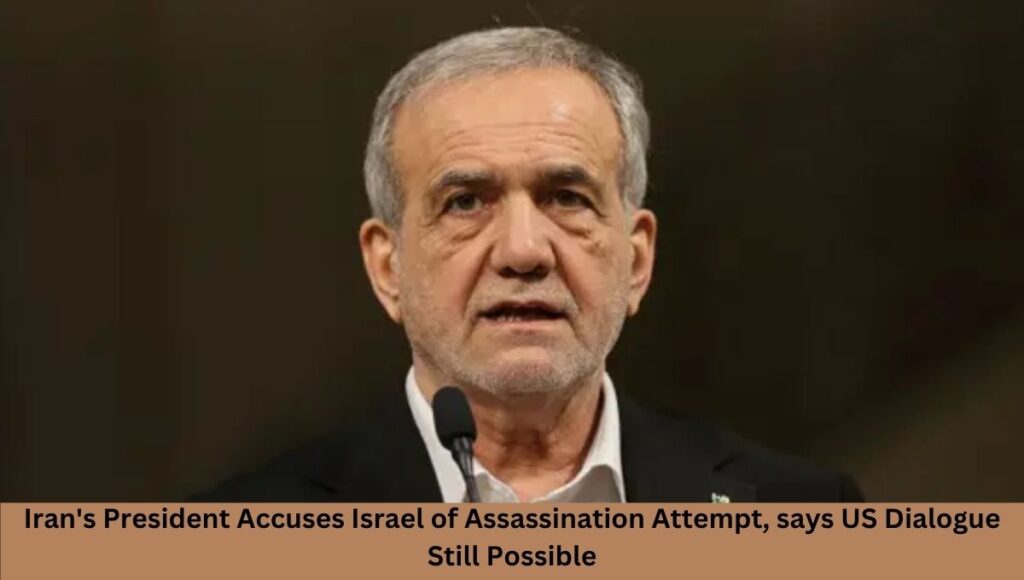
Iran’s President Accuses Israel of Assassination Attempt, says US Dialogue Still Possible
Iran-Israel War and U.S. Bombings Undermine Diplomatic Hopes
The 12-day conflict between Iran and Israel, which began on June 13, erupted just two days before Tehran and Washington were set to resume nuclear talks.
The Israeli strikes targeted Iranian military and nuclear facilities, reportedly killing over 30 senior security officials and 11 nuclear scientists.
A week later, on June 21, the U.S. bombed three key nuclear sites at Fordow, Natanz, and Isfahan, further escalating the crisis.
Iranian state media reported a death toll of over 1,060 from the war, with mass funerals held across the country.
Pezeshkian accused Israel of deliberately sabotaging diplomatic progress between Tehran and Washington. “How are we going to trust the United States again? How can we know for sure that in the middle of the talks, the Israeli regime will not be given the permission again to attack us?” Pezeshkian
Pezeshkian Alleges Israeli Assassination Attempt
In one of the most explosive claims from the interview, President Pezeshkian alleged that Israel attempted to assassinate him during the June attacks.
He said Israeli warplanes bombarded a location where he was attending a high-level meeting, but the attempt failed.
“They did try, yes. They acted accordingly, but they failed… It was not the United States that was behind the attempt on my life. It was Israel.” Pezeshkian
Israel has not officially responded to the allegation, though Israeli officials have previously stated that their military campaign targeted top-level Iranian leadership and scientists.
Netanyahu’s “Forever Wars” and the Risk to U.S. Interests
President Pezeshkian directly criticized Israeli Prime Minister Benjamin Netanyahu, accusing him of pursuing an agenda of “forever wars” in the Middle East that could drag the U.S. into further conflict.
“The US administration should refrain from getting involved in a war that is not America’s war. It is Netanyahu’s war,” Pezeshkian said.
He warned that Netanyahu’s hardline policies would plunge the U.S. into another endless conflict in the region unless President Donald Trump distanced Washington from Tel Aviv’s aggressive posture.
Pezeshkian to Trump: “Put Israel in Its Place or Fall Into a Pit”
During the interview, Pezeshkian addressed Trump directly, praising the former president’s capacity to bring peace to the region while warning him about the dangers of aligning too closely with Israel.
“The United States’ president, Mr. Trump, he is capable enough to guide the region towards peace and a brighter future and put Israel in its place. Or get into a pit, an endless pit, or a swamp.”
His comments came just as Netanyahu visited the White House for talks with Trump. The Israeli prime minister is expected to discuss Iran’s nuclear program, recent military escalations, and the U.S.-brokered 60-day ceasefire plan between Israel and Hamas.
White House Responds: Trump “Committed to Peace”
Asked about Pezeshkian’s remarks, White House Press Secretary Karoline Leavitt said she was unsure if Trump had seen the interview but agreed with the sentiment that the president is committed to peace.
“The president is the right person to move the region toward peace,” she said, echoing Pezeshkian’s cautious optimism.
Israel’s Airstrikes and Nuclear Site Damage
The June 13 Israeli airstrikes on Iran targeted military sites and nuclear facilities, resulting in widespread damage and loss of life. It was one of the most aggressive Israeli operations inside Iran to date.
Days later, the U.S. followed up with precision strikes on Iran’s Fordow, Natanz, and Isfahan nuclear facilities, dealing what Trump later described as a “tremendous success”.
“We permanently set back their nuclear program,” Trump told reporters on Friday. “They can try again somewhere else, but we’ll be watching.”
Despite the strikes, Iran continues to insist that it is not pursuing nuclear weapons, maintaining that its nuclear program is strictly peaceful.
Nuclear Talks Derailed But Not Dead?
Prior to the June 13 attacks, Tehran and Washington had scheduled a new round of nuclear negotiations, signaling a possible thaw in relations after years of tensions and sanctions.
Pezeshkian said Iran is still open to restarting the nuclear talks, but only under conditions that ensure Israel cannot derail them again.
“There is a condition for restarting the talks… How can we know for sure that in the middle of the talks the Israeli regime will not be given the permission again to attack us?”
The breakdown of talks also raises questions about the role of the U.S. in restraining its allies and the influence of domestic politics on foreign policy, particularly ahead of the U.S. elections.
Assassination Plots and Regional Fallout
Beyond the alleged attempt on Pezeshkian’s life, Iranian authorities say Israel also plotted to kill Foreign Minister Abbas Araghchi during the war.
Meanwhile, Netanyahu did not deny reports that Israel considered assassinating Iran’s Supreme Leader Ayatollah Ali Khamenei, saying such a move would “end the conflict.”
However, the plan was reportedly vetoed by Trump, who opted instead for strategic airstrikes. The ceasefire between Iran and Israel, in place since June 24, remains fragile.
Final Thoughts: Dialogue Possible, But Distrust Runs Deep
While President Pezeshkian’s interview offered a rare window into Iran’s willingness to engage with the U.S., his accusations against Israel, concerns about trust, and fear of sabotage highlight the complex web of regional rivalries and mistrust.
His dual message one of hope for diplomacy and warning against Israeli manipulation puts the onus squarely on Trump and the U.S. to chart a more independent and balanced course in the Middle East.
As Trump meets with Netanyahu and prepares for possible renewed negotiations with Iran, the stakes couldn’t be higher. Pezeshkian’s message is clear: “Dialogue is possible. Peace is possible. But not without trust. Not without accountability.”
Also Read: Iran Official Warns Trump Could Be Assassinated by Drone at Mar-a-Lago
Also Read: Pezeshkian accuses Israel of assasination attempt, ‘destroying’ US-Iran diplomacy