
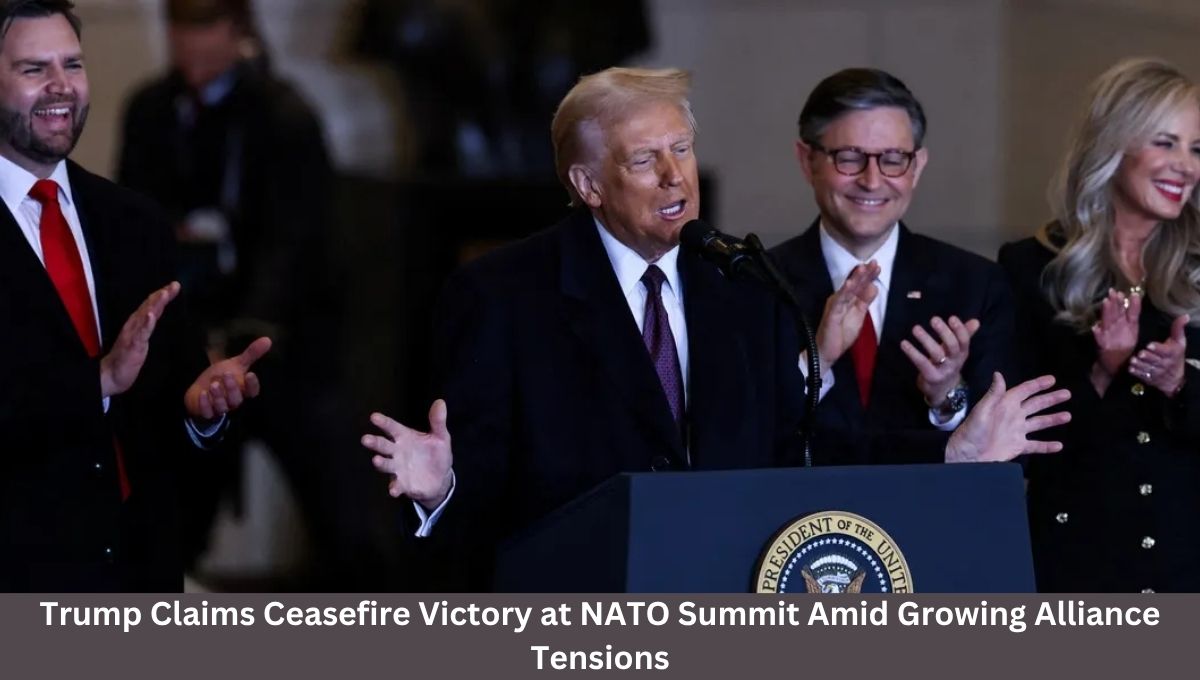
AtThe Hague, Trump Claims Ceasefire Victory at NATO Summit Amid Growing Alliance Tensions. The 2025 NATO Summit in The Hague opened with fanfare but quickly exposed the deep cracks within the alliance. President Donald Trump arrived riding high, claiming he single-handedly brokered a ceasefire between Israel and Iran, while also pushing NATO members to commit to a 5% defense spending target by 2035.
While Trump’s self-declared foreign policy win drew praise from NATO’s Secretary-General Mark Rutte, it did little to mask growing internal tensions: disagreements over Ukraine, skepticism about Trump’s commitment to Article 5, and pushback from Spain and other allies on spending.
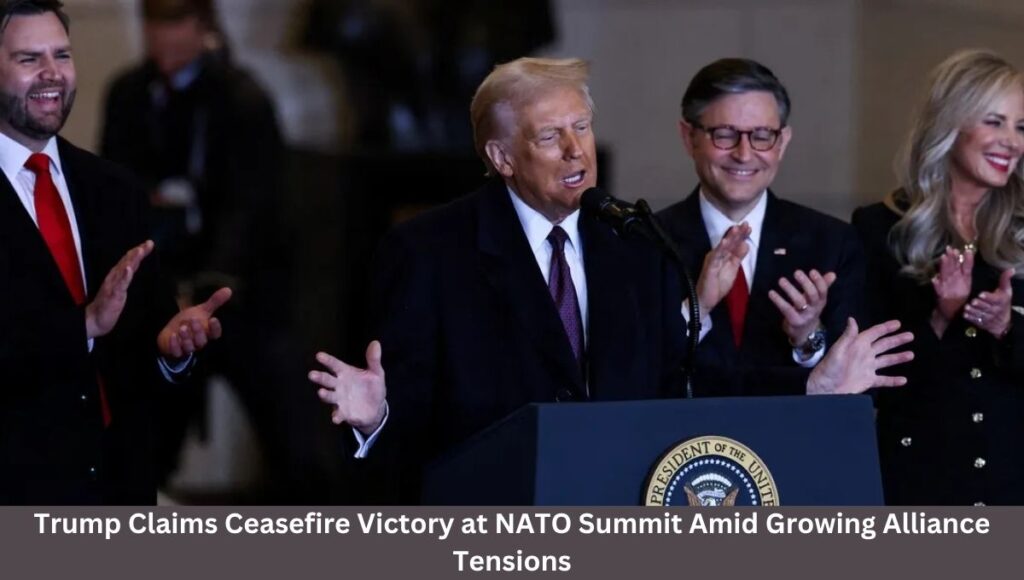
Trump Claims Ceasefire Victory at NATO Summit Amid Growing Alliance Tensions
Trump Lauded by NATO Chief Rutte Over Iran-Israel Ceasefire
Ahead of the summit, Trump revealed a personal message from NATO Secretary-General Mark Rutte, who praised him for bringing an end to nearly two weeks of war between Israel and Iran.
“That was truly extraordinary and something no one else dared to do,” Rutte wrote, according to Trump’s Truth Social post.
“Donald, you have driven us to a really, really important moment for America and Europe… Europe is going to pay in a BIG way, as they should.”
This praise marks a major shift from past Trump-era NATO relations, which were often marked by friction and public spats over defense contributions.
Rutte, a former Dutch prime minister, has positioned himself as a mediator between Trump’s America First policies and European concerns.
Trump, en route to The Hague, added: “You are flying into another big success… We’ve got them all signed onto 5 percent.”
Ceasefire Holds But Barely, and with Skepticism
Trump has declared the ceasefire between Israel and Iran remains intact, though incidents of violence and retaliatory strikes continued even after the agreement.
In one Truth Social post, Trump wrote: “ISRAEL is not going to attack Iran. All planes will turn around and head home while doing a friendly ‘Plane Wave’ to Iran… Ceasefire is in effect!”
But he also accused Israel of violating the agreement by launching fresh strikes shortly after the deal was struck. Speaking to reporters outside the White House before departure, Trump said: “I gotta get Israel to calm down now.”
Military intelligence, however, paints a murkier picture. A preliminary Pentagon review shows Iran’s nuclear program remains largely intact, despite U.S. airstrikes.
Most of Iran’s enriched uranium stockpile was moved before the attacks, and a previously unknown research site escaped damage.
Still, the White House rebuked these findings, accusing intelligence insiders of trying to sabotage Trump’s foreign policy credentials.
Rutte: “No Doubt” U.S. Remains Committed to NATO’s Article 5
Rutte moved to reassure NATO members that Trump remains committed to Article 5, the mutual defense clause at the heart of the alliance. This came after Trump hinted at alternative interpretations of the clause, which states that an attack on one member is considered an attack on all.
“I have no doubt that the U.S. is totally committed to NATO, totally committed to Article 5,” Rutte said at a press conference. Trump’s earlier comments had reignited fears among European allies that the U.S. might hesitate to defend them especially nations like Estonia and Latvia, who border an increasingly aggressive Russia.
NATO Raises Defense Spending Target to 5% Spain Pushes Back
The most contentious topic at the summit was Trump’s demand that all NATO members increase defense spending to 5% of GDP by 2035. Trump argued the increase is necessary to counter threats from Russia, Iran, and China.
The proposed breakdown includes:
- 3.5% for conventional defense (troops, weapons, logistics)
- 1.5% for broader security areas like cyber defense and infrastructure upgrades
Trump insisted that America be exempt, stating: “America has done enough. This is about others pulling their weight.” Despite strong resistance, all NATO countries formally adopted the target except Spain, which secured a flexible opt-out.
Spanish Prime Minister Pedro Sanchez said Spain would not raise its spending beyond 2.1% of GDP, citing social spending priorities and budget constraints. “We fully respect the desire of others, but we are not going to do so,” Sanchez said in a national address.
A subtle change in the summit language from “we commit” to “allies commit” gave Spain and others enough wiggle room to endorse the statement without actually committing to the full target.
Trump Criticizes Spain, Praises NATO Consensus
Trump didn’t hold back, labeling Spain “notorious” for low defense spending and warning that countries failing to meet targets risk losing U.S. protection.
“Spain has to pay what everybody else has to pay,” Trump said Friday. “They’ve gotten a free ride for too long.”
Still, Trump welcomed the overall agreement as a major victory, allowing him to claim leadership in reshaping NATO priorities.
Ukraine Support Fades from Center Stage
While Russia’s invasion of Ukraine remains one of NATO’s top challenges, the issue was not central to this year’s summit.
Ukrainian President Volodymyr Zelenskyy was invited but not included in the summit’s main session. No new U.S. aid packages were announced, marking a departure from the €50 billion pledge agreed upon at last year’s NATO gathering in Washington.
Trump’s relationship with Zelenskyy remains strained. He publicly scolded the Ukrainian leader during a White House visit in February, and there’s growing evidence of U.S. fatigue with long-term support for Kyiv.
While nations like Poland, Estonia, and Lithuania continue to advocate for strong Ukraine commitments, others including Hungary and Slovakia are backing off calls for further escalation.
Iran-Israel Conflict Still Looms Over the Alliance
Though it wasn’t on the official agenda, the Israel-Iran conflict dominated side discussions at the summit.
Following U.S. airstrikes on Iranian nuclear facilities and Iran’s retaliatory missile strikes on Al Udeid Airbase in Qatar, tensions remain high.
European leaders are quietly holding diplomatic backchannel talks with Iran, seeking a more sustainable resolution.
There’s widespread concern that Trump’s unilateral approach could drag NATO into a broader Middle East conflict without consensus.
Europe Braces for a Future with Less U.S. Involvement
Trump’s mixed messaging and unpredictable foreign policy have many European leaders preparing for a future less reliant on U.S. military leadership.
According to reports from the Financial Times, countries including Germany, France, and the Nordics are working on plans to restructure NATO funding and leadership roles.
Secretary-General Rutte emphasized the need for Europe to boost its defense production, reduce dependence on U.S. logistics and intelligence, and “stand on its own feet.” “We need to ramp up production, build more munitions factories, and reduce dependence,” Rutte said. “Europe must be ready.”
Is NATO Still United?
The 2025 NATO Summit may be remembered more for symbolic unity than for solving real divisions.
While Trump’s 5% defense target and Iran ceasefire win grabbed headlines, the underlying fractures remain:
- Uncertainty over U.S. commitment to mutual defense
- Disagreements on how to support Ukraine
- Growing divides over burden-sharing and strategic leadership
Internally, the alliance is struggling with trust. Externally, it faces threats from Russia, Iran, and cyber warfare without a cohesive strategy to tackle them.
Conclusion: Victory, Optics, and Unanswered Questions
As President Trump exits the NATO Summit 2025, he does so with claims of success: a Middle East ceasefire, a new defense spending pledge, and personal praise from NATO’s chief.
But many allies remain unconvinced that these achievements address the deeper issues threatening NATO’s cohesion. From Spain’s defiance to Ukraine’s sidelining, the alliance’s future appears increasingly uncertain. Trump may have won the moment. Whether NATO survives the coming years with its credibility and unity intact is an open question.
Also Read: NATO’s Got Daddy Issues: Trump, Rutte, and the Ceasefire Circus
Also Read: Israel-Iran ceasefire seems to hold as Trump lands in Europe for NATO summit
Related Posts:
- NATO’s Got Daddy Issues: Trump, Rutte, and the…
- 5 Powerful Highlights as Trump Lands Second Nobel…

- Trump’s 2025 Gaza Peace Plan Signing and Historic…

- Trump Stole the Show at 2025 Gaza Peace Summit in Egypt
- Can the EU and NATO Impose Tariffs on India and…

- 7 Crucial Insights Into Trump and Xi’s High-Stakes…
Comments are closed.