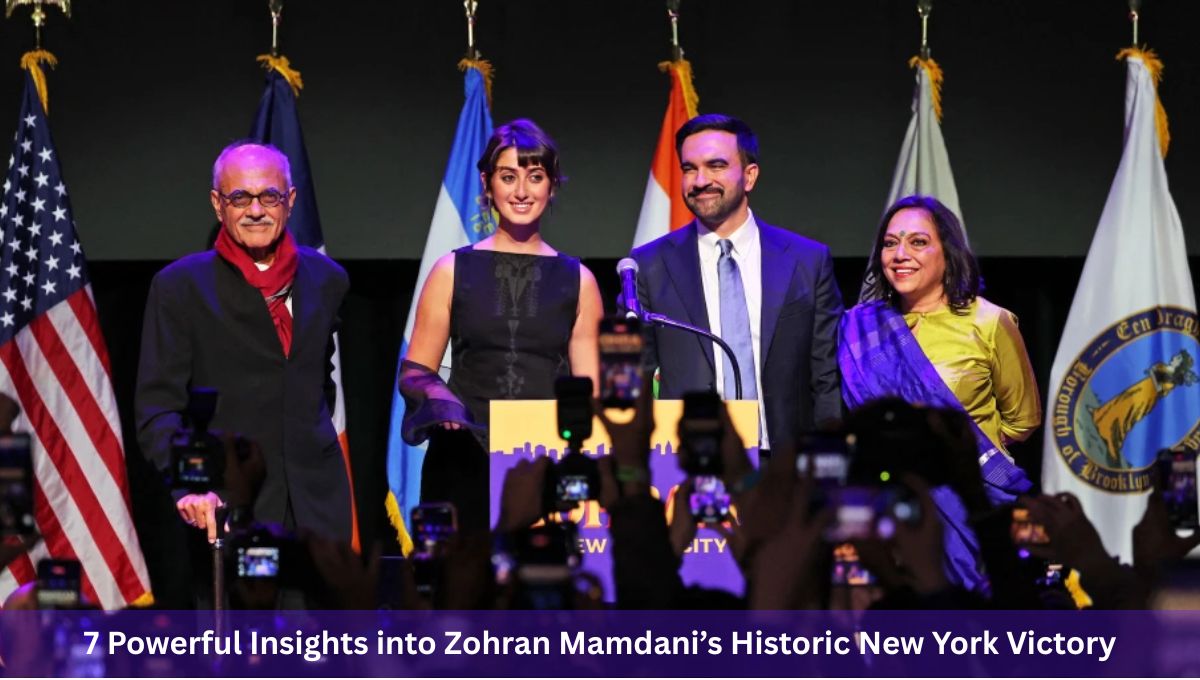
7 Powerful Insights into Zohran Mamdani’s Historic New York Victory — which marks a seismic shift in American politics. When Zohran Mamdani stood before a jubilant crowd in New York, echoing words once spoken by India’s Jawaharlal Nehru, it marked a political moment of global resonance.
His victory as New York City’s first Indian-origin and Muslim mayor was not just a local event—it was a statement about generational change, representation, and the evolving identity of American progressivism. Mamdani’s journey to this defining moment was built on grassroots energy, an affordability agenda, and a mastery of social media that turned his campaign into a movement. His win has sent ripples through the Democratic establishment, energized young voters, and redefined the political possibilities for candidates of color in the United States.

7 Powerful Insights into Zohran Mamdani’s Historic New York Victory
A Campaign Born in Secret Meetings
The roots of Mamdani’s mayoral campaign trace back to November 2023, when the Working Families Party (WFP) convened a discreet meeting in a Long Island City apartment building. The left-leaning coalition of progressive groups and labor unions had gathered to discuss how to unseat then-Mayor Eric Adams, whose administration was increasingly mired in controversy.
Among those present were City Comptroller Brad Lander, Brooklyn Borough President Antonio Reynoso, and State Senator Jessica Ramos. When Zohran Mamdani walked into the room, his presence took everyone by surprise.
“Zohran? Is Zohran thinking of running?” recalled Ana María Archila, the WFP co-chair who organized the meeting. At the time, Mamdani, then a State Assemblyman from Queens, was not yet a declared candidate.
But even in those early meetings, he was brimming with ideas—talking about freezing rent, reshaping affordability, and reimagining how city government could directly serve its people.
What began as exploratory discussions soon evolved into a strategic blueprint for a mayoral bid that would upend New York politics.
Building a Movement from the Ground Up
As the months passed, Mamdani’s conviction grew. He decided to run on a platform combining the grassroots energy of Alexandria Ocasio-Cortez and the creativity of social media-savvy local leaders like Chi Ossé.
He pledged to knock on a million doors and speak directly to voters about what mattered most: rent, transit, groceries, and daily survival in one of the world’s most expensive cities.
To translate his progressive ideals into action, he built a campaign rooted in the Democratic Socialists of America, emphasizing economic justice and community empowerment.
While many doubted whether a self-described socialist could win citywide office, Mamdani’s message began to resonate with an electorate exhausted by inequality and disillusioned with traditional politics.
The Art of Social Media — Andrew Epstein’s Genius
Behind Mamdani’s viral online presence was Andrew Bard Epstein, a Yale-educated creative strategist who became the architect of the campaign’s digital narrative. Epstein’s work transformed Mamdani’s social media feeds into a vibrant storytelling platform, where policy met personality.
From playful TikTok videos soundtracked by “New York Groove” to Instagram reels of Mamdani riding through the city, the visuals presented him as approachable, authentic, and deeply connected to the city’s rhythm.
Epstein explained to the Financial Times that the campaign’s success came from bridging the online and offline worlds:
“As people developed this relationship to Zohran through their phones, they were then getting their doors knocked on by volunteers or seeing canvassers in the streets.”
It was a fusion of digital engagement and human connection that made the campaign unstoppable. While Mamdani focused on what he would do for New Yorkers, Andrew Cuomo, his primary rival and former governor, talked mostly about his résumé. The contrast was stark—and decisive.
A Progressive Star Rises
By the summer before the election, Mamdani had emerged as a rising progressive star. His team’s internal polling showed surprising strength across boroughs, particularly among young voters, immigrants, and working-class communities.
Still, his campaign faced challenges. The energy that fueled his underdog status began to wane as the long months dragged on. His advisors worried that the relentless schedule had drained him.
After taking a short break for his wedding, Mamdani returned rejuvenated. He organized closed-door meetings with city leaders and business figures—an effort to calm skeptics and broaden his coalition beyond the activist base.
Even Senator Bernie Sanders, a key early supporter, urged him to sharpen his focus on governance and executive readiness. “They’ll try to crush you,” Sanders warned in private meetings. “You’ve got to give people a sense of action.”
The Cuomo Factor
Across town, Andrew Cuomo was mounting his own comeback attempt. Having resigned as governor under scandal, Cuomo entered the race on a platform of experience and inevitability. His strategy hinged on clearing the field—pushing Adams and Republican Curtis Sliwa aside to face Mamdani one-on-one.
But things didn’t go as planned. Adams lingered in the race for months, dividing the centrist vote, while Mamdani’s grassroots army grew larger and louder. When Adams finally dropped out, it was too late. Mamdani’s movement had become a phenomenon, powered by optimism and authenticity.
By Election Day, Mamdani’s affordability agenda, promise of free public buses, and vision of government-run grocery stores had captured the public imagination. As results rolled in, it became clear: Cuomo’s comeback was over before it began. Mamdani had beaten him decisively, ushering in a new political era.
From Albany to City Hall — A Political Journey
Zohran Mamdani’s path to City Hall was anything but ordinary. The son of filmmaker Mira Nair and Ugandan-born scholar Mahmood Mamdani, Zohran grew up straddling worlds—cinema, scholarship, and activism.
His early political career as a Democratic Socialist Assemblyman was marked by tireless advocacy for renters, low-income communities, and immigrants. He gained attention for his empathy and bold ideas, but it was his ability to communicate complex issues through storytelling that made him unique.
Throughout the campaign, Mamdani stayed connected to his roots. On Instagram, he spoke in Hindi, referenced Bollywood, and used humor to make politics relatable. This blend of cultural authenticity and policy seriousness drew in a new generation of politically engaged voters.
By the time he stood on stage on election night, quoting socialist Eugene Debs and declaring, “Against all odds, we have grasped it,” Mamdani had become the symbol of a new progressive awakening in America’s largest city.
The Sanders–Obama Influence
Behind the scenes, two political heavyweights—Bernie Sanders and Barack Obama—played unexpected roles in shaping Mamdani’s political evolution.
Sanders, long an ally of the Democratic Socialists, was both mentor and motivator. He pushed Mamdani to think strategically about executive authority, advising him to learn from both the successes and missteps of past populist leaders.
Obama’s influence was more personal and introspective. During their private conversations, Mamdani thanked the former president for his 2008 race speech, “A More Perfect Union,” saying it inspired his own address on Islamophobia during the campaign.
Obama, in turn, encouraged him to balance ideals with governance, reminding him that “success means delivering services and all the basics people rely on.”
The exchange reflected a fascinating generational shift: a young socialist mayor finding common ground with a centrist Democrat who once embodied hope and change.
A Movement, Not Just a Campaign
For many of Mamdani’s supporters, the victory was more than political—it was emotional.
Public Advocate Jumaane Williams, who had attended those early WFP strategy sessions, said it best:
“We all said we’re going to support what we believe. Nobody thought this was possible. But here we are.”
Indeed, Mamdani’s win represented a coalition of believers: from grassroots activists and student organizers to working families and progressive lawmakers who shared a vision of a more equitable city.
The campaign’s humor, creativity, and human touch made it stand out. Rather than chasing traditional endorsements or big donors, Mamdani’s team relied on vibes, volunteers, and viral videos—a strategy that confounded critics but captured hearts.
The Fallout — Allies and Rivals React
In the aftermath of the election, political maneuvering began immediately. Brad Lander, once a close ally, found himself sidelined from Mamdani’s transition plans. Although he had played a crucial role attacking Cuomo during the campaign, sources said Mamdani viewed him as ineffective and overreaching.
By the weekend before the election, word spread that Mamdani had called Lander to tell him he wouldn’t have a place in the administration. Lander’s wife reportedly told friends he was already exploring a congressional run against Rep. Dan Goldman. Meanwhile, Mamdani’s opponents were plotting their next moves.
Curtis Sliwa, the Republican candidate, declared himself “mayor in exile,” vowing to protest every overreach of Mamdani’s progressive agenda. Even billionaire John Catsimatidis, a Trump ally, predicted more revelations to come—though, for now, his threats seemed hollow.
Inside the Transition — Preparing to Govern
Behind closed doors, Mamdani and his team were already drafting plans for transition committees and policy priorities. He had surprised many during the final debate by suggesting he might retain Police Commissioner Jessica Tisch—a statement that raised eyebrows among his progressive base.
His aides were still trying to confirm whether he had discussed the matter with her directly. But the broader focus was on assembling a diverse and capable administration, blending experienced public servants with fresh voices from activist circles.
A source close to the campaign confirmed that Mamdani’s early picks reflect his values-driven approach—emphasizing transparency, accessibility, and data-backed policymaking.
As one insider put it:
“He doesn’t want to run a government that just looks different—he wants one that feels different.”
Global Ripples — Representation and Legacy
Mamdani’s win carries symbolic weight far beyond New York. As the son of Indian and African heritage, and the first Muslim mayor of America’s largest city, his rise resonates with immigrant communities worldwide.
His story also mirrors the broader shift in the Democratic Party, where diverse, progressive leaders are challenging the old guard and expanding the definition of electability.
The New York Times captured this sentiment succinctly:
“Mamdani’s intense focus on affordability, mastery of social media, and relentlessly infectious optimism galvanized record turnout among young voters and immigrant groups.”
In an age of political cynicism, Mamdani’s success offers something rare: a sense of renewed possibility.
The Road Ahead — Promise and Pressure
As Mamdani prepares to take office, expectations are sky-high. He has pledged to tackle affordability through bold experiments in housing, transit, and food access.
He inherits a city still grappling with post-pandemic inequality, rising costs, and deep distrust in government.
Supporters see him as a transformative figure, while critics warn of ideological overreach. But even skeptics admit that Mamdani’s authenticity gives him a credibility few modern politicians possess.
For now, the mood in New York is one of cautious optimism—and among Mamdani’s supporters, unbridled joy.
A New Dawn for New York Politics
In the final moments of his victory speech, as the crowd erupted to Bollywood’s “Dhoom” and Jay-Z’s “Empire State of Mind,” Mamdani stood at the intersection of worlds—cultural, political, and generational. He had done what few believed possible: unite a fragmented city behind a vision of fairness, creativity, and courage.
As he declared, “The future is in our hands,” it was clear this was not the end of a campaign, but the beginning of a movement—one that could redefine what leadership means in the 21st century.
Also Read: Trump Calls Zohran Mamdani a “Pure Communist” as NYC Mayoral Race Turns Volatile
Also Read: Trump warns Zohran Mamdani over ‘angry’ victory speech: He’s off to a bad start
Related Posts:
- 5 Key Takeaways as Zohran Mamdani Wins Historic New…
- 7 Key Numbers That Reveal Who’s Winning the New York…
- 7 Key Takeaways: Trump’s Surprise Meeting with NYC…

- 11 Defining Challenges Facing NYC’s Youngest Mayor…

- Zohran Mamdani’s Historic NYC Mayoral Win Sparks…

- Trump Calls Zohran Mamdani a “Pure Communist” as NYC…