Washington, October 10, 2025 —
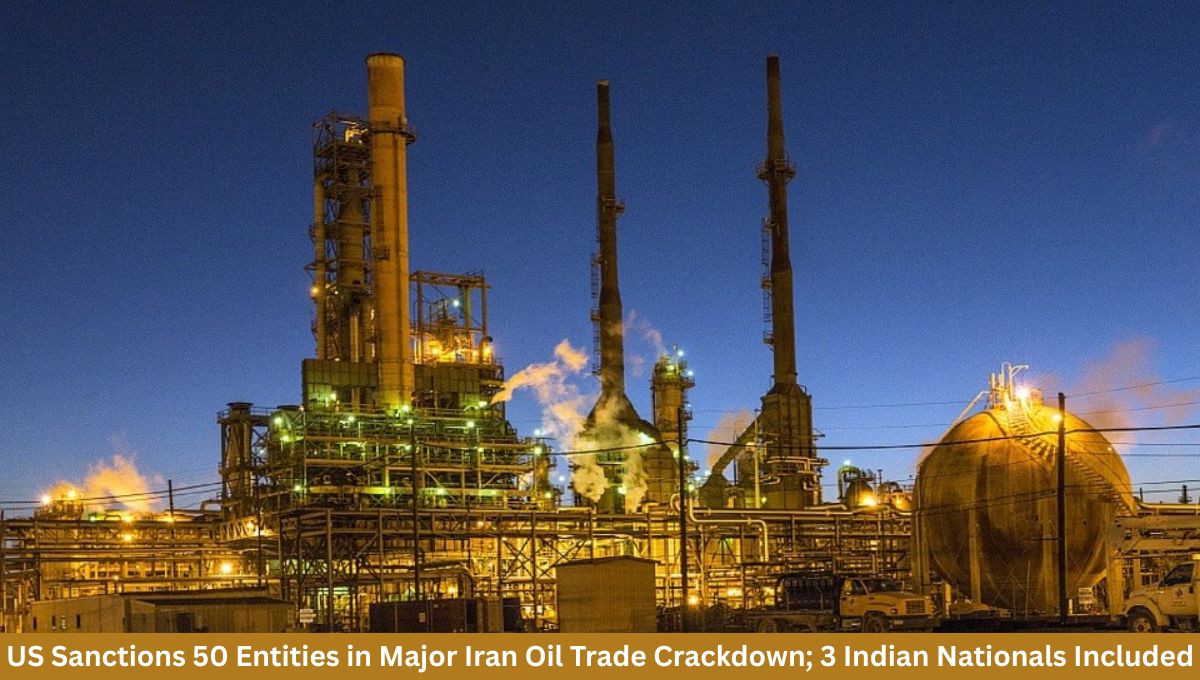
US Sanctions 50 Entities in Major Iran Oil Trade Crackdown; 3 Indian Nationals Included as they facilitated Iran’s export of Oil and LPG. The United States on Thursday announced sweeping new sanctions on more than 50 individuals, companies, and ships accused of facilitating Iran’s oil and liquefied petroleum gas (LPG) trade — a move the Trump administration says is designed to dismantle Tehran’s energy export network and choke off its funding for militant groups.
The sanctions, issued by the US Department of the Treasury’s Office of Foreign Assets Control (OFAC), include designations of three Indian nationals and their associated firms allegedly involved in moving millions of barrels of Iranian-origin petroleum to China and Pakistan through a complex “shadow fleet” network.
Treasury Secretary Scott Bessent said the action reflects the administration’s commitment to “degrading Iran’s cash flow by dismantling key elements of its energy export machine.”
He added, “Under President Trump, this administration is disrupting the regime’s ability to fund terrorist groups that threaten the United States.”

US Sanctions 50 Entities in Major Iran Oil Trade Crackdown; 3 Indian Nationals Included
Expanding the Trump Administration’s ‘Maximum Pressure’ Policy
The latest measures mark one of the most expansive enforcement actions since President Donald Trump returned to office in January 2025. They represent the fourth round of sanctions in recent months targeting Chinese and Middle Eastern refineries, shipping companies, and financial networks accused of buying or transporting Iranian petroleum products.
According to OFAC’s statement, the sanctions apply to a global web of 50 individuals, entities, and vessels that “facilitate Iranian oil and LPG sales and shipments from Iran,” generating billions in revenue for Tehran.
“These actors have collectively enabled the export of billions of dollars’ worth of petroleum and petroleum products, providing critical revenue to the Iranian regime and its support for terrorist groups,” the Treasury Department said.
Under US law, the sanctions block all property and interests of the designated individuals and entities within the United States or controlled by US persons. American citizens and companies are prohibited from engaging in transactions with them.
Indian Nationals Among Those Targeted
Among those sanctioned are Varun Pula, Iyappan Raja, and Soniya Shrestha, three Indian nationals identified as the beneficial owners of shipping firms that allegedly moved Iranian-origin LPG and oil to Asian markets.
- Varun Pula, owner of Bertha Shipping Inc., a company registered in the Marshall Islands, manages the Comoros-flagged vessel PAMIR (IMO 9208239). According to the Treasury, PAMIR has transported nearly four million barrels of Iranian LPG to China since July 2024.
- Iyappan Raja, owner of Evie Lines Inc., also based in the Marshall Islands, operates the Panama-flagged vessel SAPPHIRE GAS (IMO 9320738). The ship has allegedly moved more than one million barrels of Iranian LPG to China since April 2025.
- Soniya Shrestha, owner of Vega Star Ship Management Private Limited, an India-based maritime firm, operates the Comoros-flagged vessel NEPTA (IMO 9013701), which has reportedly transported Iranian LPG to Pakistan since January 2025.
Each of the firms — Bertha Shipping, Evie Lines, and Vega Star — has been designated under Executive Order 13902, which targets entities operating in Iran’s petroleum, petrochemical, or natural gas sectors.
US Treasury: ‘Disrupting Iran’s Revenue Network’
In its official release, the US Treasury Department accused the Iranian government of using shadow fleets and offshore companies to disguise the origin of its oil shipments.
“Iranian exporters often transfer cargoes between shadow fleet vessels, at times with the aid of tugboats, in the Persian Gulf and in the waters off Singapore and Malaysia to conceal the origin of their cargoes,” the department said.
The Treasury identified a “network of nearly two dozen vessels” used to ferry Iranian petroleum to China, Pakistan, and other countries, often using false documentation or shell companies to avoid detection.
The sanctions also targeted a China-based crude oil terminal and an independent “teapot” refinery that, according to the Treasury, have handled millions of barrels of Iranian-origin crude since 2023.
“These designations reflect the Treasury’s continued effort to hold accountable those facilitating Iran’s illicit oil trade,” Bessent said. “The administration will continue to act decisively to prevent the regime from accessing funds that fuel destabilizing activities.”
China-Based Firms and Refineries Also Targeted
Alongside the Indian-owned firms, the US sanctioned Shandong Jincheng Petrochemical Group Co., a Chinese refinery accused of purchasing millions of barrels of Iranian oil since 2023.
Another Chinese entity, Rizhao Shihua Crude Oil Terminal Co., which operates a terminal at Lanshan Port, was also designated for receiving shipments from Iran’s so-called “shadow fleet.”
According to OFAC, vessels such as Kongm, Big Mag, and Voy have delivered several million barrels of Iranian oil to the Rizhao terminal in violation of international sanctions.
The Treasury also named Jiangyin Foreversun Chemical Logistics, a China-based terminal operator, as the first to receive Iranian-origin petrochemical products in 2025.
The department said these actions are part of an effort to target China-based refineries and middlemen that provide Iran with critical access to global markets despite sanctions.
Broader Context: Iran’s Economy Under Pressure
The sanctions come amid heightened tensions between Washington and Tehran, following months of regional unrest involving Israel, Hamas, and Hezbollah.
Earlier this year, the United Nations reimposed sanctions on Iran over its nuclear and ballistic missile programs, a move that deepened Tehran’s economic isolation. The country’s currency, the rial, has since plummeted to record lows, with food and fuel prices soaring.
US officials say the latest measures are part of a “maximum pressure” approach to deny Iran any access to nuclear weapons and to counter its regional influence.
“So long as Iran attempts to generate oil revenues to fund its subversive activities, the United States will act to promote accountability for Iran and its partners in sanctions evasion,” said Tommy Pigott, principal deputy spokesperson for the State Department.
A Network of Front Companies and ‘Shadow Fleet’ Vessels
According to Treasury data, Iran’s sanctioned network uses flag-hopping, ship-to-ship transfers, and falsified cargo manifests to obscure the origin of its petroleum shipments.
Some vessels reportedly disable GPS transponders or transmit false location data to evade tracking systems. Others employ complex ownership structures, with companies registered in the Marshall Islands, Panama, and India, making enforcement difficult.
The Treasury said many of these entities are part of Iran’s “shadow fleet”—a collection of over 200 aging tankers operating under obscure flags and ownership.
“Each vessel in this network plays a role in sustaining the flow of Iranian oil and gas products to global markets, providing the regime with billions of dollars in annual revenue,” the department said.
Impact on Indian Shipping Firms
The inclusion of Indian nationals in the sanctions list underscores Washington’s growing scrutiny of South Asian intermediaries allegedly helping Iran bypass restrictions.
In July 2025, the US State Department had already sanctioned six Indian firms for trading in Iranian petrochemical products. Thursday’s designations add to that list, further tightening pressure on Indian maritime companies with alleged ties to Tehran.
Indian officials have not yet issued an official response, though diplomatic observers say New Delhi faces a delicate balancing act — maintaining strategic autonomy while avoiding the appearance of facilitating sanctioned Iranian trade.
Analysts note that India once relied heavily on Iranian crude before the 2018 US withdrawal from the nuclear deal and the reimposition of sanctions. Since then, Indian refiners have halted direct purchases, but smaller private operators and shipping intermediaries have occasionally appeared in Western enforcement reports.
Trump Administration’s Broader Strategy
President Trump, addressing the press after a Cabinet meeting, said the United States remains committed to curbing Iran’s nuclear ambitions. “We would like to see Iran rebuild, but they can’t have a nuclear weapon,” Trump said.
The administration has emphasized that the latest sanctions are not intended to punish ordinary Iranians but to “target those who enable the regime’s malign activities.”
According to senior White House officials, the coordinated action is also meant to signal deterrence to other countries that continue to trade with Iran in violation of US sanctions.
The Treasury’s move also aligns with a broader diplomatic effort to stabilize the Middle East following the Gaza ceasefire and hostage release deal earlier this week — another development that has reshaped regional dynamics.
Also Read: US Sanctions 6 Indian Companies Over Iran Oil Trade, Impacting Bilateral Ties
What the Sanctions Mean
Under the new restrictions, any US-based assets belonging to the targeted individuals or entities are frozen, and American citizens or companies are prohibited from conducting business with them.
Additionally, any entity owned 50 percent or more by one or more of the sanctioned individuals is automatically blocked.
The Treasury’s designation also requires financial institutions worldwide to report any transactions or holdings linked to the named individuals, potentially isolating them from global trade networks.
Economists say the new sanctions could disrupt Iran’s ability to maintain its shadow shipping network, though some experts caution that enforcement challenges remain.
“Iran has developed sophisticated evasion tactics, and completely shutting down its oil exports would require sustained international coordination,” said a Washington-based energy analyst.
Conclusion
The US sanctions on over 50 entities and individuals, including three Indian nationals, mark a significant escalation in the Trump administration’s ongoing campaign against Iran’s energy sector.
While the move underscores Washington’s intent to curb Tehran’s access to global markets, it also highlights the complex web of international actors — spanning India, China, and the Middle East — involved in facilitating Iran’s oil trade.
As the administration doubles down on its “maximum pressure” approach, analysts say the coming months will test the effectiveness of these sanctions in reshaping Iran’s behavior and sustaining diplomatic momentum in a volatile Middle East.
Related Posts:
- 7 Powerful Measures: Trump Sanctions Russian Oil…

- In 8 Moves, EU Targets China-Linked Refineries and…

- Afghanistan–Pakistan War 2025: Inside the 48-Hour Ceasefire

- Can the EU and NATO Impose Tariffs on India and…

- Dramatic Moments Behind Trump’s Gaza Peace Push and…

- 11 Explosive Revelations From Ted Cruz’s Leaked…