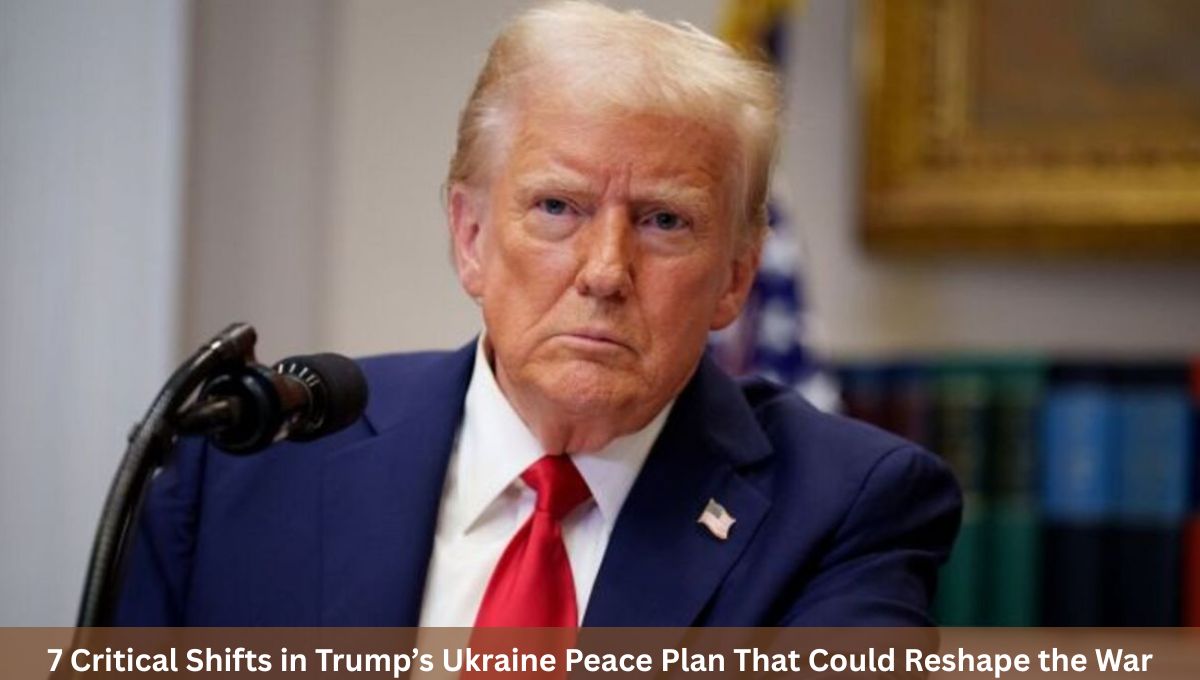
7 Critical Shifts in Trump’s Ukraine Peace Plan That Could Reshape the War — but will Moscow accept any compromise? The diplomatic whirlwind around Donald Trump’s proposed Ukraine peace plan has plunged Washington, Kyiv, Moscow, and key European capitals into one of the most consequential negotiations since Russia’s full-scale invasion in 2022.
What began as a 28-point proposal that appeared aligned with the Kremlin’s demands has rapidly evolved into a revised framework, reportedly cut down to 19 points, with Ukraine and the United States agreeing on “core terms.”
But behind the guarded optimism from U.S. and Ukrainian officials lies a stark reality:
the war continues to escalate, Russia shows little sign of accepting meaningful compromises, and the pace of diplomacy is being shaped not only by battlefield pressures but by political imperatives in Washington and Moscow.
This report synthesizes details from the Geneva negotiations, European counterproposals, Moscow’s public signals, and reactions across Ukraine to explore how the peace plan changed, why it changed, and what remains unresolved.

7 Critical Shifts in Trump’s Ukraine Peace Plan That Could Reshape the War
A Deal Ukraine Might Accept — But Not Yet
Ukrainian officials arrived in Geneva last weekend deeply concerned. The original draft of the U.S. peace plan, leaked days earlier, bore unmistakable fingerprints of Russian influence: NATO membership vetoes, drastic limits on Ukraine’s armed forces, recognition of Russian control over Crimea and the Donbas, and minimal concessions required of Moscow.
The immediate backlash was intense. European diplomats denounced the proposal as “completely unconstructive.” Ukrainian advisors described it bluntly as “capitulation.” Even members of Trump’s own Republican Party expressed alarm.
Yet Kyiv could not walk away. Trump had warned that Ukraine must accept a deal quickly or potentially lose U.S. military aid — a threat that landed heavily at a moment when Ukraine faces severe ammunition shortages, worsening winter power outages, and Russian advances in the southeast.
Despite the pressure, Ukrainian negotiators insisted on rewriting the plan, and the U.S. agreed to substantial changes. By Sunday night, both sides announced “tremendous progress,” though key issues remain sensitive enough to require direct discussion between Trump and President Volodymyr Zelensky.
How the 28-Point Proposal Became a 19-Point Framework
According to multiple participants, the initial 28-point plan was hastily assembled and included several provisions unrelated to Ukraine — primarily U.S.–Russia bilateral issues. These were removed to produce a streamlined 19-point framework.
But more importantly, entire sections were rewritten under pressure from Ukraine and European allies.
Key Changes Reported in the Revised Framework
Here are the most significant revisions:
- Removal of an automatic veto on Ukraine’s future NATO membership
Early drafts demanded that Ukraine forever renounce joining NATO. The revised plan removes the explicit veto. - Increase in permitted Ukrainian troop numbers
The original cap of 600,000 troops has been raised to 800,000, consistent with a European counterproposal. This still conflicts with Ukraine’s stance that military limits are a red line. - Deletion of full war-crimes amnesty
A blanket amnesty for Russian soldiers was removed, addressing a major Ukrainian and European objection. - No automatic territorial concessions
The requirement for Ukraine to cede remaining areas of Donetsk and Luhansk has been softened. Recovery of occupied territories would occur through diplomatic — not military — means. - Security guarantees included
European leaders have floated Article 5-style protection for Ukraine. The revised plan reportedly includes language about binding U.S. guarantees, possibly for the first time. - No permanent ban on Western troops in Ukraine
The updated version allows non-permanent Western deployments, such as training missions.
These adjustments make the framework significantly more aligned with Ukraine’s core demands.
Europe’s Role — And Russia’s Anger
France, Germany, and the United Kingdom played a critical part in reshaping the proposal. Their amendments, published by Reuters, offered Kyiv a far more acceptable package:
- No blanket territorial handovers
- No veto on NATO membership
- Strengthened security guarantees
- No troop-cap limits below wartime strength
However, Russia immediately reacted with anger.
Moscow’s Position Hardens
Russian Foreign Minister Sergey Lavrov declared Europe’s proposal “unconstructive.” He accused France and Germany of failing as mediators during the Minsk negotiations in 2014.
The Kremlin’s core message is clear:
- The original 28-point plan is acceptable.
- Revised versions are not.
- Europe should be excluded from further talks.
This stance is consistent with Putin’s long-term strategy of exploiting rifts within NATO and reducing Europe’s influence over Ukraine’s political future.
Why Did the U.S. Proposal Initially Favor Russia?
This remains one of the most sensitive questions around the negotiations.
Several officials — anonymously or indirectly — pointed to Trump’s envoy, Steve Witkoff, who visited Putin earlier in the year and returned echoing Russian narratives almost “verbatim.” Senior U.S. lawmakers said Secretary of State Marco Rubio admitted the document resembled a “Russian wish list,” though Rubio denied authoring it.
Ukrainian analysts saw the publication of the plan as a calculated intelligence maneuver: releasing Russia’s maximalist demands to test reactions, pressure Kyiv during a moment of vulnerability, and gauge the limits of European support.
Whatever the motive, the result was a weekend of frantic negotiation that reversed many of those initial provisions.
The Battlefield Context — A Race Against Time
Ukraine’s bargaining position has weakened considerably since early 2023. Russia now claims slow but steady advances along the southeastern front, aided by:
- Deployments of glide bombs
- Drone swarms
- Newly adapted “fog-generating” armored tactics
- Mass recruitment and industrial mobilization
Ukraine, meanwhile, faces:
- Severe ammunition shortages
- Manpower constraints
- Power grid destruction
- Internal political turmoil over corruption allegations
- A natural fatigue among Western backers
Russia senses this vulnerability.
Tatiana Stanovaya of the Carnegie Russia Eurasia Center said Putin is now “much more self-confident militarily” and convinced Ukraine will eventually capitulate to a deal on Moscow’s terms — if not today, then after further battlefield attrition.
The Kremlin openly believes time is on its side.
Ukrainian Public and Military Reaction — Shock, Anger, Defiance
For many Ukrainians, the initial U.S. plan felt like betrayal.
Front-line soldiers were especially blunt.
A drone operator named Bohdan told Al Jazeera:
“The West’s helplessness and cynicism are endless. They withheld aid, couldn’t decide what to do, and we keep paying with our blood.”
He mocked Russia’s slow progress — “1% of territory in three years,” — arguing that Moscow cannot achieve decisive victory.
Civilians were equally outraged. In Kyiv, residents working under generator-powered lights described Trump as preparing Ukraine for capitulation. Some even speculated about Russian kompromat influencing Washington — a reflection of the deep distrust the proposal triggered.
Kyiv’s Red Lines: “Dignified and Lasting Peace”
Despite agreeing to the “core terms” of the revised plan, Kyiv remains adamant about several non-negotiables:
- No recognition of Russian sovereignty over Crimea or the Donbas
- No permanent troop caps limiting national defense
- No NATO veto or security gray zones
- No elections within 100 days unless conditions ensure safety and fairness
- No ceasefire without enforcement mechanisms
As Ukrainian parliamentary speaker Ruslan Stefanchuk declared:
“Ukraine will not agree to recognizing occupation, limiting our armed forces, or vetoes on our NATO membership.”
Russia’s Strategy — Delay, Divide, Exhaust
Analysts warn that Putin is manipulating Trump’s eagerness for a quick deal. There are several motivations:
1. Undermine U.S. Sanctions
New sanctions on Russia’s oil giants took effect on November 21, 2025. A ceasefire or ongoing diplomatic engagement could slow enforcement.
2. Delay the secondary sanctions bill in Congress
If the U.S. is in active peace talks, some Republican lawmakers may hesitate to support tougher sanctions.
3. Split Europe from the U.S.
By rejecting European amendments, Russia seeks to cast Europe as irrelevant or hostile to peace.
4. Buy time for battlefield advantages
The winter favors Russian forces, and Ukraine’s manpower shortages are reaching crisis levels.
Lavrov even hinted at this delay strategy, saying:
“We are not rushing our American colleagues.”
Dramatic Escalation in Kyiv — Russia’s Deadliest Barrage in Weeks
As diplomats debated peace in Geneva and Abu Dhabi, Russia launched a massive attack on Kyiv using:
- Ballistic missiles
- Cruise missiles
- Iranian-style drones
- Heavy glide bombs
Seven people were killed, homes and hospitals were damaged, and emergency crews raced through streets jammed with debris. Witnesses described doors blowing off their hinges and windows shattering “instantly.”
This latest strike underscored the urgency — and the volatility — surrounding the negotiations.
Peace talks are proceeding alongside some of the most intense bombardments of the war.
The Path Forward — A Deal, But Not a Final One
Despite the optimism expressed by Ukrainian and U.S. officials, the revised 19-point plan remains only a framework — far from a binding agreement.
Three critical phases remain:
- U.S.–Ukraine alignment
— now mostly achieved, though troop caps and NATO language remain sensitive. - Direct Trump–Zelensky negotiations
— expected in Washington in November. - Russia’s response
— Russia has not even received the revised document.
— And early signals suggest Moscow rejects the changes.
In short:
Ukraine and the U.S. have agreed to negotiate.
Russia has not agreed to negotiate on the revised terms.
Conclusion — Hope, Pressure, and Deep Uncertainty
The transformation of Trump’s Ukraine peace plan from a Kremlin-friendly blueprint into a more balanced framework shows how diplomacy can shift under intense pressure. Ukraine, backed by European allies, forced the U.S. to reconsider core elements and produce a version Kyiv can at least contemplate.
But the central dilemma remains unchanged:
Russia does not yet want peace on these terms.
Putin appears convinced that Ukraine will weaken further. He believes he can stall Trump, divide Europe, and outlast the West. For Ukraine, the stakes are existential. For Europe, they are strategic. For the United States, they are political. And for millions of civilians under bombardment, they are a matter of survival.
The coming weeks — and the eventual Trump–Zelensky meeting — will determine whether this revised plan marks the beginning of a genuine path to peace… or simply another chapter in a war with no end in sight.
Also Read: 19 Bold Shifts: Inside Zelenskyy’s High-Stakes Talks with Trump on a Revised Ukraine Peace Deal
Also Read: U.S. envoy coached Putin aide on how Russian leader should pitch Trump on Ukraine peace plan: Report