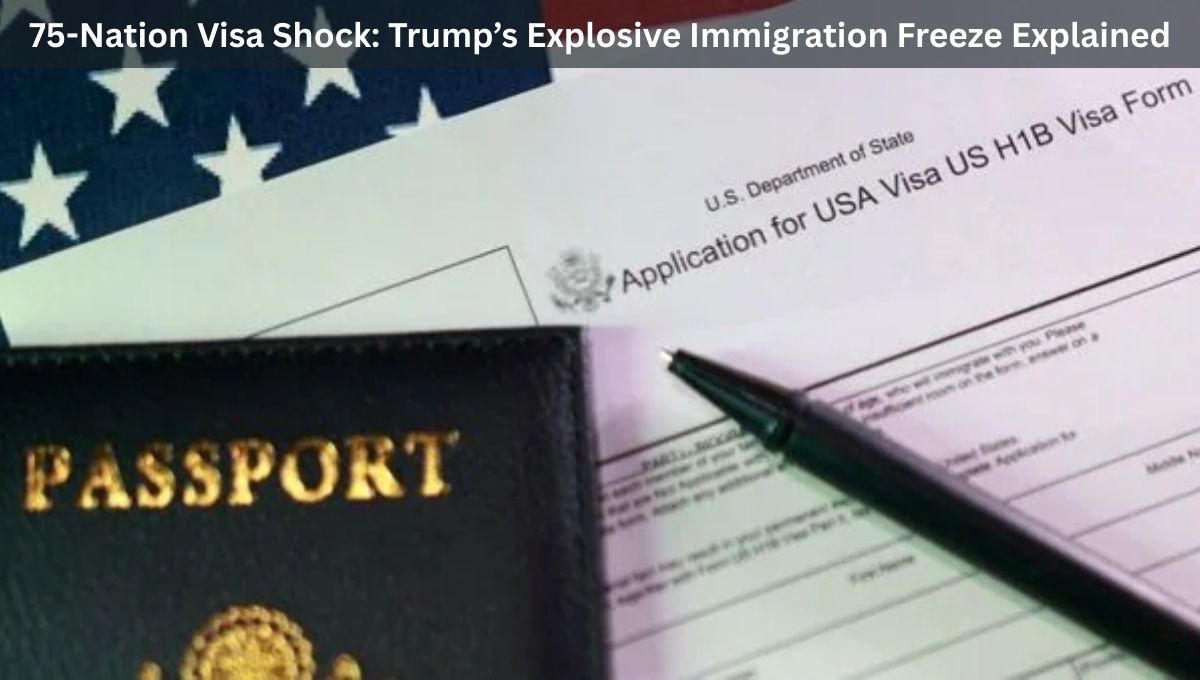
75-Nation Visa Shock: Trump’s Explosive Immigration Freeze Explained — who’s affected and why. The United States has announced one of the most sweeping restrictions on legal immigration in modern history.
Beginning January 21, the Trump administration will indefinitely suspend immigrant visa processing for applicants from 75 countries, dramatically reshaping pathways for permanent migration to the US.
The move, confirmed by the US State Department, applies only to immigrant visas—those sought by people hoping to live permanently in the United States, either through family sponsorship or employment.
Tourist, business, student, and other non-immigrant visas remain unaffected, a distinction that has become crucial as the US prepares to host the 2026 FIFA World Cup and the 2028 Olympics.
Yet the breadth of the decision—and the countries included—has sparked confusion, diplomatic unease, and fierce debate about America’s evolving stance toward immigration.

75-Nation Visa Shock: Trump’s Explosive Immigration Freeze Explained
What Exactly Has the US Announced?
The State Department has formally instructed US embassies and consulates worldwide to halt the approval and issuance of immigrant visas for nationals of 75 countries.
According to official guidance:
- Applications may still be submitted
- No immigrant visas will be approved or issued
- The suspension is open-ended, with no deadline for review or lifting
In a sharply worded statement, the department said:
“The Trump administration is bringing an end to the abuse of America’s immigration system by those who would extract wealth from the American people.”
The stated rationale is a reassessment of immigration procedures to prevent the admission of individuals deemed likely to become “public charges”—a legal term referring to migrants who may rely heavily on government welfare programs.
Who Is Impacted—and Who Is Not
Affected
- Family-sponsored immigrants
- Employment-based immigrant visa applicants
- Diversity visa (green card lottery) winners from listed countries
- Refugees seeking permanent resettlement pathways linked to immigrant visas
Not Affected
- Tourist visas (B-1/B-2)
- Student visas (F-1, J-1)
- Business visas
- Short-term work visas
- Athletes, officials, and fans traveling for the World Cup
An exception also applies to dual nationals who use a passport from a non-listed country.
Why Now? The “Public Charge” Doctrine Returns
At the heart of the decision is the revival and expansion of the “public charge” rule, a long-standing but rarely enforced principle in US immigration law.
Under this doctrine, applicants can be denied entry if they are deemed likely to depend on:
- Welfare benefits
- Food assistance programs
- Housing subsidies
- Public healthcare programs
While the rule existed for decades, Trump’s first term significantly expanded its scope, and the Biden administration later rolled those changes back.
In November 2025, Trump reinstated and broadened the criteria once again, instructing diplomats to prioritize financial self-sufficiency above all else.
An internal State Department cable reviewed by Reuters noted that nationals from the affected countries showed higher statistical tendencies to seek public benefits in the US.
The Full List: 75 Countries Affected
The suspension applies to citizens of the following nations:
Afghanistan, Albania, Algeria, Antigua and Barbuda, Armenia, Azerbaijan, Bahamas, Bangladesh, Barbados, Belarus, Belize, Bhutan, Bosnia, Brazil, Cambodia, Cameroon, Cape Verde, Colombia, Democratic Republic of the Congo, Cuba, Dominica, Egypt, Eritrea, Ethiopia, Fiji, The Gambia, Georgia, Ghana, Grenada, Guatemala, Guinea, Haiti, Iran, Iraq, Ivory Coast, Jamaica, Jordan, Kazakhstan, Kosovo, Kuwait, Kyrgyzstan, Laos, Lebanon, Liberia, Libya, North Macedonia, Moldova, Mongolia, Montenegro, Morocco, Myanmar, Nepal, Nicaragua, Nigeria, Pakistan, Republic of the Congo, Russia, Rwanda, Saint Kitts and Nevis, Saint Lucia, Saint Vincent and the Grenadines, Senegal, Sierra Leone, Somalia, South Sudan, Sudan, Syria, Tanzania, Thailand, Togo, Tunisia, Uganda, Uruguay, Uzbekistan, and Yemen.
Why Countries Like Thailand, Kuwait, and Brazil Raised Eyebrows
While the inclusion of conflict-affected or economically fragile nations such as Afghanistan, Sudan, Haiti, and Somalia was widely expected, the appearance of relatively prosperous or stable countries shocked observers.
Thailand
Thailand’s inclusion triggered immediate diplomatic action. Bangkok summoned the US chargé d’affaires, seeking urgent clarification. The country is a major American tourism destination and has historically maintained cordial relations with Washington.
Kuwait
An oil-rich Gulf state with one of the world’s highest GDPs per capita, Kuwait’s presence on the list stunned analysts. Fewer than 40,000 Kuwaitis live in the US, and nearly a third are students.
Journalists and experts questioned whether the decision was driven less by income levels and more by statistical welfare usage patterns.
Brazil
Brazil, Latin America’s largest economy, also came as a surprise. Brazilians account for only about 1% of the US foreign-born population, yet the country found itself swept into the freeze.
Why India Is Not on the List
India’s absence from the list has been repeatedly highlighted by analysts.
Experts point to:
- Extremely low welfare dependency rates
- Strong compliance with US documentation standards
- A large proportion of skilled migrants
- Deep economic and consular cooperation, especially through the H-1B visa system
As one commentator noted, including India would undermine the stated goal of preventing public charge risks.
Part of a Broader Immigration Clampdown
This visa suspension is not an isolated move. It fits into a broader, multi-layered immigration crackdown since Trump returned to office.
Key Measures So Far
- Full travel bans on 18 countries
- Lowest refugee admissions cap in US history: 7,500 for FY 2026
- Refugee prioritization skewed toward white Afrikaners from South Africa
- Suspension of asylum processing for several nationalities
- Expanded social media vetting
- Citizenship and green card processing freezes
- Revocation of over 100,000 visas
Deportations at Record Levels
The crackdown extends beyond visas.
By early December:
- 605,000 people deported
- 1.9 million self-deported
- Net negative immigration for the first time in 50 years
According to the Brookings Institution, the US lost between 10,000 and 295,000 immigrants in 2025 alone.
Impact on Refugees and Families
Migration-rights groups warn the policy will disproportionately affect:
- Mixed-status families
- US citizens sponsoring spouses or parents
- Refugees awaiting family reunification
- Applicants already far along in the process
Consular officers were instructed to deny even print-authorized visas that had not yet been physically issued.
World Cup and Olympics: Why Visitors Are Safe—for Now
Despite fears, the State Department insists:
- Tourist visas remain unaffected
- Athletes and officials will travel under special visa categories
- Fans can still apply for visitor visas
However, critics warn that longer wait times and heightened scrutiny may still discourage travel.
Political Fallout and Global Reaction
Several governments have sought clarification or lodged quiet protests. Others fear the suspension could become permanent, similar to earlier Trump-era bans that lasted years.
Immigration policy experts argue the move effectively blocks nearly half of all legal immigrants, potentially denying entry to over 300,000 people annually.
What Happens Next?
There is no timeline for lifting the suspension. Officials say the pause will remain until vetting procedures are reassessed, but similar reviews in the past have stretched indefinitely.
Legal challenges are expected, particularly around:
- Family reunification rights
- Equal protection claims
- Administrative overreach
For now, applicants from the affected countries face an uncertain future.
Conclusion: A Defining Shift in US Immigration Policy
The suspension of immigrant visa processing for 75 countries marks a defining moment in US immigration history.
Framed as a financial safeguard, the policy represents a fundamental reordering of who America is willing to welcome as permanent residents.
As global mobility, refugee crises, and labor shortages intensify worldwide, the decision underscores a stark reality:
legal immigration to the United States has become harder than ever—and for millions, effectively impossible.
Whether this pause becomes a permanent wall or a temporary freeze will shape the lives of families, workers, and refugees for years to come.
Also Read: 7 Critical Impacts of the US Immigration Pause on Green Cards and Citizenship
Also Read: Trump administration halts visa processing for 75 nations – Pakistan, Bangladesh among worst hit
Related Posts:
- 7 Shocking Facts About Trump’s $1 Million Gold Card…

- 7 Alarming Impacts of Trump’s Plan to Expand the US…
- 7 Explosive Shifts in Trump’s New Immigration…

- 7 Critical Impacts of the US Immigration Pause on…

- 7 Powerful Shifts: Trump’s New H-1B Rules Shake Up India

- 9 Explosive Revelations as Trump Declares His Health…