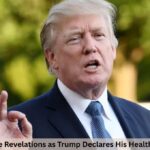
Trump’s Clash with Australian Envoy Kevin Rudd Escalates Tensions at White House Meeting. What began as a friendly White House meeting between U.S. President Donald Trump and Australian Prime Minister Anthony Albanese quickly turned into an uncomfortable moment that stole headlines worldwide.
During a joint press event on October 20, 2025, meant to celebrate an $8.5 billion deal on rare earth minerals and reaffirm the AUKUS submarine partnership, Trump took a sharp detour — publicly rebuking Kevin Rudd, Australia’s ambassador to the United States and a former prime minister.
When a journalist asked Trump about Rudd’s past criticism of him, the president smirked and said, “Maybe he’d like to apologize.” He then turned to Albanese and asked, “Where is he? Is he still working for you?”
The Australian prime minister, smiling awkwardly, pointed across the table to Rudd. What followed next was a moment that perfectly captured Trump’s unfiltered style of diplomacy.
Rudd began to respond: “That was before I took this position, Mr. President.”
Trump interrupted sharply:
“I don’t like you either. I don’t. And I probably never will.” Laughter rippled across the room as officials from both sides tried to lighten the mood. Another reporter quickly changed the subject — but the damage was done.

Trump’s Clash with Australian Envoy Kevin Rudd Escalates Tensions
Rudd’s Past Criticism Comes Back to Haunt Him
The tension traces back years. While out of office, Kevin Rudd had been one of Trump’s most outspoken critics on social media.
Rudd had labeled Trump:
- “The most destructive president in history.”
- “A traitor to the West.”
- “A village idiot.”
He even suggested that Trump had “dragged America and democracy through the mud” following the January 6 Capitol riot in 2021.
Although Rudd deleted those posts after Trump’s 2024 election victory, the remarks clearly stuck in Trump’s mind. During his campaign last year, Trump called Rudd “nasty” in an interview with British commentator Nigel Farage, adding that he “wouldn’t last long” as ambassador.
‘Village Idiot’ Remark Sparks Trump’s Fury
According to reports from Sky News Australia and The Financial Times, the trigger moment came when a journalist reminded Trump of Rudd’s earlier insult, calling him a “village idiot.”
Trump reportedly paused, visibly irritated, before asking:
“Did an ambassador say something bad about me? Don’t tell me. Where is he? Is he still working for you?”
Albanese’s nervous laughter and Rudd’s attempt to explain only worsened the tension. The president’s curt reply — “I don’t like you either, and I probably never will” — instantly became a viral soundbite.
The uncomfortable exchange overshadowed what should have been a milestone in U.S.-Australia relations.
Diplomatic Fallout: Allies Laugh, Opponents Attack
Australia’s Foreign Minister Penny Wong was quick to dismiss the episode as harmless banter.
“We heard the laughter. It was clearly tongue-in-cheek,” Wong said on Nine Network. “We had a very successful meeting — full credit to Kevin.”
But back home, the political fallout was swift. Opposition leader Sussan Ley blasted the Albanese government, saying Rudd’s role had become “untenable.”
Ley accused the prime minister of failing to defend Australia’s interests, noting that Trump’s tariffs on Australian steel and aluminum remain in place.
“The president didn’t appear to know the ambassador,” Ley said. “After sledging him the way he did, and for the prime minister to laugh, shows the relationship isn’t where it needs to be.”
She urged Albanese to “back him or sack him,” warning that Rudd’s diplomatic baggage could harm Australia’s standing in Washington.
Trump Defends Tariffs, Dismisses Criticism
In a follow-up exchange, Trump doubled down on his trade policy, insisting that Australia faced “very low” tariffs compared to other allies.
“Australia’s subject to a baseline 10 percent rate, and 50 percent on steel and aluminum — that’s very low,” he said.
Foreign Minister Wong, while acknowledging the tariffs, maintained that Australia was in “the best possible position” under Trump’s regime.
“We’ll continue to engage constructively,” she told ABC Radio, emphasizing that “great success” came from the meeting despite the awkward moment.
Behind the Scenes: A Private Apology and a Partial Truce
According to Australian officials quoted by Reuters and The Guardian, Kevin Rudd privately apologized to Trump after the meeting.
Trump’s reported response:
“All is forgiven.”
Still, insiders said the president later told aides he “doesn’t like the ambassador and probably never will.”
That sentiment echoes Trump’s first term, when he clashed with foreign diplomats — including Britain’s ambassador Kim Darroch, who resigned in 2019 after Trump called him “a fool.”
Whether Rudd faces a similar fate remains uncertain.
A High-Stakes Relationship in the Balance
The U.S.-Australia alliance is one of Washington’s most vital partnerships in the Indo-Pacific. Under the AUKUS security pact, Australia is set to acquire nuclear-powered submarines built with U.S. and U.K. technology.
The two nations also agreed on a major rare earth minerals deal, worth $8.5 billion, to reduce dependency on China’s supply chain.
Analysts say the awkward Trump-Rudd moment risks clouding these achievements.
“It’s a reminder that diplomacy under Trump is often personal,” one Washington observer noted. “Old grudges can become policy issues overnight.”
Despite that, Trump assured reporters that the AUKUS project was “moving along rapidly” and that Australia was “getting the submarines.”
Greens and Critics Push Back on AUKUS
Not everyone in Canberra celebrated the meeting. Greens senator Nick McKim denounced the AUKUS deal, calling it a “$350 billion waste of money.”
“If the prime minister was acting in Australia’s best interest, he would’ve told Trump that directly,” McKim said on Channel Nine’s Today Show.
Still, Albanese’s government insists that AUKUS and the minerals partnership cement Australia’s strategic independence and deepen cooperation with the U.S. amid rising tensions in the Pacific.
Rudd’s Future and the Path Ahead
Rudd’s appointment as ambassador was originally seen as a strategic masterstroke. A Mandarin-speaking former diplomat, Rudd was expected to strengthen Australia’s influence in Washington, particularly on China policy.
But with Trump’s second term well underway, his continued presence in Washington could become politically fraught.
“Trump never forgets an insult,” a senior U.S. official told reporters. “That’s just part of his DNA.”
For now, both governments are downplaying the spat. The White House labeled the meeting “productive,” and Canberra emphasized the positive outcomes — trade, defense, and the reaffirmation of U.S.-Australia friendship.
Yet beneath the smiles, there’s a sense of unease about how personal politics might again overshadow global strategy.
Why This Matters: Diplomacy in the Trump Era
This episode underscores a larger truth: under Trump, diplomacy often revolves less around policy and more around personality.
From branding NATO allies as “free riders” to calling Canada’s prime minister “weak,” Trump’s personal style has long challenged traditional diplomatic norms.
The Rudd incident shows that even long-standing allies like Australia aren’t immune.
While the alliance itself remains intact, the tone has shifted. Trump’s remark — part joke, part jab — served as both a reminder of his combative instincts and a signal of what’s to come: a foreign policy defined by loyalty tests and personal grudges.
For Albanese, it’s a balancing act: maintaining access to the Trump White House while defending his ambassador and preserving national dignity.
Conclusion: A Laugh, an Apology, and Lingering Tension
By the end of the day, both sides tried to laugh it off. Rudd offered his apology, Trump offered forgiveness — and diplomats smiled for the cameras.
But the viral exchange — “I don’t like you either” — captured the fragility of even the strongest alliances when personalities collide.
As Trump begins his second term, U.S.-Australia relations remain crucial for stability in the Indo-Pacific, yet prone to flare-ups whenever old insults resurface.
In politics, memories may fade — but not for Donald Trump. And for Kevin Rudd, the next few months in Washington could determine whether an awkward moment becomes a footnote or a turning point in one of the world’s most important alliances.
Also Read: Anthony Albanese Secures Historic Second Term as Australia Rejects Trump-Style Politics
Related Posts:
- 5 Powerful Highlights as Trump Lands Second Nobel…

- 10 Big Takeaways from Trump’s 155% Tariff Warning to China

- Trump Stole the Show at 2025 Gaza Peace Summit in Egypt
- Trump’s 2025 Gaza Peace Plan Signing and Historic…

- 7 Crucial Insights Into Trump and Xi’s High-Stakes…
- 9 Explosive Revelations as Trump Declares His Health…