Amid escalating budget standoff with democrats, Trump Administration Orders Agencies to Prepare Mass Firings if US Government Shutdown Hits. The Trump administration has raised the stakes in the ongoing budget standoff with Democrats by directing federal agencies to prepare for mass firings in the event of a government shutdown. The move, outlined in an Office of Management and Budget (OMB) memo, marks a dramatic departure from how past administrations have handled shutdown scenarios.
Instead of the usual temporary furloughs where workers eventually return with back pay, this directive signals that federal jobs could be permanently eliminated. The policy would target programs deemed “not consistent with the President’s priorities,” leaving thousands of federal workers vulnerable if Congress fails to pass a spending bill before the September 30 deadline.
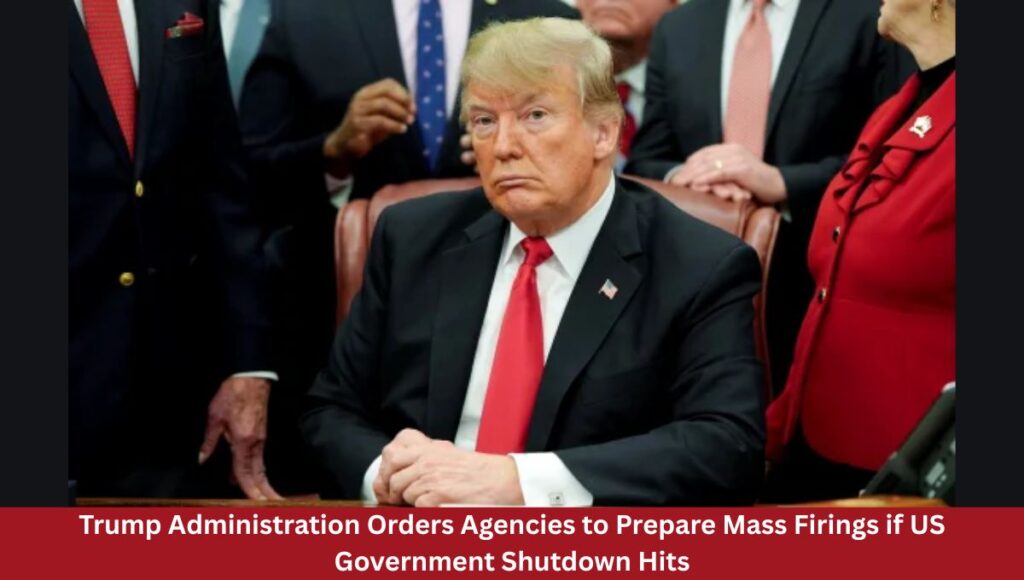
Trump Administration Orders Agencies to Prepare Mass Firings if US Government Shutdown Hits
What the OMB Memo Says
According to the memo, obtained by multiple media outlets, federal agencies must identify programs that rely solely on annual congressional funding and have no alternative financial source.
Those programs would be targeted for “reduction in force” (RIF) plans, meaning permanent layoffs rather than temporary suspensions.
“We remain hopeful that Democrats in Congress will not trigger a shutdown and the steps outlined above will not be necessary,” the memo stated.
Unlike previous shutdowns where furloughs were temporary, the Trump administration is signaling it intends to use a shutdown as an opportunity to permanently shrink the size of the federal workforce.
Why the White House is Threatening Firings
This latest directive reflects the administration’s broader push to reshape government in line with Trump’s priorities. Earlier in the year, the president signed an executive order requiring agencies to draft large-scale workforce reduction plans.
The OMB memo reinforces that vision, explicitly telling agencies to draft lists of jobs and programs that could be cut permanently if the budget impasse continues.
Critics argue the move is more about political pressure than fiscal management. By threatening federal jobs, the administration is putting pressure on Democrats to accept a “clean” funding extension — one without additional provisions, particularly healthcare-related subsidies Democrats are demanding.
Political Standoff Over Government Funding
At the heart of the looming shutdown is a familiar Washington standoff.
- Democrats are pushing for an extension of enhanced Affordable Care Act (ACA) subsidies, set to expire at the end of the year. They argue these subsidies are critical for millions of Americans relying on affordable healthcare.
- Republicans and the White House insist on a “clean” extension of government funding without additional provisions.
President Trump recently canceled a meeting with Democratic leaders Chuck Schumer and Hakeem Jeffries, saying their demands were “ridiculous.” Instead, the administration doubled down on threats, calling the Democrats’ position “insane.”
Democrats Call It Intimidation
The reaction from Democratic leaders was swift and furious.
- Senate Minority Leader Chuck Schumer accused Trump of trying to scare federal workers for political leverage:
“Donald Trump has been firing federal workers since day one—not to govern, but to scare. This is nothing new and has nothing to do with funding the government.”
- House Democratic Leader Hakeem Jeffries also slammed the memo as intimidation, writing on social media:
“Donald Trump continues to make up reasons to exercise emergency powers that don’t exist… We will not be intimidated.”
Unions representing federal employees were equally alarmed. The National Treasury Employees Union said it had no knowledge of the memo but vowed to fight any attempts at unlawful firings.
What Happens in a Typical Government Shutdown?
Normally, a government shutdown means:
- Essential services (Social Security, air traffic control, law enforcement, border patrol) continue.
- Non-essential employees are furloughed — temporarily out of work but usually rehired with back pay when funding resumes.
- Services like national parks, museums, food inspections, and immigration hearings may be disrupted.
In the most recent near-shutdown earlier this year, about 1.4 million workers were deemed essential and kept working, while 900,000 would have been furloughed without pay.
But this time, the OMB memo introduces a new twist: permanent layoffs.
Also Read: US Shutdown Looms as Trump, Democrats Fail to Reach Deal in White House Showdown
How Mass Firings Would Change the Game
If enacted, this would fundamentally shift the government’s approach:
- Instead of temporary disruption, the shutdown could cause lasting job losses.
- Federal agencies would permanently lose employees, stripping away expertise and institutional knowledge.
- The economic consequences could ripple far beyond Washington, affecting local economies where federal workers live.
Bobby Kogan, a former OMB official now at the Center for American Progress, called it “an action of enormous self-harm.”
“Needlessly ridding the country of talent and expertise. It’s also extortive: ‘Give us what we want in a funding fight, or we’ll hurt the country.’”
The Trump Administration’s Broader Effort to Shrink Government
This isn’t the first time the Trump administration has moved aggressively to reduce the federal workforce:
- Early executive orders instructed agencies to identify “non-essential” functions.
- Some departments carried out significant layoffs, while others reversed course or even rehired staff.
- Trump’s Department of Government Efficiency (DOGE) has already overseen thousands of job cuts.
The OMB memo appears to be the most aggressive step yet, signaling a willingness to use the shutdown as a tool for structural change in government.
The Budget Deadline
The federal government’s current funding expires at midnight on September 30. Without congressional action, a shutdown will begin on October 1, the start of the new fiscal year.
Republicans in the House passed a short-term funding bill to extend operations through November 20, but Senate Democrats blocked it, pushing instead for healthcare funding to be included.
With both sides entrenched and the White House escalating pressure, the possibility of a shutdown appears increasingly likely.
Potential Consequences of Mass Firings
The threat of permanent layoffs raises several pressing questions:
1. Legal Challenges
Unions and advocacy groups are expected to challenge the firings in court, arguing that shutdowns have never before been used as a justification for mass layoffs.
2. Impact on Services
Even essential services could be indirectly affected if support staff are permanently cut, slowing operations across multiple agencies.
3. Economic Ripple Effects
Federal jobs are a lifeline for local economies, especially in areas with large government facilities. Permanent layoffs could hurt housing markets, consumer spending, and regional employment.
4. Political Fallout
If hundreds of thousands of federal workers lose their jobs, the blame game could dominate the 2025 election cycle, with both parties accusing the other of creating the crisis.
Critics Warn of “Weaponizing Shutdowns”
Left-leaning policy experts argue the Trump administration is weaponizing the shutdown process:
- Past shutdowns were painful but temporary.
- Using shutdowns as an excuse for permanent workforce reductions sets a dangerous precedent.
- It risks normalizing the use of federal workers as bargaining chips in political negotiations.
Kogan summarized it as:
“Give us what we want in a funding fight, or we’ll hurt the country.”
Supporters Say It’s About Priorities
Administration officials argue the move is about aligning the government with the president’s priorities.
They claim federal programs without mandatory legal requirements should not continue indefinitely and that mass firings would free resources for more essential priorities like border security, defense, and infrastructure.
Looking Ahead
With less than a week before the deadline, agencies are scrambling to update their contingency plans, some of which OMB has not yet made public.
The big questions remain:
- Will Congress reach a deal before September 30?
- If not, will the administration truly follow through with mass firings?
- And what will the legal and political fallout be if it does?
For now, uncertainty grips federal workers, many of whom could soon find themselves not just furloughed, but permanently unemployed.
Conclusion
The looming US government shutdown is no longer just about temporary disruption. The Trump administration’s OMB memo marks a sharp departure from tradition, threatening mass permanent firings that could reshape the federal workforce for years.
Democrats call it intimidation, unions say it would be illegal, and policy experts warn it would be national self-harm. But with negotiations deadlocked, the White House appears willing to push the standoff to the brink.
If Congress does not act before September 30, America may be entering uncharted territory — one where a shutdown doesn’t just pause government, but rewrites it.