
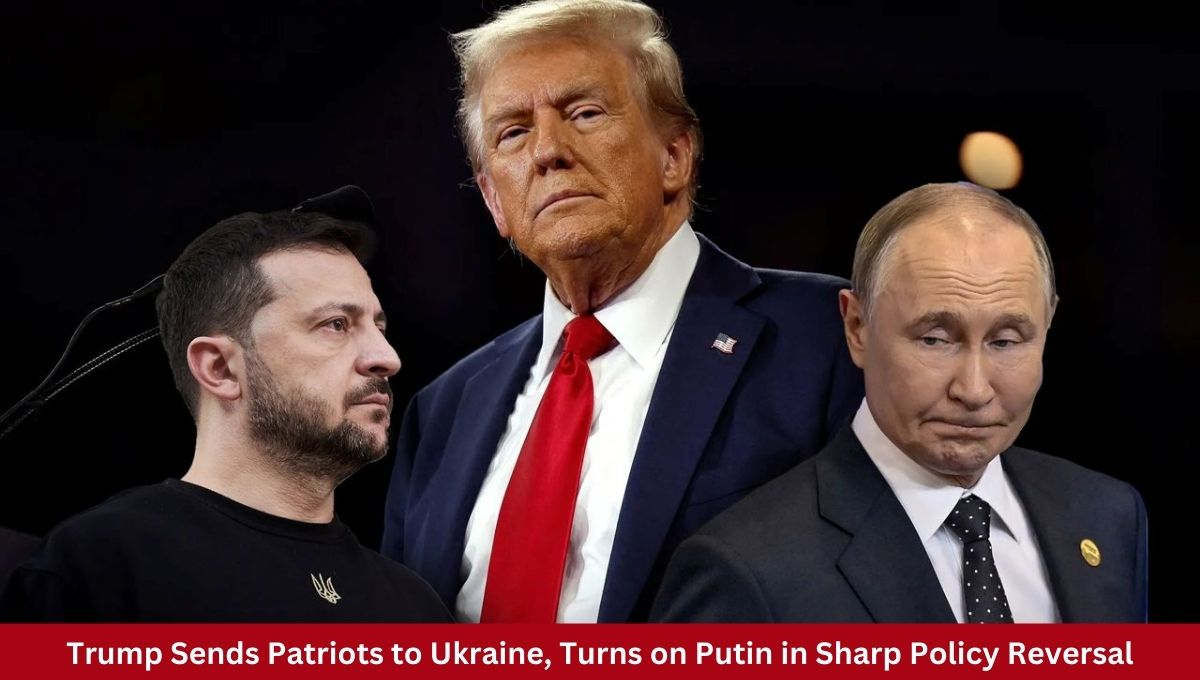
In a stunning shift that has upended international expectations, Trump Sends Patriots to Ukraine, Turns on Putin in Sharp Policy Reversal. U.S. President Donald Trump has approved the delivery of Patriot missile systems and other advanced military equipment to Ukraine, signaling a major reversal from his earlier stance of diplomatic restraint toward Russia.
The announcement, which comes amid record Russian drone attacks on Ukrainian cities, follows Trump’s recent public condemnation of Vladimir Putin, whom he accused of being duplicitous in negotiations while ramping up bombings at night.
What began as a Trump campaign promise to end the war in 24 hours through diplomacy has evolved into an assertive, transactional foreign policy that now includes military aid, tough sanctions, and NATO coordination. With a major announcement expected after a meeting with NATO Secretary General Mark Rutte, the U.S. appears poised for a deeper, more aggressive role in the Ukraine war.
Trump Sends Patriots to Ukraine, Turns on Putin in Sharp Policy Reversal
Trump: “Putin Talks Nice, Then Bombs”
Speaking from Joint Base Andrews on Sunday, Trump didn’t mince words.
“Putin talks nice and then bombs everybody in the evening. I don’t like it,” Trump told reporters, referencing the Russian President’s pattern of diplomatic platitudes followed by airstrikes.
The decision to supply Patriot air defense systems, long requested by Ukrainian President Volodymyr Zelenskyy, signals a major policy pivot.
Though the exact number of Patriot systems is still undecided, Trump confirmed Ukraine would receive “some” of them.
“We will send them Patriots, which they desperately need,” he added.
Military Package and Payment Model
The Patriots are part of a broader military aid package reportedly in the works. According to Axios, it may include long-range weapons capable of striking Russian territory, potentially reaching as far as Moscow. What makes this package distinct is its transactional structure.
Trump made clear the U.S. will not be footing the bill:
“We’re basically going to send them various pieces of very sophisticated military equipment, and they’re going to pay us 100 percent for them.”
This “you buy, we supply” model is a departure from traditional American foreign aid practices and reflects Trump’s long-held America First philosophy.
A Year of Shifting Ground: Trump’s Ukraine Timeline
Campaign 2024: Criticizing Aid and Praising Putin
In his 2024 re-election campaign, Trump repeatedly lambasted U.S. aid to Ukraine and portrayed Zelenskyy as a “salesman” milking U.S. taxpayers. He promised to quickly end the war, but never provided a detailed plan beyond suggesting he could pressure both sides into a ceasefire.
November 2024: Trump Reaches Out to Putin
Just days after winning the presidency, Trump personally phoned Putin and urged him not to escalate in Ukraine. The move, which bypassed Kyiv and other allies, raised alarm bells globally. Many viewed this as an attempt to revive the Trump–Putin rapport and broker peace unilaterally.
December 2024: Cold Reception in Paris
At a Paris meeting with Zelenskyy and French President Emmanuel Macron, Trump avoided solid promises of continued U.S. support. While hinting at economic threats toward Russia, Trump prioritized peace negotiations and avoided direct confrontation.
February 2025: A Turning Point
Secret Talks and Oval Office Clash
On February 12, Trump held a call with Putin. Shortly after, he sent Senator Marco Rubio and National Security Adviser Mike Waltz to Saudi Arabia for secret talks with Russian Foreign Minister Sergey Lavrov. Notably, Ukraine and NATO were excluded.
Later that month, a White House meeting with Zelenskyy turned confrontational. Trump proposed that Ukraine share mineral revenues in exchange for U.S. support a proposal that Zelenskyy flatly rejected.
“You’re gambling with World War Three,” Trump told him.
“I’m not playing cards. I’m the president in a war,” Zelenskyy replied.
Soon after, Trump paused all military aid to Ukraine.
March 2025: A Fragile Ceasefire and Backlash
Trump’s administration made aid conditional on a 30-day ceasefire, which Ukraine accepted. But Russia violated the truce almost immediately with continued attacks near Kharkiv and in Donbas.
By mid-March, limited U.S. aid resumed, but the political damage was done. Lawmakers in both parties began pushing for a more consistent and assertive strategy.
April–May 2025: Congress Takes the Lead
Bipartisan frustration led to the introduction of the Sanctioning Russia Act, which allows Trump to impose up to 500% tariffs on any country that continues to do business with Russia especially in oil, gas, and nuclear fuel.
This bill would directly impact nations like China, India, and Brazil, all of which have boosted Russian imports since 2022.
“This is truly a sledgehammer available to President Trump to end this war,” said Senator Lindsey Graham, who co-sponsored the bill with Senator Richard Blumenthal.
Trump initially hesitated, but the growing bipartisan momentum and NATO allies’ anxiety reportedly swayed his decision.
July 2025: Trump Breaks with Putin
On July 8, Trump publicly rebuked Putin in a Cabinet meeting, calling his behavior “dishonest and destabilizing.”
“He’s very nice all the time, but it turns out to be meaningless… a lot of bullshit thrown at us,” Trump said, marking his sharpest break with the Russian leader to date.
July 13: Patriot Missiles Approved
On July 13, Trump announced the delivery of Patriot systems to Ukraine, clarifying that NATO would cover the cost.
The following day, Trump formally endorsed the Sanctioning Russia Act, confirming his administration’s full pivot to a more confrontational stance.
NATO, Europe, and the Business Model
According to Trump, NATO will purchase the Patriot systems from the U.S., then distribute them to Ukraine. This allows Trump to maintain fiscal neutrality while supporting Kyiv militarily.
Zelenskyy confirmed that Germany will fund two Patriot systems and Norway one, while other European nations also plan contributions.
“This is exactly the kind of leverage that can bring peace closer,” Zelenskyy posted on X.
Biden-Era Aid and the Shift in U.S. Posture
Since returning to the White House, Trump had halted new weapons shipments approved during Joe Biden’s term, pending a review of U.S. strategy.
However, the escalation in Russian attacks and record civilian casualties in June compelled the administration to reassess.
According to the UN, June 2025 marked the deadliest month in three years, with 232 civilians killed and over 1,300 injured.
Ukraine’s defense ministry said it faced 728 drone attacks in a single night, with expectations of even more in coming weeks.
The Role of Frozen Russian Assets
Senator Blumenthal revealed that the U.S. may soon release $5 billion in frozen Russian assets to support Ukraine.
This move, coupled with NATO coordination and upcoming military aid, could mark a broader financial front against Moscow.
These discussions are expected to feature in Trump’s Monday meeting with Mark Rutte, where additional announcements on sanctions and aid could be made.
Strategic Reversal or a New Doctrine?
Analysts remain split on whether Trump’s actions mark a permanent strategic reset or simply a response to mounting pressure.
While Trump continues to promote America First policies, his recent shift includes a far more muscular military stance.
He has:
- Criticized Putin publicly
- Authorized high-tech weapons for Ukraine
- Endorsed bipartisan legislation to sanction Russian allies
- Pushed NATO to fund Ukraine’s defense
- Reinforced U.S. leadership in NATO without spending more taxpayer dollars
This blend of assertiveness and transactional diplomacy is beginning to look like Trump Doctrine 2.0.
Conclusion: A Defining Week in U.S.–Ukraine Policy
Trump’s abrupt U-turn on Ukraine has not only reignited American leadership within NATO but also sent a clear message to Moscow. The days of behind-the-scenes diplomacy and paused military shipments appear to be over.
With Patriot missiles en route, a bipartisan sanctions hammer ready, and NATO leaders aligned, Trump has redefined his second-term foreign policy one rooted in strength, skepticism, and strategy.
As the world waits for Monday’s potential announcement, one thing is clear: Trump’s Ukraine pivot is not just policy it’s a signal of war-time leadership.
Also Read: Trump’s 50-Day Ultimatum to Putin: Ceasefire or Face 100% Tariffs, Sanctions
Also Read: Trump to send Patriot missiles to Ukraine in major shift on arms policy
Related Posts:
- Trump's Shocking U-Turn: 5 Facts Behind the Stalled…
- 9 Explosive Revelations as Trump Declares His Health…

- 7 Explosive Revelations Behind Trump’s Move to…

- Trump to Host 2026 G20 Summit at His Florida Golf…

- Trump’s 2025 Gaza Peace Plan Signing and Historic…

- 7 Shocking Reasons FIFA’s Peace Prize for Trump…
