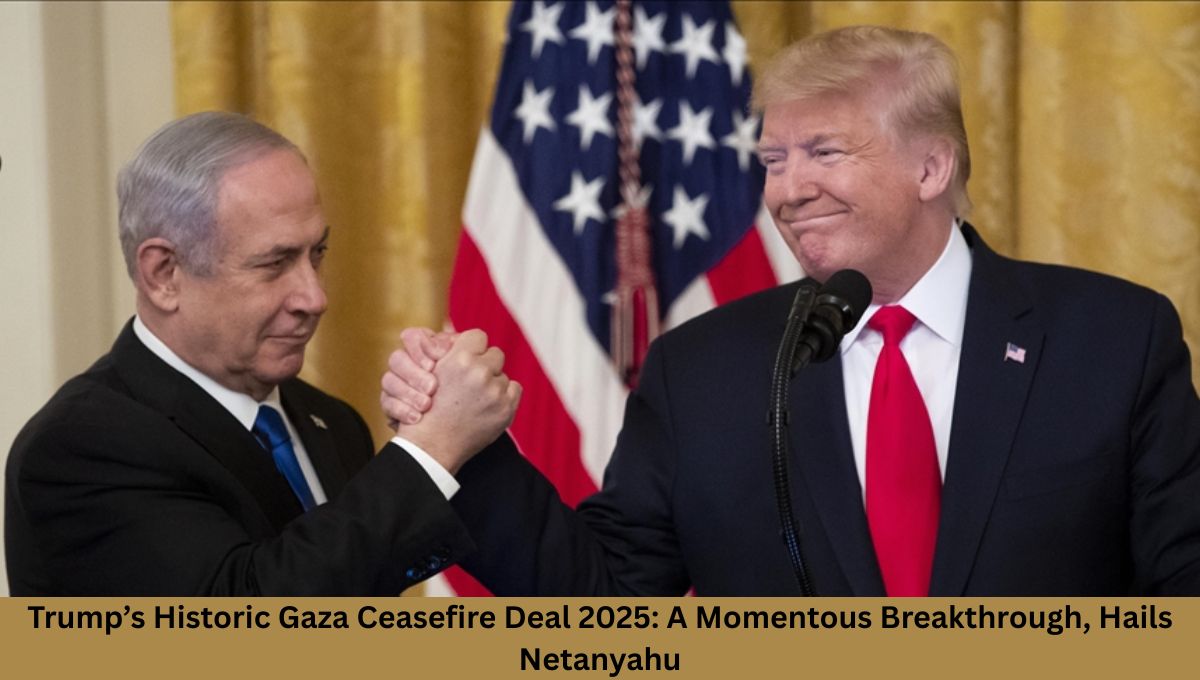
Jerusalem, October 10, 2025 : Trump’s Historic Gaza Ceasefire Deal 2025: A Momentous Breakthrough, Hails Netanyahu, credits Trump for ceasefire and hostage release. Israeli Prime Minister Benjamin Netanyahu on Thursday described the newly approved Gaza ceasefire as a “momentous development,” marking what he called a decisive step toward fulfilling Israel’s war aims.
In a late-night cabinet meeting, Netanyahu confirmed that Israel’s government had approved the first phase of a U.S.-brokered peace plan, crediting U.S. President Donald Trump and his team for their “extraordinary help” in reaching a long-awaited breakthrough.
The Trump Gaza ceasefire deal 2025—hailed by both Israeli and Palestinian leaders—promises the release of all remaining Israeli hostages held by Hamas, alongside a gradual withdrawal of Israeli forces from Gaza. The deal, years in the making, may finally signal an end to one of the longest and most devastating conflicts in recent Middle East history.

Trump’s Historic Gaza Ceasefire Deal 2025: A Momentous Breakthrough, Hails Netanyahu
Trump’s Role: Diplomatic Leverage Behind the Breakthrough
In his televised remarks, Netanyahu directly thanked Trump and his senior peace envoys Steve Witkoff and Jared Kushner, acknowledging their behind-the-scenes diplomacy.
“We couldn’t have achieved it without the extraordinary help of President Trump and his team. They worked tirelessly,” Netanyahu said.
He emphasized that Israel’s combination of military pressure and diplomacy “isolated Hamas,” making this agreement possible.
“That, and the courage of our soldiers who entered Gaza, created the pressure that brought us to this point,” Netanyahu added.
Trump’s peace initiative—part of his broader 20-point Gaza peace plan—involved months of coordination between Washington, Cairo, Doha, and Ankara. Officials say the breakthrough came after U.S. and Turkish mediation efforts persuaded Hamas to accept a phased hostage release and ceasefire schedule.
Inside the Trump Gaza Ceasefire Deal 2025
The Israeli cabinet’s approval marks the first phase of Trump’s 20-point plan. Under its framework:
- A mutual ceasefire takes effect within 24 hours.
- Hostage releases will begin within 72 hours, starting with civilians, then soldiers.
- Israel will release Palestinian prisoners and withdraw to an agreed line inside Gaza.
- The U.S. will assign 200 military personnel to coordinate logistics and humanitarian monitoring from bases in Israel and regional headquarters, without entering Gaza.
Netanyahu’s office confirmed that “the plan for the release of all hostages — the living and the fallen — has been approved.” The U.S. clarified that these troops are not combat forces, but rather observers assisting with coordination between international mediators.
Palestinian Authority Welcomes the Ceasefire
In a rare interview with Israel’s Channel 12, Palestinian President Mahmoud Abbas welcomed the agreement, describing it as “a historic moment” and expressing optimism for “lasting peace.”
“We have been hoping to bring an end to the bloodshed in Gaza, the West Bank, and East Jerusalem. Today we are very happy that the bloodshed has ceased. We hope it remains this way,” Abbas said.
When asked about Trump’s calls for Palestinian Authority reform, Abbas confirmed that restructuring efforts are already underway. “I want to say honestly – we have launched reforms,” he said.
His remarks signal renewed willingness by the Palestinian leadership to work with the U.S. and regional partners toward broader governance reforms in Gaza and the West Bank.
A Deal Built on Concessions from Both Sides
The Trump Gaza ceasefire deal 2025 required major compromises from both Israel and Hamas.
For Israel, the biggest concession came when it halted airstrikes days before the deal was finalized—marking the first time in the war that Israel paused without prior guarantees from Hamas.
On the other hand, Hamas agreed to release all hostages simultaneously, including both the living and deceased captives—a significant shift from its earlier position of phased releases.
Hamas and allied militant groups still hold 48 hostages, including 26 confirmed dead, according to Israeli military sources. Under the agreement, Hamas has 96 hours to release all captives and bodies in its possession.
How the Breakthrough Was Brokered
Diplomatic insiders say the deal’s sequencing and structure—not just its content—made the difference this time. Earlier efforts in 2024 and early 2025 collapsed because both sides insisted on their own preconditions.
The new plan, however, prioritizes parallel and phased implementation with trust-building steps leading up to final commitments. Trump’s personal involvement proved decisive.
According to Israeli media reports, the former U.S. president told Netanyahu directly: “Bibi, this is your chance for victory.”
Turkey and Qatar also played critical roles in persuading Hamas to accept the plan, with Turkish President Recep Tayyip Erdoğan leveraging his longstanding ties to the group to secure their agreement.
Also Read: Gaza Peace Deal First Phase Achieved: Trump’s Israel Visit Post-Truce
Scenes of Relief and Cautious Celebration
As news of the ceasefire spread, Israelis and Palestinians took to the streets in celebration. In Tel Aviv’s Hostages Square, families of captives gathered at dawn, waving Israeli and American flags and chanting, “Our loved ones are coming home!”
For many, the moment carried deep emotional significance. Anat Angrest, mother of hostage Matan Angrest, said: “Our Matans are coming back!”
She embraced Einav Zangauker, whose son shares the same name, as they awaited the release of their loved ones.
Even those expecting only the return of bodies expressed relief. Michel Illouz, father of slain hostage Guy Illouz, said, “We’ll rejoice with the hostages’ families, and then, when they return the corpses, we’ll mourn our losses.”
Trump confirmed on Truth Social that 48 hostages would “probably be released on Monday,” including “the bodies of the dead.”
US Delegates Praise Netanyahu’s Leadership
At the Israeli cabinet meeting approving the ceasefire framework, U.S. envoys Steve Witkoff and Jared Kushner praised Netanyahu’s resolve.
“Prime Minister Netanyahu made some very difficult calls, and lesser people would not have made them. Hamas had to do this deal—the pressure was on,” Witkoff said.
Kushner added that Netanyahu had done a “great job in negotiations,” emphasizing the value of combining strength with diplomacy.
Netanyahu, in turn, thanked both men:
“You put in your brains and your hearts. We know this is for the benefit of Israel, the United States, and decent people everywhere.”
Washington Clarifies U.S. Troop Role
While early reports claimed the U.S. would send troops into Gaza, the White House clarified that the 200 personnel would remain in Israel.
Press Secretary Karoline Leavitt said on X:
“This is NOT true. Up to 200 U.S. personnel already stationed at CENTCOM will monitor the peace agreement from Israel. No U.S. boots on the ground in Gaza.”
These troops will focus on logistics, engineering, and humanitarian coordination—part of a joint international task force involving Egypt, Qatar, Turkey, and the UAE.
Global Reactions: Optimism and Skepticism
The deal has drawn cautious optimism worldwide. UN Secretary-General António Guterres described it as a “momentous opportunity” and urged “all sides to fully abide by its terms.”
Former New Zealand Prime Minister Helen Clark wrote on X:
“For the hostages, prisoners, and their families, this news is tremendous. While the road ahead will be difficult, this first phase brings enormous relief.”
However, analysts remain wary. Mouin Rabbani, a Dutch-Palestinian Middle East expert, warned that the deal “is hardly a peace agreement nor one that lays the basis for Palestinian rights.”
The Fragile Nature of Peace
Despite the relief, both Israeli and Palestinian officials acknowledge that peace remains tenuous.
Within Israel, Netanyahu faces internal political pressure. Far-right minister Itamar Ben-Gvir threatened to “bring down the government” unless Hamas is dismantled.
Hamas, meanwhile, warned that any deviation from the agreement’s terms could “reignite hostilities.” A senior Hamas official, Osama Hamdan, told Al Jazeera that “no Palestinians will surrender their weapons,” underscoring unresolved tensions.
Also Read: Will Hamas agree to hand over its weapons as part of a Gaza ceasefire deal?
Humanitarian Aftermath and Reconstruction Challenges
The humanitarian situation in Gaza remains catastrophic. According to UN agencies, more than 67,000 Palestinians, mostly women and children, have been killed during the two-year war. Much of Gaza is now in ruins, with critical infrastructure destroyed.
Trump’s plan calls for a technocratic, apolitical Palestinian committee to govern Gaza temporarily, overseen by an international “Board of Peace” chaired by Trump and former UK Prime Minister Tony Blair, until the Palestinian Authority can be reformed.
Humanitarian organizations welcomed the ceasefire but warned of “enormous challenges” ahead, including the safe return of displaced civilians and rebuilding destroyed neighborhoods.
What Happens Next?
According to the Israeli Prime Minister’s Office, the ceasefire is expected to begin within 24 hours, followed by a 72-hour window for hostage releases.
If all goes as planned, hostages—both living and deceased—could be home by Monday or Tuesday.
Trump announced he plans to travel to Egypt for the official signing ceremony alongside regional leaders and international mediators.
“The sides have taken the first steps toward a strong, durable, and everlasting peace,” Trump wrote on social media. “A GREAT day for the Arab and Muslim world, Israel, and the United States.”
Cautious Hope After Two Years of War
The Trump Gaza ceasefire deal 2025 represents the first genuine pause in violence after two years and two days of relentless warfare that began with Hamas’s October 7, 2023, attack. That assault killed 1,200 Israelis and triggered an Israeli campaign that devastated Gaza.
Over the past 24 months, several ceasefire attempts failed, but this time, the combined military, diplomatic, and humanitarian momentum appears stronger.
While both sides have suffered immense losses—Israel lost around 2,000 soldiers and civilians—the sense of exhaustion and mutual destruction has driven renewed pragmatism.
The Long Road Ahead
Experts warn that while the ceasefire may hold initially, long-term peace will depend on deeper political reforms and security guarantees.
Hamas’s future remains uncertain: whether it will transform into a political movement or resurface as an armed group could determine the region’s stability.
For now, families on both sides are breathing a sigh of relief. In Khan Younis, Gazan children celebrated with drums, while in Tel Aviv, hostages’ relatives danced through the night.
As the world watches this fragile truce unfold, many hope that Trump’s Gaza ceasefire deal 2025 will not just mark an end to war—but the beginning of a new era of diplomacy in the Middle East.