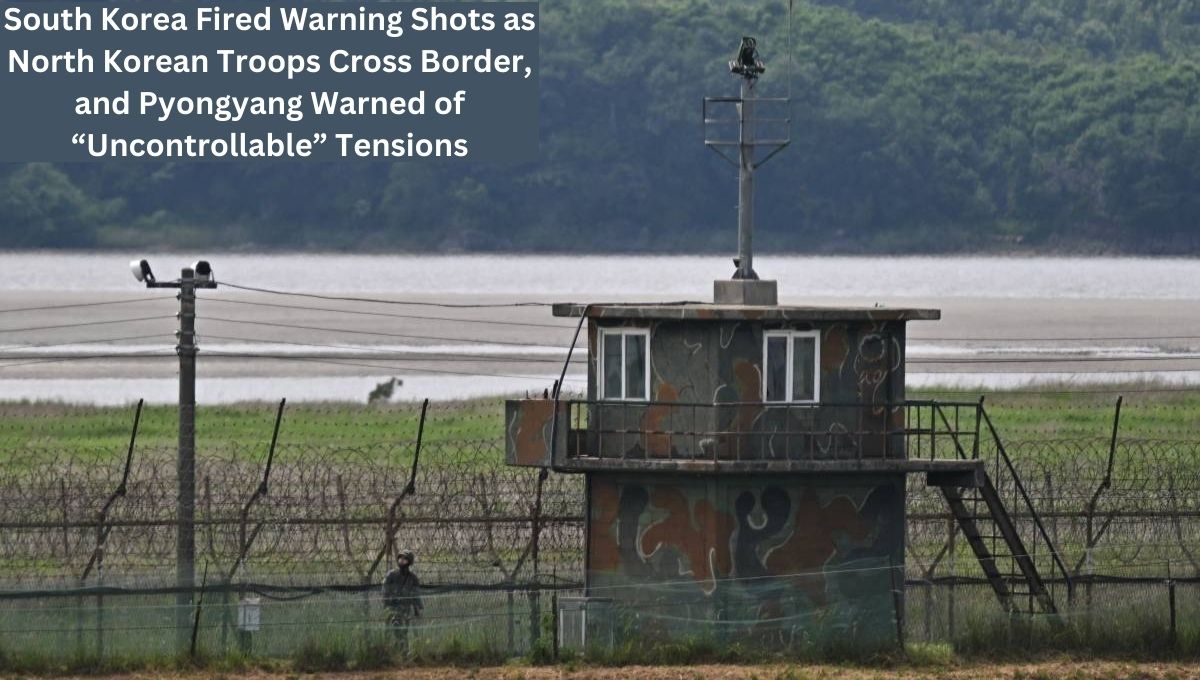
According to military officials, South Korea Fired Warning Shots as North Korean Troops Cross Border, and Pyongyang Warned of “Uncontrollable” Tensions. South Korea’s military has confirmed that it fired warning shots at North Korean soldiers earlier this week after they briefly crossed the heavily fortified Demilitarised Zone (DMZ) that divides the two countries.
The incident has triggered a fresh war of words, with Pyongyang denouncing the action as a “deliberate provocation” and warning of “uncontrollable” tensions along the border. The exchange, though brief and without casualties, underscores how fragile inter-Korean relations remain despite recent efforts by Seoul’s new president Lee Jae Myung to restore dialogue and ease hostility.
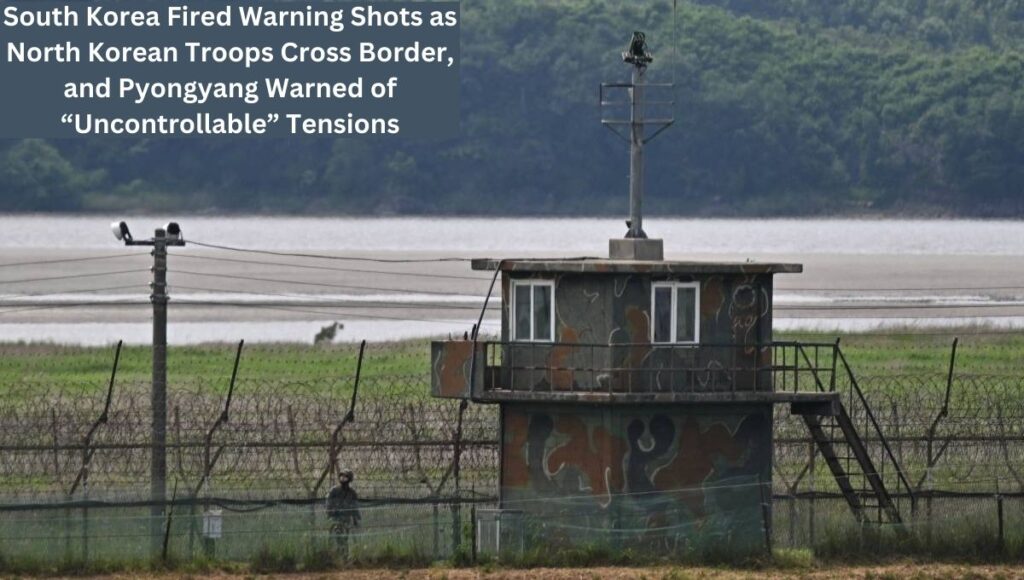
South Korea Fired Warning Shots as North Korean Troops Cross Border, and Pyongyang Warned of “Uncontrollable” Tensions
The Border Incident
According to South Korea’s Joint Chiefs of Staff (JCS), the incident occurred at around 3 p.m. local time on Tuesday.
A group of North Korean troops operating in the DMZ briefly crossed the Military Demarcation Line (MDL), the de facto border that bisects the peninsula.
South Korean forces responded by issuing verbal warnings before firing more than 10 warning shots with a machine gun. The North Korean soldiers soon retreated back across the line, the JCS said.
In a statement, the JCS explained:
“Some North Korean soldiers operating near the Military Demarcation Line within the central frontline DMZ crossed the MDL, prompting our military to fire warning shots. The North Korean soldiers then moved north of the line.”
While South Korea characterized the action as a defensive measure, Pyongyang took a sharply different view.
North Korea: “Deliberate Provocation”
North Korea’s state-run Korean Central News Agency (KCNA) quoted Army Lieutenant General Ko Jong Chol, vice chief of the General Staff, as condemning the warning shots.
“This is a very serious prelude that would inevitably drive the situation in the southern border area, where a huge number of forces are stationing in confrontation with each other, to the uncontrollable phase,” Ko said.
He accused Seoul of firing “more than 10 warning shots” at soldiers engaged in a non-military border reinforcement project aimed at permanently sealing the frontier.
The general warned that any interference with North Korea’s border construction would be seen as “deliberate military provocation” and vowed “corresponding countermeasures” if such actions persist.
Timing: As South Korea’s President Visits Tokyo and Washington
The revelation of the incident coincided with President Lee Jae Myung’s first overseas tour since taking office in June.
Lee departed Seoul on Saturday for visits to Tokyo and Washington, where North Korea policy is expected to be a key item on the agenda.
Lee, who campaigned on a platform of improving inter-Korean ties, has sought to de-escalate tensions since his election.
Shortly after taking office, his government suspended propaganda loudspeaker broadcasts along the border, which Pyongyang has long denounced as acts of war.
Despite these gestures, North Korea has shown little interest in reconciliation, with Kim Jong Un’s sister, Kim Yo Jong, dismissing Seoul’s overtures and asserting that Pyongyang has “no will to improve relations.”
The DMZ: A Powder Keg
The Demilitarised Zone (DMZ), stretching 250 kilometers across the Korean Peninsula, has long been one of the world’s most dangerous flashpoints.
Despite its name, the DMZ is bristling with soldiers, minefields, artillery, and surveillance systems.
Intrusions are not uncommon, but they often trigger heightened tensions. Dense vegetation obscures the border markers, making it possible for soldiers to accidentally or deliberately cross the line.
The latest confrontation mirrors a similar clash in April, when South Korea fired warning shots after about ten North Korean soldiers briefly crossed into the South’s side of the DMZ.
North Korea’s Border-Sealing Project
Since last year, North Korea has accelerated efforts to seal its southern border, citing concerns about “accidental conflict” and infiltration.
In October 2024, Pyongyang announced plans to permanently close cross-border routes, even sending a message to US forces in South Korea to “prevent misjudgment.”
Shortly after, it demolished symbolic but unused roads and railways once built for inter-Korean cooperation.
The border reinforcement project has continued into 2025, with soldiers working near the MDL.
According to Pyongyang, the troops targeted by South Korean warning shots were engaged in this work when the confrontation occurred.
Warning of Retaliation
General Ko Jong Chol made it clear that North Korea views any obstruction of the border project as hostile.
“If the act of restraining or obstructing the project unrelated to the military character persists, our army will regard it as deliberate military provocation and take corresponding countermeasure,” he declared.
This statement follows a familiar pattern in Pyongyang’s rhetoric, where small incidents are often portrayed as existential threats to justify future escalation.
A History of Border Clashes
The Korean border has been a site of frequent skirmishes since the 1953 armistice that ended the Korean War without a peace treaty.
- April 2025: South Korea fired warning shots at 10 North Korean soldiers who crossed the MDL.
- 2024: North Korea sent thousands of trash-filled balloons across the border in retaliation for South Korean activists floating anti-Pyongyang leaflets.
- 2024: Seoul reactivated propaganda loudspeakers for the first time in six years, blasting K-pop music and international news. Pyongyang retaliated by transmitting bizarre sounds across the frontier.
Though such clashes rarely escalate into full-scale combat, they keep the Korean Peninsula in a state of suspended conflict, with both sides technically still at war.
Seoul’s Efforts to “Restore Trust”
President Lee Jae Myung has pledged to rebuild trust with Pyongyang. In his first month in office, Seoul halted loudspeaker broadcasts and reported that North Korean forces were dismantling some of their own propaganda equipment.
Lee has emphasized dialogue without preconditions, declaring:
“Our government will take consistent measures to substantially reduce tensions and restore trust.”
However, North Korea’s leadership remains skeptical. Kim Yo Jong has publicly dismissed Lee’s overtures, underscoring Pyongyang’s deep mistrust of Seoul’s intentions, especially amid ongoing US–South Korea joint military drills, which the North brands as “rehearsals for invasion.”
US–South Korea Drills Under Fire
In a separate statement on Saturday, North Korean state media lashed out at ongoing US–South Korea joint military exercises, calling them an “extremely provocative drill for an actual war.”
Washington and Seoul maintain that the exercises are defensive in nature, designed to deter Pyongyang’s missile and nuclear threats.
Still, the drills remain one of the North’s primary grievances, fueling its refusal to engage in talks.
Symbolism of the Border
The border remains both a physical and symbolic divide between two nations that share history, culture, and language but have been locked in ideological confrontation for over seven decades.
The fact that both sides continue to clash over symbolic infrastructure roads, railways, loudspeakers, and even balloons shows how sensitive the frontier remains.
North Korea’s recent decision to destroy inter-Korean transport links, once hailed as pathways to reunification, was particularly significant.
It signaled Pyongyang’s shift from even symbolic engagement to an entrenched policy of separation.
International Reactions
So far, the latest incident has not sparked a major international crisis, but regional observers are closely monitoring the situation.
- Japan: With Lee Jae Myung visiting Tokyo, Japanese officials have expressed concern about North Korea’s military activities and stressed the importance of trilateral cooperation with the US.
- United States: Washington has yet to formally comment on the latest border clash but continues to reaffirm its security commitments to South Korea.
- China: Beijing, Pyongyang’s main ally, has urged restraint on both sides, wary of instability along its own border with North Korea.
Analysis: A Test for Lee Jae Myung
For President Lee, this incident represents an early test of his North Korea policy. While he has pledged engagement, he also must demonstrate firmness in defending South Korea’s sovereignty.
Balancing diplomacy with deterrence will be critical. Overreaction risks escalating tensions, while underreaction could embolden Pyongyang.
Analysts say Lee will likely continue his dual-track approach: confidence-building measures where possible, coupled with firm military responses to border violations.
The Road Ahead
The Korean Peninsula remains in a precarious state. Small incidents like Tuesday’s confrontation carry outsized risks in a region where mistrust runs deep and both militaries remain on high alert.
While the warning shots caused no casualties, the exchange highlights how quickly tensions can spiral and how far the two Koreas are from meaningful reconciliation.
With Pyongyang threatening “corresponding countermeasures” and Seoul vowing to protect its borders, the possibility of further flare-ups remains high. Until a broader diplomatic breakthrough occurs, the DMZ will continue to be one of the most dangerous flashpoints in the world.
Also Read: Russia Warns US, Japan, South Korea Over North Korea Alliance
Also Read: North Korean man crosses heavily fortified DMZ border to South Korea