
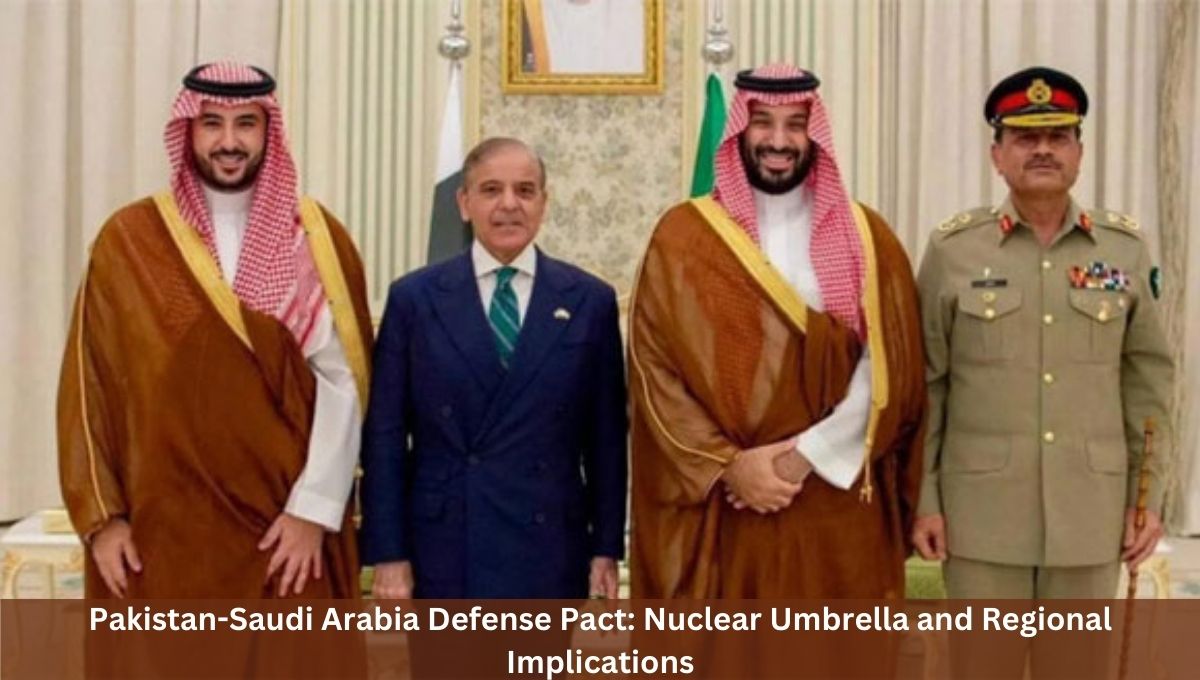
The Pakistan-Saudi Arabia Defense Pact: Nuclear Umbrella and Regional Implications under the Strategic Mutual Defence Agreement. Pakistan’s Defence Minister Khawaja Asif has confirmed that the country’s nuclear capabilities could be extended to Saudi Arabia under a new Strategic Mutual Defence Agreement signed on Wednesday, marking the first time Islamabad openly acknowledged placing Riyadh under its nuclear umbrella.
The landmark pact declares that an attack on either nation will be considered an attack on both, formalizing decades of military cooperation while adding a strategic nuclear dimension. Asif emphasized that Pakistan’s nuclear installations are open to inspections and that the arrangement is designed purely for defensive purposes.
Pakistan-Saudi Arabia Defense Pact: Nuclear Umbrella and Regional Implications
Details of the Defence Pact
Mutual Defence Clause
The agreement between Pakistan and Saudi Arabia stipulates that any act of aggression against one country will be treated as aggression against both nations. In his remarks to Geo TV, Asif said:
“What we have, our capabilities, will absolutely be available under this pact. If there is aggression against either party – from any side – it will be jointly defended, and the aggression will be met with a response.”
This mutual defence clause formalizes a long-standing arrangement between the two nations, rooted in decades of Islamic solidarity and strategic interests.
Pakistan’s Nuclear Role
For the first time, Pakistan has publicly acknowledged that its nuclear arsenal, developed primarily to counter India, could be leveraged under the pact in the event of a threat to Saudi Arabia. Asif clarified:
“Let me make one point clear about Pakistan’s nuclear capability: that capability was established long ago when we conducted tests. Since then, we have forces trained for the battlefield.”
While the nuclear weapons are not intended for offensive use, their potential role in Saudi Arabia’s defence adds a new strategic layer to Gulf security dynamics.
Also Read: Why the Pakistan-Saudi Arabia defence pact is unsettling India
Historical Military Ties
Pakistan and Saudi Arabia have maintained a long-standing military relationship for nearly eight decades. Highlights include:
- Over 15,000 Pakistani troops have been stationed in Saudi Arabia historically.
- Pakistani army personnel have frequently provided security training to Saudi forces.
- Pakistan has contributed to the Saudi-led Islamic Military Counter Terrorism Coalition, especially under General Raheel Sharif’s leadership since 2017.
- Joint military exercises, defence production collaborations, and advisory roles have strengthened the bilateral partnership.
The new agreement formalizes these understandings, especially in the wake of heightened regional tensions following the Israeli strike in Doha targeting Hamas leaders.
Strategic Context
Gulf Security Concerns
Saudi Arabia’s decision to formalize a defence pact with Pakistan reflects its desire to diversify security partnerships. Analysts argue that Riyadh’s trust in the US as the sole security guarantor has waned, particularly after Washington’s muted response to recent Israeli strikes in the region.
“The United States certainly didn’t do anything to stop [the Doha strike], and they did very little to complain afterwards. If you’re Saudi Arabia, that is an unacceptable response,” said geopolitical analyst Ian Bremmer.
The pact signals a broader strategy to ensure regional deterrence and secure an additional defence option outside traditional US support.
Potential Expansion to Other Gulf States
Defence Minister Asif noted that the doors are not closed for other Arab states to join the agreement, suggesting the possibility of extending the pact to UAE, Qatar, or other Gulf nations.
“There was no clause in the agreement that ruled out the entry of any other country,” Asif said, underscoring the flexibility of the strategic arrangement.
This flexibility allows Saudi Arabia to expand its collective security network with regional allies, ensuring broader protection against potential aggression.
India’s Response
Official Statements
India’s Ministry of External Affairs (MEA) expressed cautious concern over the pact, emphasizing the need for Riyadh to consider mutual interests and sensitivities. Spokesperson Randhir Jaiswal noted:
“India and Saudi Arabia have a wide-ranging strategic partnership which has deepened considerably in recent years. We expect that this strategic partnership will keep in mind mutual interests and sensitivities.”
India reiterated that it would take all necessary steps to safeguard national security, and officials are actively studying the implications of the agreement on regional and global stability.
Security Calculus
The pact adds a new layer to India’s strategic calculations in West Asia, especially given the ongoing border tensions with Pakistan and recent military operations such as Operation Sindoor.
“If Saudi Arabia is committed to come to Pakistan’s defence, if I’m India, that has to factor into my calculations. That’s going to change life for India, no question,” Bremmer said.
The nuclear dimension and the formalization of collective defence make the agreement a game-changer for New Delhi, requiring careful monitoring of Saudi-Pakistan dynamics in the Middle East.
Geopolitical Implications
Pakistan’s Strategic Strength
The agreement bolsters Pakistan’s geopolitical standing in the Gulf by formalizing its role as a security partner and nuclear guarantor. Analysts highlight that the pact complements Islamabad’s longstanding ties with China and strengthens its influence in regional security arrangements.
“Their principal ally remains China. That’s where they’re getting most of their military support and shared intelligence,” Bremmer said.
Saudi Arabia’s Diversification Strategy
For Riyadh, the pact represents a shift from relying exclusively on the US for defence. Bremmer explained:
“It is an effort to diversify alliances, to rely less exclusively on the United States. The need to ensure that they have a broader array of security partners around the world is growing. That’s why they made that decision.”
The formal recognition of Pakistan’s nuclear umbrella is also a signal to regional adversaries, particularly Israel, about Saudi Arabia’s enhanced security posture.
Regional Stability and Global Reactions
The pact could have broader ramifications across West Asia, including:
- Increased caution among Gulf countries regarding Israeli military actions.
- Potential recalibration of US influence in the region.
- Heightened vigilance in India, given the nuclear dimension and historical Pakistan-India tensions.
India’s extensive economic and political ties in the Gulf, combined with millions of Indian citizens living and working there, make it particularly sensitive to these developments.
Historical and Strategic Background
Past Defence Arrangements
Pakistan and Saudi Arabia’s military cooperation is not new. Key historical points include:
- 1967: First formal defence agreement signed.
- 1982: Defence pact upgraded.
- 2017 onward: Pakistani military leadership in the Islamic Military Counter Terrorism Coalition.
- Pakistani troops have historically provided training and advisory services to Saudi forces.
The new agreement is the culmination of decades of strategic alignment, accelerated by recent regional tensions, including Israel’s attack in Doha.
Economic and Financial Ties
Saudi Arabia has historically supported Pakistan financially during economic crises, strengthening the strategic interdependence between the two countries. Combined with decades-long defence collaboration, this financial support adds resilience to the partnership.
Key Takeaways
- Pakistan’s nuclear capabilities may now extend to Saudi Arabia under the new defence pact.
- The agreement formalizes decades of military cooperation and advisory roles.
- Other Gulf countries could potentially join the pact, broadening the collective security arrangement.
- India is closely monitoring the developments, with potential implications for its security calculus.
- Saudi Arabia’s diversification of alliances signals a shift from exclusive reliance on the US.
- Regional stability may be affected, particularly amid ongoing Israeli military actions in the Gulf.
Conclusion
The Strategic Mutual Defence Agreement between Pakistan and Saudi Arabia marks a significant development in Middle East and South Asian geopolitics. By formalizing decades of cooperation and openly acknowledging Pakistan’s nuclear umbrella, the pact strengthens Saudi Arabia’s strategic autonomy while enhancing Pakistan’s geopolitical influence.
India, a major regional stakeholder, will need to adapt its security strategy in light of this development, balancing strong ties with Saudi Arabia against the newly formalized Pakistan-Saudi defence link.
As regional tensions continue to simmer in the wake of Israeli operations in Qatar, the new defence pact introduces a complex layer of deterrence and collective security, signaling a potential realignment of strategic calculations in the Gulf and beyond.
Related Posts:
- Pakistan Defence Minister Khawaja Asif Contradicts…

- India Reacts to Pakistan-Saudi Arabia Defence Pact:…
- 7 Powerful Ways the US–Saudi $1 Trillion Partnership…
- 9 Powerful Signals Behind Saudi Arabia Honoring…

- 5 Key Takeaways as Pakistan–Afghanistan Peace Talks…

- Afghanistan–Pakistan War 2025: Inside the 48-Hour Ceasefire
