

As the Gaza war intensifies and global pressure mounts, Netanyahu Signals Temporary Gaza Ceasefire Amid Expanding Israeli Offensive. Israeli Prime Minister Benjamin Netanyahu has indicated openness to a temporary ceasefire in Gaza if it facilitates the release of hostages. His statement came during a Jerusalem press conference on Wednesday, where he also addressed escalating tensions with Iran, humanitarian concerns, and Israel’s ongoing military strategy.
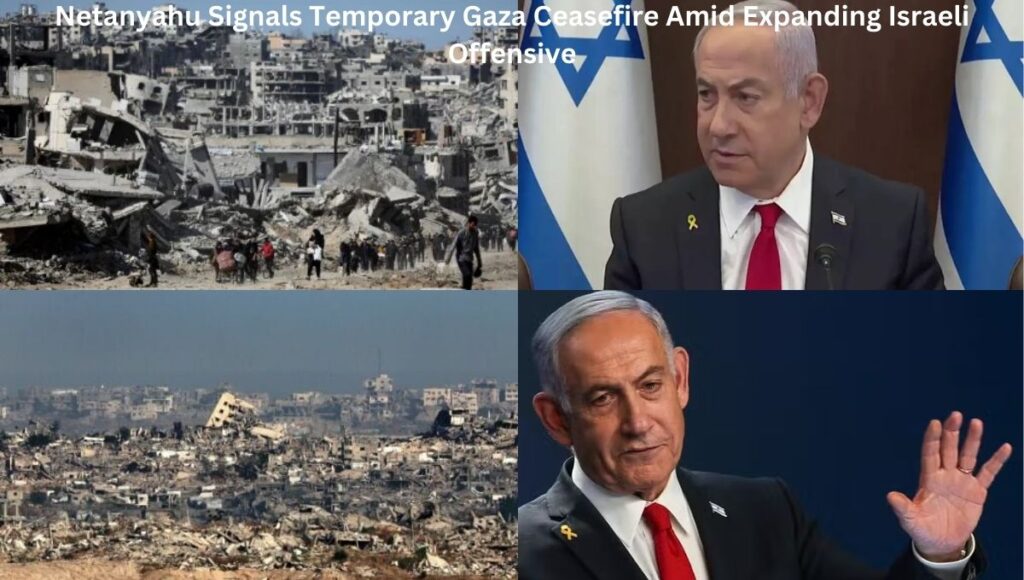
Netanyahu Signals Temporary Gaza Ceasefire Amid Expanding Israeli Offensive
Netanyahu Open to Temporary Ceasefire for Hostage Release
Facing growing international scrutiny, Prime Minister Benjamin Netanyahu stated that Israel is prepared for a temporary ceasefire in Gaza, provided it leads to the return of more hostages.
“There are certainly 20 living hostages remaining, and up to 38 deceased. We will bring them all back,” he declared.
“If there is an opportunity for a temporary ceasefire to bring back more hostages and I emphasize:
a temporary ceasefire we are prepared for that,” Netanyahu said, drawing a firm line between short-term humanitarian negotiations and his long-term military goals.
Full Security Control Over Gaza the Endgame
In a clear message of intent, Netanyahu emphasized that the current Gaza offensive aims for full Israeli security control over the entire Strip.
“At the end of this campaign, all of Gaza’s territory will be under Israeli security control, and Hamas will be completely defeated,” he asserted.
Chief of Staff Maj. Gen. Eyal Zamir echoed these sentiments during a military tour in Gaza, noting that the IDF had made significant strategic gains, including capturing the Morag Corridor and expanding the buffer zone.
“We are defending ourselves, and for that we must attack,” Zamir said. “We will expand the maneuver, occupy additional areas, and destroy Hamas’s infrastructure.”
Mounting Humanitarian Crisis in Gaza
Despite military advancements, the humanitarian crisis in Gaza continues to deepen. Gaza residents are struggling to access basic necessities such as food and medicine after nearly two months of an aid blockade.
“No one is distributing anything to us,” said Umm Talal Al-Masri, a displaced Palestinian in Gaza City. “We’re grinding lentils and pasta to make some loaves of bread.”
Although Israel allowed 100 aid trucks into Gaza on Wednesday and 93 the day before, humanitarian organizations say the volume is far from sufficient.
“We must avoid a humanitarian crisis to preserve our operational freedom and ensure our best allies can continue to support us,” Netanyahu acknowledged.
Diplomatic Tensions After West Bank Incident
Netanyahu’s remarks came just hours after Israeli troops fired what the military described as “warning shots” near a foreign diplomatic delegation in the occupied West Bank.
The delegation, which included European diplomats, had traveled to witness the destruction from recent Israeli military raids.
The incident drew condemnation from the Palestinian Foreign Ministry, which accused Israel of deliberately targeting the diplomats.
The Israeli military said the group had entered a restricted zone and that the shots were intended to redirect them. The EU has called for a full investigation and accountability for the incident.
Iran and the Nuclear Threat
Turning attention to regional security, Netanyahu reaffirmed Israel’s opposition to a nuclear-armed Iran.
“We hope an agreement can be reached [with the United States] to prevent Iran from obtaining nuclear weapons. That would mean denying Iran the ability to enrich uranium,” he said.
While welcoming a potential deal, Netanyahu made it clear that Israel reserves the right to act independently. “Let me be clear: the state of Israel reserves the right to defend itself against a regime that threatens to destroy us.”
EU and UK Pressure on Israel Grows
The European Union and the United Kingdom have taken concrete steps in response to the Gaza war. The UK has suspended free-trade negotiations with Israel and imposed sanctions on certain West Bank settlers. Meanwhile, the EU is reviewing its trade cooperation with Israel.
EU foreign policy chief Kaja Kallas said a “strong majority” of EU foreign ministers support the reassessment of relations.
Sweden has gone further, advocating for sanctions on Israeli government officials. In contrast, Germany defended its cooperation agreement with Israel, calling it essential for diplomatic engagement.
U.S. Coordination and the Trump Plan
Netanyahu also voiced strong support for former President Donald Trump’s Gaza reconstruction plan, calling it “so correct and so revolutionary.
” The proposal reportedly includes relocating a portion of Gaza’s population and establishing U.S.-run aid centres in a “sterile zone” free of Hamas influence.
Netanyahu emphasized that the war could end if Hamas releases all hostages, lays down its arms, and its leadership leaves Gaza. “We’re ready to end the war under clear conditions that guarantee Israel’s security,” he said.
Casualties Continue to Rise
Meanwhile, Palestinian officials report over 53,000 deaths in Gaza since the war began in October 2023.
The latest Israeli airstrikes have reportedly killed at least 62 people, including a newborn, in areas such as Jabalia, Deir al-Balah, and Khan Younis.
The Israeli army confirmed striking over 115 targets in the past 24 hours but did not offer further details.
The war began after Hamas’s October 7 attack on Israel, which killed over 1,200 people and led to the abduction of approximately 250 hostages.
Israel’s military response has since escalated into one of the deadliest conflicts in the region’s modern history.
Conclusion: No End in Sight Without Conditions Met
As international pressure intensifies, Netanyahu remains resolute in achieving Israel’s war aims. “Anyone calling for us to stop fighting before these goals are achieved is essentially calling to leave Hamas in power,” he warned.
Despite diplomatic backlash and humanitarian concerns, Israel’s leadership insists on proceeding “decisively but carefully” with the Gaza offensive.
While a temporary ceasefire remains on the table for humanitarian reasons, the broader campaign aims for nothing less than the complete eradication of Hamas and full Israeli control over Gaza.
Also Read: Trump’s 2025 Middle East Peace Plan – Hamas Rejects ‘Absurd’ Gaza Terms
Also Read: Hamas Signals Rejection of Latest US-Led Gaza Ceasefire Deal
Related Posts:
- Israel–Hamas Ceasefire Under Strain: 4 More Hostage…

- 5 Key Developments as Israel Confirms Hamas Handed…

- Trump’s Historic Gaza Ceasefire Deal 2025: A…

- Israel Demands Full Hostage Release, Gaza Ceasefire…

- Netanyahu Orders Gaza Hostage Talks as Israel Pushes…

- Trump’s Breakthrough Gaza Ceasefire Deal 2025: Key Insights
