

11 Explosive Developments as Iran Warns US Over Strikes and Executions — saying it would trigger all-out war. Iran has issued its strongest warning yet to the United States, cautioning that any military strike — particularly one targeting Supreme Leader Ayatollah Ali Khamenei — would amount to an all-out war, as the Islamic Republic grapples with its deadliest unrest in decades and signals that executions of detained protesters may proceed.
The sharp escalation in rhetoric comes amid wildly differing death toll claims, mounting international pressure, repeated threats from US President Donald Trump, and an ongoing crackdown that has included internet blackouts, mass arrests, and lethal force on the streets.
As protests that erupted over economic grievances evolved into a nationwide political challenge to clerical rule, Iran’s leadership is now attempting to deter foreign intervention while asserting control at home — even as evidence of severe violence continues to emerge.
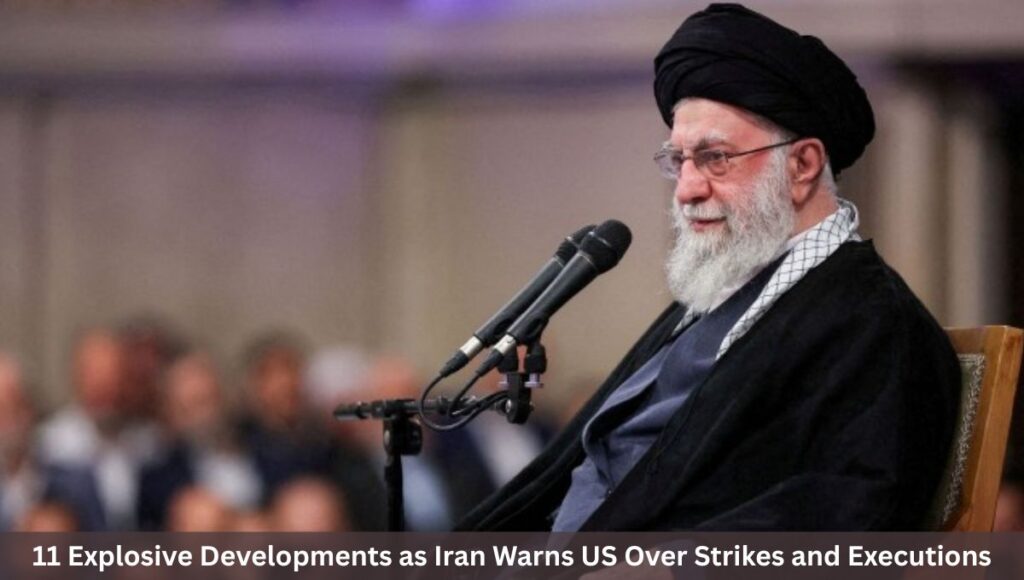
11 Explosive Developments as Iran Warns US Over Strikes and Executions
Iran’s President Issues Stark Warning to Washington
On Sunday, Iranian President Masoud Pezeshkian warned that Tehran’s response to any US military action would be severe and irreversible.
In a post on X, Pezeshkian said Iran’s response to “any unjust aggression will be harsh and regrettable,” adding that any attack on Supreme Leader Ayatollah Ali Khamenei would be considered an act of war against the entire Iranian nation.
“Any aggression against the Supreme Leader of our country is tantamount to an all-out war,” Pezeshkian wrote.
The warning followed days of escalating comments from Donald Trump, who has repeatedly suggested that Iran needs “new leadership” and hinted at possible intervention if executions or killings of protesters continue.
Trump Signals Regime Change as Military Assets Move
US President Donald Trump has openly questioned Iran’s leadership amid the unrest, raising fears in Tehran that Washington may consider direct military action.
Speaking to Politico on Saturday, Trump said:
“It’s time to look for new leadership in Iran.”
Trump has repeatedly stated that the United States would not tolerate mass executions or continued killings of protesters, and he has acknowledged moving US military assets into the region, though without specifying operational plans.
In a social media post on Friday, Trump thanked Iran’s leaders for allegedly calling off the scheduled execution of 800 detainees, claiming credit for the pause — a claim that Iranian officials later disputed.
Supreme Leader Khamenei Calls Trump a ‘Criminal’
Iran’s Supreme Leader Ayatollah Ali Khamenei, 86, directly addressed Trump’s comments in a nationally broadcast speech, branding the US president a “criminal” and accusing Washington of responsibility for the bloodshed.
Khamenei acknowledged for the first time that thousands of people had been killed during more than two weeks of unrest — though he placed the blame squarely on what he described as foreign-backed “rioters” and “terrorists.”
“We consider the US president a criminal, both for the casualties and the damage,” Khamenei said, according to excerpts published on his official website.
He accused the United States and Israel of encouraging and supporting the protests, alleging that Washington had promised protesters military assistance.
Deadly Protests Erupt From Economic Grievances
The protests began last month in Tehran’s Grand Bazaar, sparked by public anger over high inflation, unemployment, and economic hardship in a country battered by sanctions.
What initially started as demonstrations over the economy rapidly evolved into political protests calling for the end of clerical rule, spreading nationwide and drawing participants from across society:
- Shopkeepers and traders
- University students
- Men and women
- Poor and middle-class Iranians
- Urban and regional populations
Analysts describe the unrest as the bloodiest since the 1979 Islamic Revolution, which toppled the Shah and established the Islamic Republic.
Conflicting Death Toll Figures Fuel Global Alarm
The true scale of the violence remains unclear, with vastly conflicting figures emerging from Iranian officials, rights groups, and independent reports.
Iranian Official Claim
A senior Iranian official, speaking to Reuters on condition of anonymity, said at least:
- 5,000 people have been killed, including
- About 500 security personnel
The official claimed the deaths were caused by “terrorists and armed rioters” allegedly supported by Israel and foreign groups, adding that the final toll was unlikely to rise sharply.
Human Rights Groups
The US-based Human Rights Activists News Agency (HRANA) reported:
- 3,308 confirmed deaths
- 4,382 additional cases under review
- More than 24,000 arrests
HRANA’s figures are widely cited but cannot be independently verified.
Other Reports
A report obtained by The Sunday Times from doctors on the ground claimed far higher casualties, alleging at least 16,500 protesters killed and 330,000 injured, with many victims under the age of 30 — figures that remain disputed.
Judiciary Signals Possible Executions of Detainees
Fears intensified after Iran’s judiciary indicated that executions of people detained during the unrest may proceed, invoking one of the most severe charges under Iranian law.
Judiciary spokesperson Asghar Jahangir said authorities had identified actions that constitute “Mohareb” — an Islamic legal term meaning “waging war against God.”
“A series of actions have been identified as Mohareb,” Jahangir told a press conference.
Under Iranian law, Mohareb is punishable by death.
While Iranian officials insist there are no plans for mass executions, prosecutors have refused to rule them out, saying responses would be “firm, deterrent and swift.”
Trump Claims Credit for Halted Executions
Trump has repeatedly asserted that his public threats forced Iran to pause executions.
“The best decision he ever made was not hanging more than 800 people two days ago,” Trump said in an interview, referring to Khamenei.
Iran’s judiciary later denied that any such death sentences had been finalized, stating that one high-profile detainee, Erfan Soltani, had not been sentenced to death, despite earlier fears.
Security Forces Accused of Brutal Crackdown
Eyewitnesses, videos, and rights groups have accused Iran’s security forces of using lethal force to crush demonstrations.
Residents in Tehran told reporters they saw riot police firing directly into crowds, while verified videos showed:
- Security forces shooting from rooftops
- Protesters being beaten and detained
- Streets flooded with tear gas
- Military drones hovering overhead
One protester told CNN:
“They were aiming with lasers and shooting people in the face.”
Another said:
“They massacred people… they killed our kids.”
Iranian authorities deny targeting peaceful demonstrators, saying violence was driven by armed groups.
Kurdish Regions See Heaviest Fighting
Iranian officials acknowledged that some of the deadliest clashes occurred in Kurdish-majority areas in the country’s northwest.
The region has long been a flashpoint, with Kurdish separatist groups periodically clashing with state forces.
Three sources told Reuters earlier this month that armed Kurdish groups attempted to cross into Iran from Iraq, raising Tehran’s claims that foreign actors were exploiting instability.
Mass Arrests and Fear Inside Iran
According to HRANA, more than 24,000 people have been arrested, including protesters, activists, and alleged organizers.
Families of detainees have expressed fear that their relatives could face capital punishment, especially under charges related to national security or Mohareb.
Iranian prosecutors have said many cases have already resulted in formal indictments and have been referred to courts.
Internet Blackouts Isolate the Country
As protests intensified, Iran imposed sweeping internet shutdowns, cutting off access nationwide on January 8.
While connectivity briefly improved over the weekend, monitoring group NetBlocks said traffic later dropped again to around 2% of normal levels.
“There is no indication of a significant return,” NetBlocks said.
Iran’s government said the shutdown was necessary to combat what it described as “terrorist unrest”, though critics say it was aimed at suppressing information.
Economic Pain Acknowledged by Supreme Leader
In his address, Khamenei acknowledged that Iran’s economy is “truly difficult”, urging unity and calling on officials to ensure supplies of essential goods.
However, he maintained that the protests had been “extinguished”, citing pro-government rallies staged across the country.
Despite this claim, intermittent clashes and arrests continue to be reported.
US Officials and Analysts Warn of Escalation
Former US ambassador to Israel Dan Shapiro warned that Trump may attempt a direct strike on Iran’s leadership.
In a post on X, Shapiro predicted that Trump could seek to kill Khamenei, arguing that the arrival of a US carrier strike group would make such action feasible.
However, Shapiro cautioned that killing Iran’s supreme leader would not guarantee regime change, and could instead trigger an IRGC takeover and prolonged instability.
Iran Blames Sanctions and Washington
President Pezeshkian blamed the United States for Iran’s economic hardship, citing “inhumane sanctions” imposed by Washington and its allies.
Iranian officials argue that sanctions — reimposed after Trump’s return to office — reignited inflation and unrest, undoing gains made when restrictions were eased during Barack Obama’s presidency.
International Pressure Mounts
Iran is facing mounting criticism from human rights groups and foreign governments over:
- The scale of killings
- Use of lethal force
- Threats of executions
- Mass arrests
- Internet blackouts
Yet Tehran insists it will handle the crisis “using our own methods”, rejecting foreign interference.
A Dangerous Standoff With Global Consequences
The crisis has pushed US-Iran relations to their most dangerous point in years.
Trump’s rhetoric, Iran’s warnings of all-out war, and the unresolved fate of thousands of detainees have created a volatile situation with global implications, particularly for the Middle East.
An attack on Khamenei, Iranian officials warn, would not simply be retaliation — it would be war.
Conclusion: Iran at a Breaking Point
Iran now stands at a crossroads.
The leadership insists the protests are over, yet the scale of death, arrests, and repression tells a different story. The threat of executions looms, the economy remains strained, and tensions with Washington continue to escalate.
Whether Iran’s crisis leads to reform, deeper repression, or international conflict remains uncertain — but the consequences of miscalculation, on either side, could be catastrophic.
Also Read: 7 Explosive Signals in a Brutal Showdown: Trump Demands New Leadership in Iran
Also Read: Iran warns against any US strike as judiciary hints at unrest-linked executions
Related Posts:
- 7 Dead in Explosive Iran Protests as Economic Anger…

- 9 Explosive Signals as Trump Cancels Iran Talks and…

- Afghanistan–Pakistan War 2025: Inside the 48-Hour Ceasefire

- Trump’s 20-Point Gaza Peace Plan Gains Urgent Global…

- 7 Explosive Signals in a Brutal Showdown: Trump…

- In 8 Moves, EU Targets China-Linked Refineries and…
