
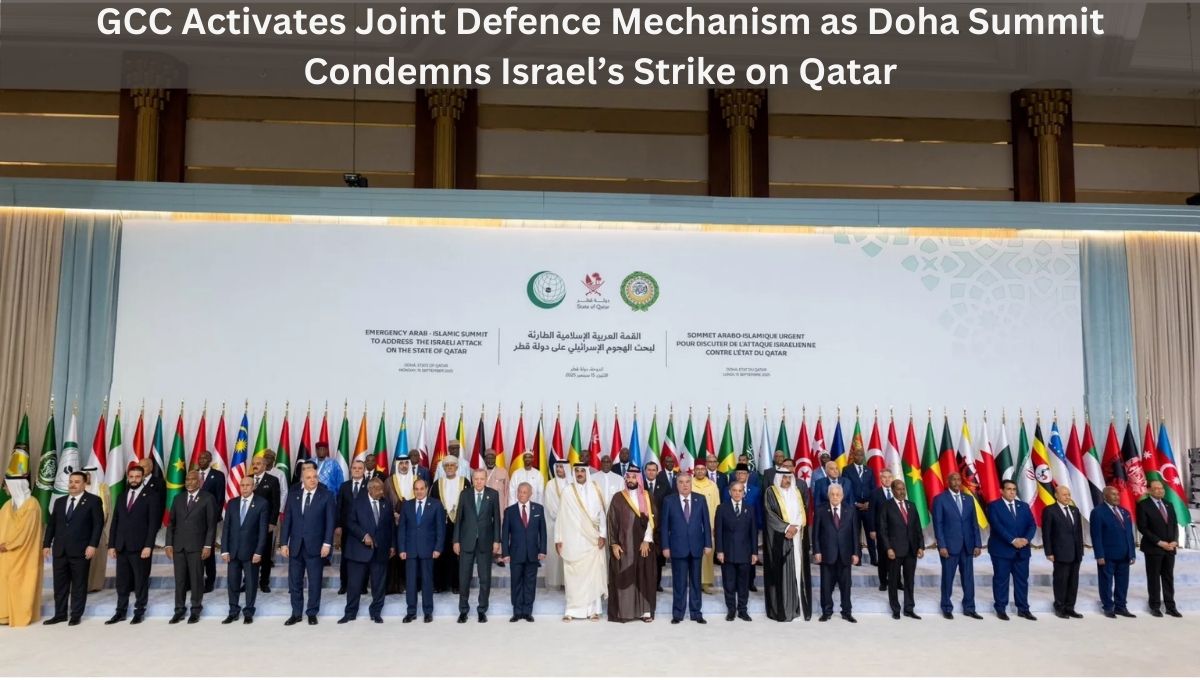
Amid mounting pressure over regional stability, the GCC Activates Joint Defence Mechanism as Doha Summit Condemns Israel’s Strike on Qatar. An emergency summit in Doha brought together Arab and Islamic leaders who condemned Israel’s strike on Hamas leaders in Qatar, calling it a blatant violation of sovereignty and international law.
While the summit was marked by fiery rhetoric, the most concrete outcome was the Gulf Cooperation Council (GCC)’s pledge to activate a joint defence mechanism. The meeting highlighted deepening regional anger at Israel’s expanding military campaign, concerns about its long-term strategic goals, and growing calls for collective Arab-Islamic action.

GCC Activates Joint Defence Mechanism as Doha Summit Condemns Israel’s Strike on Qatar
The Israeli Strike on Qatar: Catalyst for Regional Outrage
The emergency gathering was convened after Israeli airstrikes targeted a Hamas delegation in Doha on September 9, 2025, killing six people, including a Qatari security official. Israel confirmed responsibility, claiming the strike was aimed at eliminating Hamas leadership.
Qatari Emir Sheikh Tamim bin Hamad Al Thani opened the summit with a scathing rebuke of Israel’s actions. He described the attack as “blatant, treacherous, and cowardly” and accused Israel of sabotaging ongoing U.S.-backed ceasefire negotiations in Gaza.
“My country’s capital was subjected to a treacherous attack targeting a residence housing the families of Hamas leaders and their negotiating delegation,” Sheikh Tamim said.
The emir argued that the strike exposed Israel’s lack of genuine interest in peace and its determination to prolong the Gaza war, which has already killed more than 64,800 Palestinians.
GCC’s Defence Pact: A Rare Collective Step
The GCC states—Bahrain, Kuwait, Oman, Qatar, Saudi Arabia, and the UAE— announced that they would activate a joint defence mechanism, the most notable outcome of the summit.
Majed Mohammed Al-Ansari, spokesman for Qatar’s Ministry of Foreign Affairs, confirmed that consultations were underway among the bloc’s military bodies. A meeting of the Unified Military Command will take place in Doha to develop Gulf deterrent capabilities.
“The joint statement obviously called for a meeting of the high command to discuss further steps to ensure the safety and security of GCC countries,” Al-Ansari said.
The GCC’s principle is clear: an attack on one member state is considered an attack on all.
Strong Condemnations but Limited Concrete Action
While the GCC defence pledge marked progress, the broader Arab League and Organisation of Islamic Cooperation (OIC) issued a communique heavy on condemnations but light on enforcement.
The statement condemned Israel’s “cowardly and illegal attack on the State of Qatar”, reaffirmed solidarity with Doha, and praised Qatar’s mediation efforts.
However, no economic sanctions or military responses were agreed upon, highlighting divisions within the Arab-Islamic bloc over how far to confront Israel.
Calls for Stronger Measures from Individual States
Several leaders went beyond the joint communique, urging tougher action:
- Turkey’s President Recep Tayyip Erdoğan called for economic pressure on Israel and for Israeli officials to face international justice.
- Egypt’s President Abdel Fattah el-Sisi described the strike as a “grave violation of international law” and warned that peace agreements could be jeopardized.
- Pakistan’s Prime Minister Shehbaz Sharif urged the creation of an Arab-Islamic task force and called for Israel’s suspension from the UN.
- Malaysia’s Prime Minister Anwar Ibrahim pressed for sanctions and suspension of diplomatic ties, declaring: “Condemnations will not stop the missiles.”
- Iran’s President Masoud Pezeshkian urged all Muslim states to cut relations with Israel, framing the strike as an attack on Arab and Muslim sovereignty.
This divergence highlighted the tension between symbolic solidarity and actionable steps against Israel.
Sheikh Tamim: Warning Against Israel’s Expansionist Agenda
The Qatari emir warned that Israel was pursuing a regional expansionist vision, citing bombings in Lebanon, Syria, and Yemen, alongside illegal settlements in the West Bank and occupation of southern Lebanon.
He accused Israeli Prime Minister Benjamin Netanyahu of seeking to turn the Arab world into “an Israeli sphere of influence”, calling it “a dangerous illusion”.
The remarks underlined broader fears that Israel’s war in Gaza is only one element of a regional strategy of dominance.
Trump’s Warning to Israel: “Have to Be Careful”
The summit unfolded amid tensions between Israel and its strongest ally, the United States.
U.S. President Donald Trump revealed that Netanyahu had not informed him in advance about the strike in Qatar. Reports suggested Washington was notified only when the missiles were already in the air.
Trump, facing criticism for failing to restrain Israel, adopted a more cautious tone:
“Qatar has been a very great ally. Israel and everyone else, we have to be careful. When we attack people, we have to be careful,” Trump told reporters.
His comments followed reports of a heated phone call with Netanyahu, in which Trump expressed frustration over being blindsided.
Marco Rubio’s Diplomatic Balancing Act
As the summit proceeded in Doha, U.S. Secretary of State Marco Rubio visited Israel, reaffirming U.S.-Israeli ties while attempting to smooth over tensions.
Standing alongside Netanyahu, Rubio maintained that Washington still enjoyed strong relations with Gulf allies, despite Qatar’s fury. He later travelled to Doha, where he was expected to engage in damage-control talks.
Netanyahu, for his part, declared that Israel had the right to defend itself “beyond its borders” and refused to rule out further strikes on Hamas leaders in Qatar.
Qatar’s Push for International Accountability
Qatar vowed to hold Israel accountable through international law.
Al-Ansari emphasized that Qatar would continue working through the UN Security Council, the Arab League, and the OIC to deter future aggression.
“Our tool is our belief in international law and international organisations,” he said.
Qatar, which has hosted Hamas’ political bureau since 2012, also continues to serve as a key mediator in Gaza ceasefire negotiations.
Humanitarian Fallout in Gaza
As regional diplomacy unfolded, Israel pressed ahead with its offensive in Gaza City, demanding that hundreds of thousands of residents evacuate south.
The UN warned that an intensified offensive in an area already experiencing famine would push civilians into “an even deeper catastrophe”.
Residents reported being unable to leave due to poverty, lack of transport, and unsafe conditions in southern Gaza, where Israeli strikes also continued.
International Reactions and Palestinian Statehood Push
The Qatar attack further strained Israel’s global standing. Several Western allies, including the UK, France, Canada, Australia, and Belgium, are expected to recognize the State of Palestine at the upcoming UN General Assembly session.
This development has reignited internal debates in Israel, with hardline ministers pushing for annexation of large parts of the West Bank to prevent Palestinian statehood.
Also Read: UN Security Council members condemn Israel over deadly strike on Qatar
Settlements and Annexation Plans
Netanyahu’s government recently approved the E1 settlement project east of Jerusalem, which would split the West Bank in two, undermining Palestinian territorial continuity.
Far-right Finance Minister Bezalel Smotrich unveiled a plan to annex four-fifths of the West Bank, despite international law deeming settlements illegal.
Israel has already built about 160 settlements housing 700,000 Jews, while 3.3 million Palestinians live under occupation in the West Bank and East Jerusalem.
Expert Analysis: A Change of Tone but Not Yet Action
Andrea Dessi, assistant professor at the University of Rome, told Al Jazeera that the Doha summit marked a shift in rhetorical unity among Arab and Muslim states.
“At the rhetorical level, we are seeing the beginnings of a coming together… the actions will have to follow.”
The summit underscored recognition that the regional security architecture must change, even if practical measures remain elusive.
Conclusion: Symbolism, Solidarity, and a Fragile Future
The Doha summit showcased widespread condemnation of Israel’s strike on Qatar, solidarity with Doha, and renewed calls for Palestinian statehood.
Yet the lack of concrete collective action exposed divisions and limitations within the Arab-Islamic bloc. The GCC’s move to activate a joint defence mechanism is notable, but its effectiveness remains to be tested.
As Israel signals readiness for further cross-border strikes and Arab-Islamic states weigh how far to escalate their response, the region stands at a dangerous crossroads.
Also Read: Hamas Survives Israeli Assassination Attempt in Doha; Qatar Condemns Strike as ‘State Terrorism’
Related Posts:
- PM Modi Condemns Israeli Strikes on Doha: Qatar…

- Hamas Survives Israeli Assassination Attempt in…

- US, Qatar Near Defence Pact After Israeli Strike on…

- Israel–Hamas Ceasefire Under Strain: 4 More Hostage…

- Hamas Executes 50 Rivals After Ceasefire – Inside…

- Trump’s 20-Point Gaza Peace Plan Gains Urgent Global…
