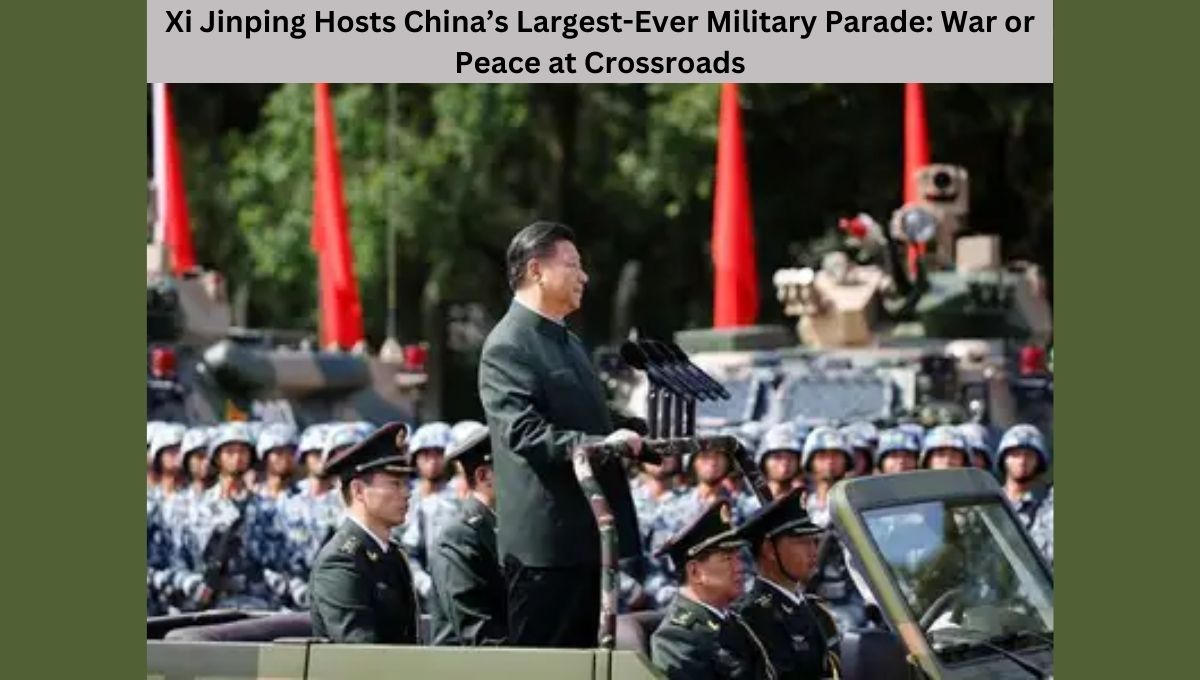
Unveiling his vision of a new global order, Xi Jinping Hosts China’s Largest-Ever Military Parade: War or Peace at Crossroads. China staged its most elaborate and powerful Victory Day military parade in Beijing, marking 80 years since the end of World War II.
With President Xi Jinping declaring that the world stands at a crossroads between war and peace, the event was more than just a commemoration it was a calculated display of military strength and political ambition.
Flanked by Russia’s Vladimir Putin and North Korea’s Kim Jong Un, Xi used the parade to underline China’s global aspirations, strengthen partnerships with countries defying Western influence, and reinforce his leadership both domestically and internationally.

Xi Jinping Hosts China’s Largest-Ever Military Parade: War or Peace at Crossroads
A Historic Occasion at Tiananmen Square
The event took place at Tiananmen Square, one of the most symbolic and politically significant spaces in China.
More than 50,000 spectators, hand-picked guests, and over 20 foreign leaders gathered under the watchful eye of the Communist Party.
Xi, wearing a Mao-style suit, greeted his counterparts in English with “Nice to meet you” and “Welcome to China.”
The personal touch contrasted with the enormous spectacle of marching formations, hypersonic missiles, drones, fighter jets, and advanced military equipment.
While the parade commemorated Japan’s surrender in 1945, it was also unmistakably about modern-day geopolitics.
By bringing Putin and Kim to the forefront, Xi framed China as the central power in an emerging alternative world order.
Xi Jinping’s Warning: War or Peace
Xi’s keynote message carried global resonance:
“Today, mankind is faced with the choice of peace or war, dialogue or confrontation, win-win or zero-sum. The Chinese people firmly stand on the right side of history.”
This framing positioned China as a defender of peace against what Xi described as hegemonism and power politics a veiled reference to the United States and its allies.
The message also resonated domestically, reinforcing Xi’s image as the strong leader steering China through turbulent global currents.
Guests of Honour: Putin and Kim
Vladimir Putin
The Russian president’s presence at the parade underscored the deepening China-Russia partnership. Already closely aligned in opposition to Western sanctions, Putin used the occasion to secure new energy deals with China, strengthening their economic ties.
Kim Jong Un
Kim’s attendance was particularly historic: it marked the first time in 66 years that a North Korean leader joined a Chinese military parade.
Accompanied by his daughter Kim Ju Ae, widely seen as his potential successor, Kim leveraged the moment to show international support for his regime despite international sanctions.
Together, Xi, Putin, and Kim projected what many Western analysts call an “axis of upheaval”, challenging the Western-led order.
Trump’s Reaction
Former US President Donald Trump, currently facing his own political turbulence, responded on Truth Social with sarcasm:
“Please give my warmest regards to Vladimir Putin, and Kim Jong Un, as you conspire against The United States of America.”
However, he later softened his stance, telling reporters that he didn’t see the parade as a challenge to the US, and reiterated his “very good relationship” with Xi.
His remarks highlighted the unpredictability of US-China relations under his leadership.
Also Read: Trump’s Military Parade: Patriotic Tribute or Authoritarian Power Play?
Military Might on Display
The 70-minute parade featured:
- 45 troop contingents marching in perfect formation
- Hundreds of PLA aircraft in aerial displays
- Hypersonic missiles and cutting-edge unmanned drones
- Tanks, electronic jamming systems, and naval hardware
- Over 1,000 musicians and 80 buglers, symbolically marking 80 years since Japan’s surrender
Spectators sat on colour-coded chairs green for fertile land, red for sacrifices, and gold for peace a symbolic nod to China’s interpretation of history and future aspirations.
The Security Clampdown
Beijing was placed under an unprecedented lockdown for the parade:
- Major roads, schools, and offices along the route were shut
- Residents were told to stay away from balconies and windows
- Subway stations were closed, and shared city bikes were removed
- Over 200,000 flags and floral displays were put up across the capital
More than six square miles of Beijing four times the size of New York’s Central Park were sealed off to the public. Only party dignitaries and select invitees were allowed near Tiananmen Square.
This extreme security mirrored the Chinese Communist Party’s obsession with control and image management, ensuring no disruption tarnished the spectacle.
Victory Day: Historical Context
While the Western world dates WWII from Germany’s 1939 invasion of Poland, China’s narrative begins with Japan’s invasion of Manchuria in 1931.
By 1937, full-scale war broke out between China and Japan, lasting until Tokyo’s surrender in 1945.
Key historical points:
- Estimated 20 million Chinese deaths, most of them civilians
- The Nanjing Massacre, where thousands were killed and women assaulted
- The united front between Mao’s Communists and Chiang Kai-shek’s Nationalists, despite internal civil war
- US entry into the war after Pearl Harbor in 1941
- Japan’s surrender after the atomic bombings of Hiroshima and Nagasaki and the Soviet declaration of war in 1945
In 2014, China officially declared September 3 as Victory Day, turning the memory of WWII into a rallying point for nationalism and unity.
The Vision for a New Global Order
Earlier in the week, Xi unveiled his global governance vision at the Shanghai Cooperation Organisation (SCO) summit in Tianjin.
His message emphasized opposition to Western-led institutions and resistance to sanctions and tariffs imposed by the US.
This aligns with China’s broader ambitions:
- Reducing reliance on the US-dominated financial system
- Building alternative trade routes like the Belt and Road Initiative
- Strengthening ties with Russia, Iran, and other countries sidelined by the West
The parade, therefore, was not just a military show but part of China’s broader narrative of rising as a central global power.
Also Read: China’s Big Moment And A Message To West After Xi-Putin-Modi Meet
Domestic Messaging: Pride and Patriotism
For Xi, the parade served a dual purpose: projecting power internationally and consolidating domestic legitimacy. At a time when China faces:
- Sluggish economic growth
- Youth unemployment
- Falling property values
- Anti-corruption investigations
…the parade became a nationalist rallying cry.
State media and films glorifying China’s role in WWII have flooded screens and headlines, reinforcing Xi’s call for unity and pride.
Why It Matters
The 2025 Victory Day military parade was far more than an anniversary celebration. It was a showcase of:
- China’s military modernization
- Xi Jinping’s firm grip on power
- A China-Russia-North Korea alignment against Western pressure
- A vision of a multipolar world order
For the world, the message was stark: as Xi said, humanity faces a choice between war or peace, dialogue or confrontation.
And China wants to be at the center of that choice.
Conclusion
Xi Jinping’s largest-ever military parade on Victory Day was as much about the future as it was about the past. With Putin and Kim by his side, Xi sought to project strength, unity, and leadership while reminding the West that China is prepared to challenge the global balance of power. For Beijing, the parade symbolized the “great rejuvenation of the Chinese nation.”
For the world, it was a reminder that China’s rise is reshaping geopolitics, and the stakes war or peace could not be higher.